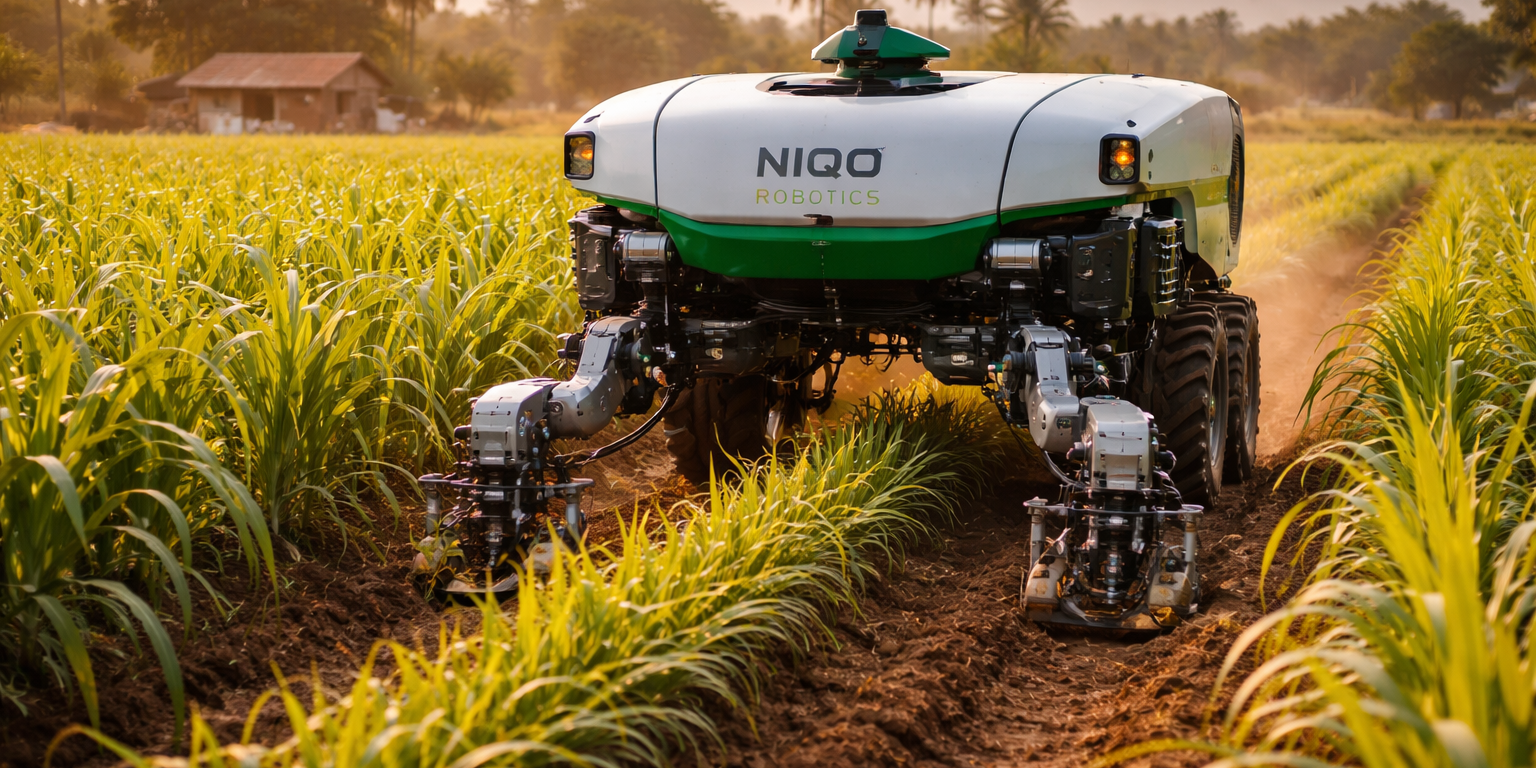
Niqo Robotics, a five-year-old Bengaluru firm building autonomous platforms for row-crop management, has been selected to represent India's agricultural robotics sector at Bharat Innovates 2026, the government's flagship deep-tech conclave launching in Brussels this October. The company was chosen from a pool of more than 400 applicants across twelve technology verticals, with 120 firms ultimately making the cut. For Niqo, the selection represents a pivotal moment in a strategy that has quietly shifted from proving concepts in Karnataka's sugarcane belt to pursuing commercial contracts in France, Spain, and the Netherlands, where growers face acute labor shortages and mounting pressure to reduce chemical inputs.
The timing matters. India's robotics export data tells a story of incremental but accelerating growth: shipments of autonomous agricultural equipment from Indian manufacturers reached $47 million in the fiscal year ending March 2026, up from $12 million three years prior, according to data from the Ministry of Commerce. Niqo accounts for a fraction of that total, but the company's trajectory mirrors a broader pattern. Indian firms have spent the past half-decade building competence in sensor fusion, path planning, and real-time object detection under conditions that would challenge any platform: irregular field geometry, variable crop spacing, extreme heat, and infrastructure that ranges from fiber-optic connectivity to intermittent 3G. The robots that survive those conditions tend to be overbuilt for European farms, where power is reliable and field boundaries are well-defined. That gap between design requirements and deployment environments has become a quiet advantage.
Niqo's platform centers on a modular base unit that supports swappable implements for weeding, precision spraying, and soil sampling. The company uses a combination of stereo vision and LiDAR to build localized maps in real time, relying on onboard inference rather than cloud connectivity for navigation and task execution. That architecture was a necessity in rural Karnataka, where internet uptime is inconsistent, but it resonates with European buyers concerned about data sovereignty and subscription lock-in. The base unit weighs 320 kilograms, runs on a 15-kilowatt-hour lithium-iron-phosphate battery, and operates autonomously for six to eight hours depending on implement load. Niqo has deployed 140 units across India, primarily with mid-sized growers cultivating sugarcane, cotton, and vegetables. The company is now conducting pilot programs with three agricultural cooperatives in southern France and one large estate in Andalusia, with plans to place another 30 units in Europe by the second quarter of 2027.
Bharat Innovates 2026, organized by the Department of Science and Technology in partnership with Invest India, is designed to function as both showcase and sales floor. The event will host procurement officers from European agricultural equipment distributors, venture investors focused on climate tech, and representatives from national research institutes exploring partnerships in robotics and AI. For Niqo, the primary objective is straightforward: convert pilots into purchase orders and establish relationships with distributors who can handle service and parts inventory. The company is also seeking a Series A round, with early conversations underway with investors in Singapore and London. Niqo has raised $3.8 million to date, primarily from Indian venture funds and a strategic investment from a Pune-based agricultural equipment manufacturer. The competitive landscape in Europe is dense but not impenetrable. Established players such as Naïo Technologies in France and the UK's Small Robot Company have demonstrated that demand exists for lightweight autonomous platforms, but pricing remains a friction point: most European-built units retail between €80,000 and €150,000, while Niqo is targeting a landed cost in the €50,000 to €70,000 range for its base configuration. Whether that price advantage translates into market share depends on factors beyond hardware cost, including after-sales support infrastructure and the ability to navigate CE certification and data privacy regulations.
What to Watch: Niqo's CE certification process, expected to complete by December 2026, will determine how quickly the company can scale European distribution. Track announcements from the three French cooperatives currently piloting the platform; any multi-unit orders would signal early traction. Also monitor whether Indian competitors such as Aakaar Automation or TartanSense follow Niqo into European markets, which would indicate that Bharat Innovates is functioning as a repeatable channel rather than a one-off opportunity. Finally, watch for Series A funding news in the third or fourth quarter of 2026, as capital availability will directly constrain Niqo's ability to build local service networks.