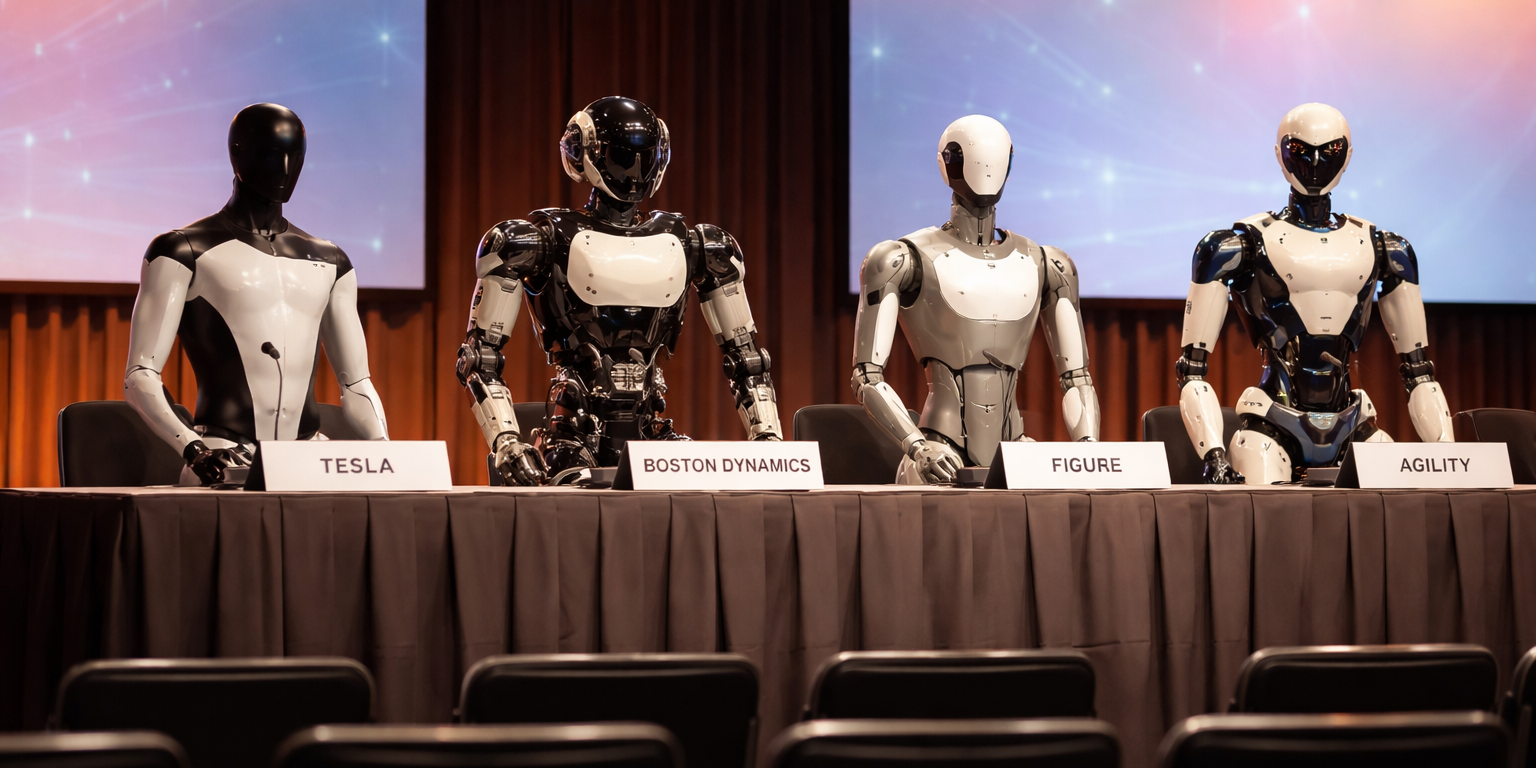
More than fifteen companies now claim to have humanoid or mobile manipulation platforms in some stage of development, but a new survey attempts to separate marketing timelines from actual hardware delivery schedules. The report, compiled by industry analysts and made available as a free download, collects technical specifications, announced partnerships, and executive commentary into a single reference document aimed at procurement teams and investment committees evaluating the sector. What emerges is a picture of an industry still learning how to price and position systems that lack clear precedent in manufacturing workflows.
Mobile manipulators occupy a middle ground between traditional industrial arms and the fully bipedal platforms that dominate press coverage. Several companies interviewed for the report noted that wheeled or tracked bases paired with articulated torsos solve many of the same use cases as legged robots while avoiding the control complexity and energy consumption that come with dynamic balance. Agility Robotics, Figure AI, Apptronik, and Sanctuary AI all operate in this space, though their approaches diverge sharply on questions like actuator topology, perception stack architecture, and whether to prioritize teleoperation or full autonomy. Boston Dynamics, which spent years refining Atlas as a research platform, pivoted to a commercial electric version in early 2025 and has since disclosed pilot deployments at automotive suppliers and logistics operators. The report documents these pilots in detail, including cycle times, uptime figures, and the specific tasks each platform has been assigned.
Humanoid form factor remains the most debated design choice. Proponents argue that matching human proportions allows robots to operate in spaces built for people without retrofitting infrastructure. Critics counter that the business case depends on labor cost arbitrage that may not materialize if these systems require dedicated supervision or frequent maintenance. The report includes interview excerpts with CTOs from three companies building bipedal platforms. One executive acknowledged that current battery technology limits useful work time to roughly four hours before recharge, a constraint that shapes deployment models and total cost of ownership calculations. Another noted that compliance and torque control in the arms matter more than locomotion for near-term applications, since most commercial interest centers on pick-and-place tasks rather than navigating stairs or uneven terrain. The third pointed to simulation environments and reinforcement learning pipelines as the real unlock, arguing that hardware has outpaced the software needed to train general-purpose manipulation policies.
The document also surveys the supply chain forming around these platforms. Actuator manufacturers, vision sensor providers, and companies building simulation tools all appear as supporting players. Several humanoid developers rely on the same small set of joint motor suppliers, creating potential bottlenecks as production scales. On the perception side, the split between lidar-based and vision-only approaches mirrors debates in the autonomous vehicle industry, with similar tradeoffs around cost, data density, and compute overhead. One section of the report compares the sensor suites on five different platforms, revealing wide variation in camera count, field of view, and depth-sensing methods. These choices ripple through software architecture, since vision-only systems require different neural network backbones than those fusing lidar point clouds with RGB images. The report stops short of declaring a winner but notes that companies targeting warehouse environments tend to favor lidar, while those focused on unstructured spaces lean toward camera arrays.
Investment activity provides another lens. Figure AI raised a $675 million Series B in early 2025 at a $2.6 billion valuation, with backing from Microsoft, NVIDIA, and OpenAI. Apptronik announced partnerships with NASA and Mercedes-Benz, though specific unit volumes and delivery dates remain undisclosed. Sanctuary AI secured funding from Bell Canada and others to build systems for retail and logistics. The report tracks these deals alongside earlier-stage companies that have yet to demonstrate full prototypes, noting that capital flowing into the sector has shifted from pure research bets to partnerships tied to specific deployment milestones. This transition raises the stakes for companies that have shown impressive demos but not yet delivered systems that run multi-shift operations without human intervention.
What to Watch: Track whether Boston Dynamics discloses unit economics for Atlas deployments by end of Q3 2026, as that data will set benchmarks for competing platforms. Monitor supply chain announcements from actuator and sensor vendors, especially any exclusive partnerships that could constrain competitor access. Watch for updates from automotive manufacturers piloting humanoid systems, since those environments offer controlled conditions and clear ROI metrics that could validate the business model for broader industrial adoption.