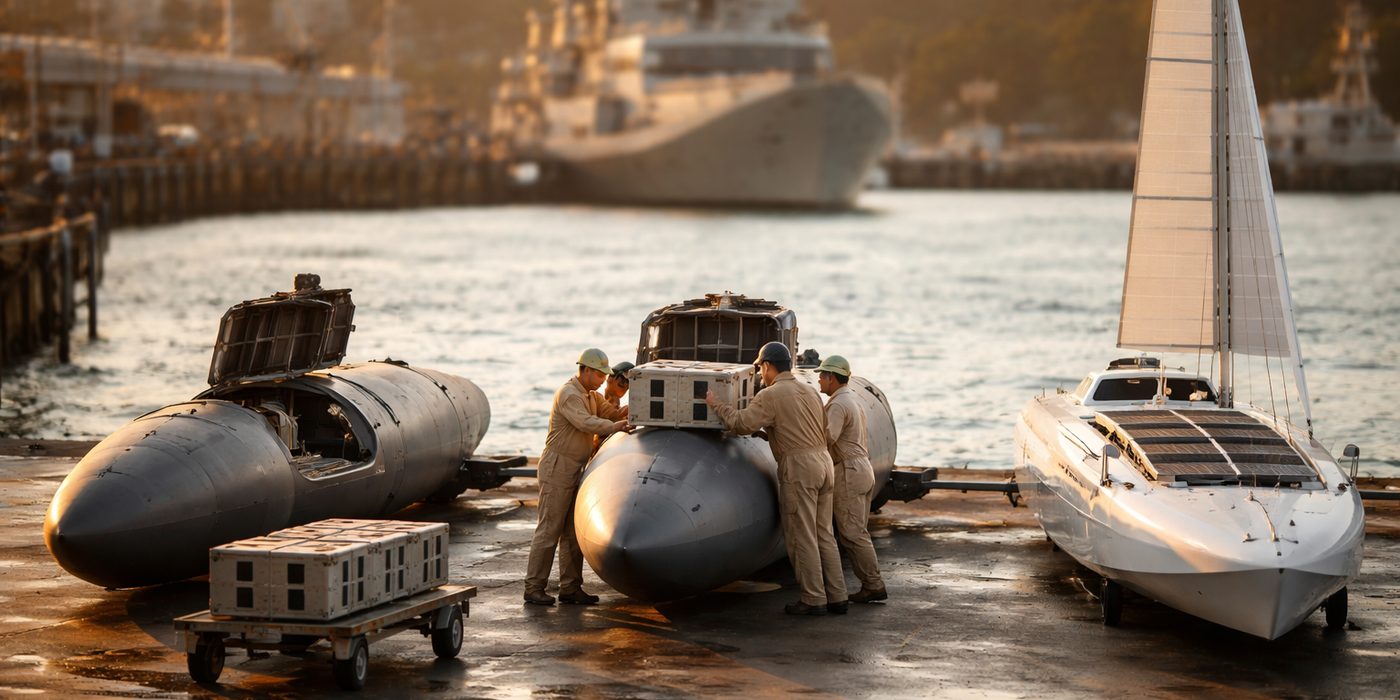
The most telling detail in Australia's latest uncrewed maritime announcement is not any single piece of hardware. It is that one set of modular payloads is intended to fit three vehicles built by three different companies. The Department of Defence said the payloads will be integrated onto Anduril's Ghost Shark and C2 Robotics' Speartooth unmanned underwater vehicles, and onto Ocius's Bluebottle unmanned surface vessel. Two of those are submersibles. One floats. The common thread is a payload architecture designed to be hull-agnostic, which turns the vehicles from bespoke platforms into carriers for interchangeable mission modules. Breaking Defense, which first reported the announcement, framed it as giving the Ghost Shark teeth. The more consequential reading is structural: Canberra is buying a payload ecosystem, not just boats.
The path to this point has run through a program Australia has pursued with unusual speed by defense-procurement standards. Ghost Shark, built by Anduril Australia, emerged from a rapid prototyping effort under the Royal Australian Navy's Strategic Capabilities Office and was designed as a large, long-endurance extra-large autonomous undersea vehicle that could be produced at scale rather than hand-built in small numbers. Speartooth, from Sydney-based C2 Robotics, occupies a different niche as a smaller, more attritable vehicle. Bluebottle, from Ocius Technology, is a solar-, wind- and wave-assisted surface vessel known for months-long persistence at sea. Until now, each pursued its own route to relevance. The payload announcement stitches those routes together under a shared integration approach.
For engineers, the interesting question is what modular means in practice underwater. Surface vessels can lean on mast-mounted sensors and abundant power from solar arrays. Submersibles cannot. Every payload bay must contend with pressure, buoyancy trim, power budgets drawn from finite battery capacity, and thermal limits in sealed housings. A payload that works on Bluebottle's deck and also on Ghost Shark's pressure-rated bay has to reconcile those very different constraints through standardized mechanical, electrical and data interfaces. That is a hard systems-integration problem, and it explains why payload standards tend to lag hull development by years. Australia is attempting to compress that gap, and the discipline required on interface definition will shape how easily third-party suppliers can plug in.
The commercial implications reach beyond the three named vehicle makers. A defined payload interface creates a market in which sensor, communications, and effects suppliers can build once and sell across platforms, which lowers barriers for smaller Australian firms that could never fund a full vehicle program. It also pressures competing prime contractors abroad, since allies evaluating uncrewed undersea capability will compare Australia's integration model against closed, vendor-locked alternatives. For investors, the signal is that value in maritime autonomy is migrating up the stack, toward the software, interfaces, and mission modules that determine what a vehicle can actually do. Hull builders who treat payloads as an afterthought may find their platforms commoditized by the very standards that make them useful.
There is also a manufacturing story embedded here. Ghost Shark was conceived around production volume, and a payload strategy that reuses modules across vehicle classes supports that logic by spreading development cost over more units. The surface-and-subsurface mix matters too. Pairing the persistent, comparatively cheap Bluebottle with deeper-operating undersea vehicles allows operators to distribute sensing and communications roles across layers, using the surface vessel as a relay while submersibles work below. Whether the Australian industrial base can sustain that production tempo, and whether integration timelines hold through 2026 and into 2027, will determine if the announcement translates into fielded capability or remains a well-structured plan.
What to Watch Track whether the Department of Defence publishes interface specifications or opens a supplier call, since the openness of the payload standard will determine how many Australian firms can participate. Watch for sea trials of the integrated payloads on Ghost Shark and Speartooth over the coming months, particularly any public demonstration of a payload swapped between an undersea vehicle and Bluebottle. Anduril, C2 Robotics and Ocius announcements on production rates and delivery schedules through the rest of 2026 will indicate whether manufacturing can match the integration ambition. Finally, monitor whether allied navies reference Australia's approach in their own uncrewed maritime procurements.