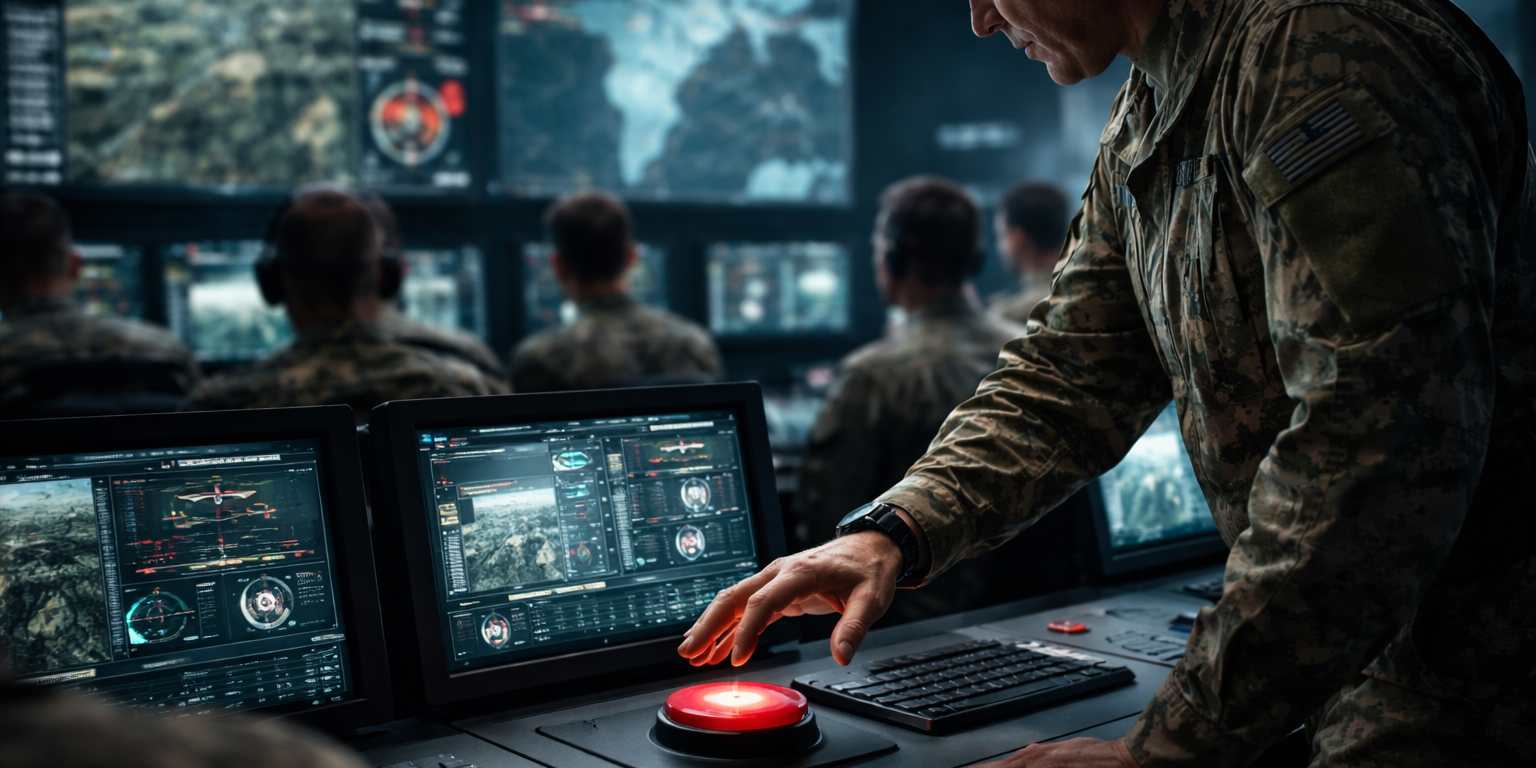
The phrase "meaningful human control" has appeared in every major international discussion on autonomous weapons since 2013, yet no two delegations at the United Nations can agree on what it actually means. Country delegations have spent more than 100 hours in formal sessions debating whether a human must authorize each individual strike, or whether programming mission parameters before deployment satisfies the requirement. The stalemate has practical consequences: military contractors are designing and building lethal autonomous systems without settled legal standards, and defense procurement offices are writing requirements based on divergent interpretations of the same three-word phrase. At stake is whether future wars will feature machines that select and engage targets based solely on sensor data and algorithms, or whether humans will retain veto authority over individual strikes.
The problem crystallized during recent UN Convention on Certain Conventional Weapons discussions, where Russia and the United States argued that setting geographical boundaries and target profiles before launch constitutes meaningful control. France, Germany, and several non-aligned nations countered that meaningful control requires a human in the loop for each engagement decision, with real-time ability to abort. China has proposed a middle position: humans must be "on the loop" with oversight capability but not necessarily approving each action. These are not semantic disputes. Each interpretation enables fundamentally different weapons architectures. A loitering munition that patrols a grid square and autonomously engages any vehicle matching a sensor signature is legal under the U.S. interpretation but potentially illegal under the European view. Defense contractors cannot design to a standard that does not exist.
The scenario that drives the debate involves precision strikes in complex environments. A military drone tasked with destroying two propane tanks in an industrial district would, under current technology, use computer vision and pre-loaded mission parameters to identify and engage its targets. If communication links fail mid-mission—a common occurrence in contested electromagnetic environments—the drone must either abort and return to base, loiter until contact resumes, or complete the mission autonomously. The first option wastes the sortie and leaves targets intact. The second risks fuel exhaustion or enemy air defenses detecting a predictable holding pattern. The third option means the machine decides whether the objects it identifies actually match the intended targets, with no human reviewing sensor data before weapons release. Militaries want that third option available. Arms control advocates consider it unacceptable. International humanitarian law remains ambiguous on which side is correct.
Defense industry sources indicate that current-generation systems already possess the technical capability to operate in fully autonomous mode, but most militaries impose policy restrictions requiring human authorization for weapons release. Israel's Harpy loitering munition, operational since the 1990s, can search for and destroy radar emitters without further human input after launch. The U.S. Phalanx close-in weapons system aboard Navy ships operates in automatic mode, engaging incoming missiles at speeds that preclude human reaction time. Russia's Poseidon nuclear torpedo reportedly navigates to targets autonomously across thousands of miles. Yet these systems exist in a regulatory gray zone, neither clearly permitted nor prohibited under current international law, because the law itself has not settled on what meaningful human control requires. The proliferation continues regardless. At least thirty nations now field or are developing weapons with autonomous engagement capabilities, according to UN reporting. The absence of agreed standards has not slowed development; it has simply ensured that development proceeds along national lines with divergent approaches to human oversight.
What to Watch: The next UN CCW meeting scheduled for November 2026 in Geneva will reveal whether delegations can move beyond definitional disputes to operational standards. Watch for industry responses from defense primes including Lockheed Martin, BAE Systems, and Dassault, which have autonomous systems in development pipelines and need regulatory clarity for export licensing. China's position merits attention—Beijing has filed multiple technical papers proposing specific metrics for measuring human control, potentially breaking the impasse if other nations engage seriously. Track whether the European Parliament's proposed AI Act amendments, expected for final vote in October 2026, will impose stricter requirements on EU-based defense contractors than current international discussions contemplate.