A signed toy robot is not usually a milestone in industrial automation, but this one carries real weight. When LG Group Chairman Koo Kwang-mo and Nvidia CEO Jensen Huang posed at Nvidia's headquarters with a miniature humanoid they had both autographed, the photo marked the public start of a partnership that is now landing on a manufacturing floor in Clarksville, Tennessee. The site builds washing machines. It is not a laboratory, a showroom, or a pilot cell tucked in a corner. It is a working plant with throughput targets, labor constraints, and a cost structure that punishes any technology that cannot pay for itself.
The choice of Clarksville is telling. LG has operated its Tennessee washer facility for years, and it sits at the center of the company's U.S. manufacturing footprint, which has taken on added strategic importance as tariff pressure and reshoring incentives reshape where appliance makers want to build. A plant in that position becomes a natural candidate for automation that reduces dependence on scarce labor while keeping production close to American customers. Koo, who took the helm of LG Group in 2018 after the death of his father, Koo Bon-moo, has spent much of his tenure pushing the conglomerate toward AI and next-generation businesses beyond consumer electronics. Robotics now sits squarely in that push.
What Nvidia brings is less a robot than a stack. The company has spent the past two years assembling an end-to-end platform for what it calls physical AI, spanning simulation through Omniverse and Isaac Sim, foundation models for humanoid control under its GR00T effort, and onboard compute in the Jetson Thor family. LG, for its part, brings the manufacturing know-how, the component supply chain, and its own robotics ambitions, including the household and commercial machines it has shown at trade events. Pairing the two lets LG train and validate behaviors in a digital twin of the Clarksville line before a single machine moves on the real floor, which is precisely the workflow Nvidia has been selling to industrial customers worldwide.
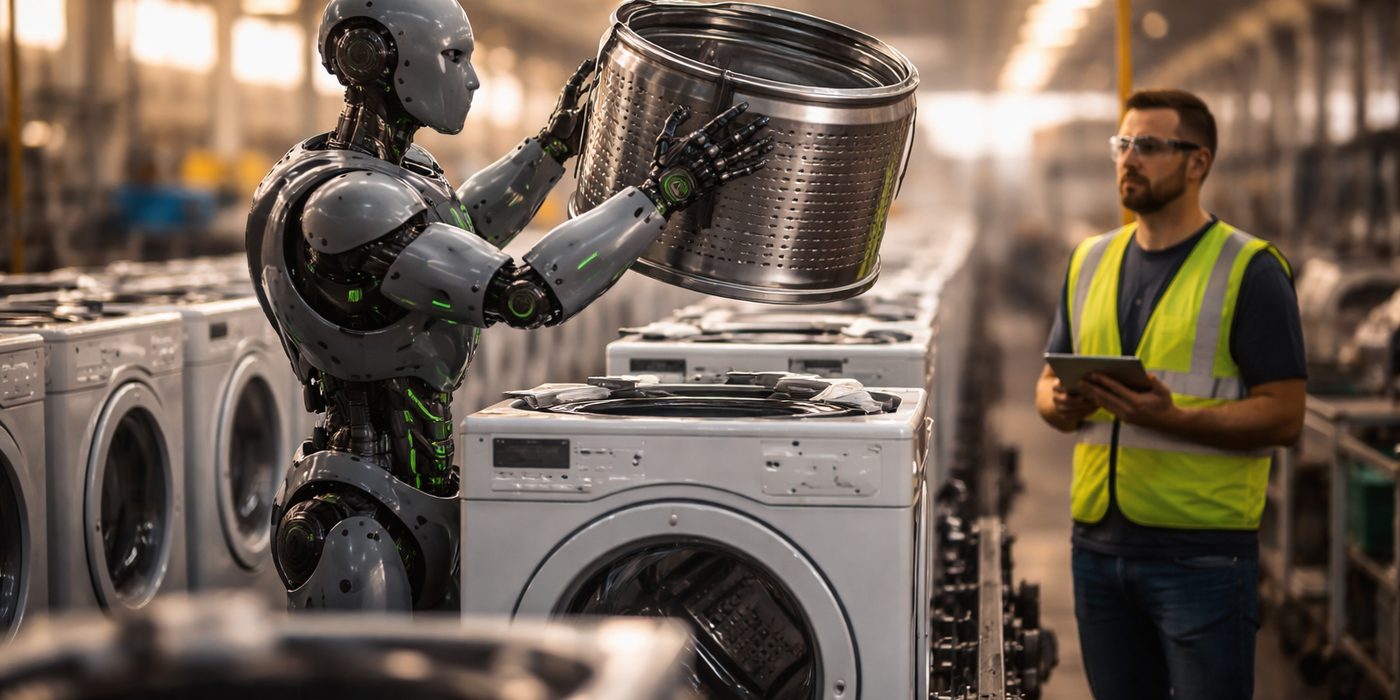
For engineers, the interesting question is not whether a humanoid can lift a drum or carry a part. Demonstrations have settled that. The harder question is whether a general-purpose machine can match the cycle time, uptime, and safety record of the purpose-built conveyors, gantries, and fixed arms that already dominate appliance assembly. Washer plants are about as structured as factories get, which cuts both ways. Structure makes the environment easier for AI to model, but it also means the incumbent automation is already good, and any newcomer has to beat a very low baseline cost per task. Investors watching the humanoid sector should read the Clarksville effort as a test of unit economics, not of spectacle. If LG discloses payback periods or task-level productivity numbers, those figures will matter more than any stage demo.
The broader industry context sharpens the stakes. Hyundai has committed to deploying Boston Dynamics machines at its Georgia manufacturing complex, BMW has trialed Figure's humanoids at its Spartanburg, South Carolina plant, and Mercedes-Benz has worked with Apptronik. Each of those programs carries the same underlying bet that humanoid form factors can slot into human-designed workflows without retooling the building. LG's version differs in that it pairs a hardware-agnostic AI platform with an owner that also makes the products being assembled, giving it a closed loop between the robot, the line, and the finished machine. That vertical angle could make LG both a customer and, eventually, a supplier to other manufacturers. It also puts Nvidia in a familiar and comfortable position, selling the picks and shovels to every player in the race regardless of who wins.
What to Watch
Track whether LG or Nvidia publishes concrete Clarksville metrics in the first quarter of 2027, particularly task counts, uptime percentages, and any stated payback window, since the absence of numbers would itself be informative. Watch Nvidia's GTC 2027 event in March for updates to GR00T and Jetson Thor that reference LG or other appliance and consumer-goods manufacturers. Monitor LG Electronics' next earnings call for capital expenditure commentary tied to U.S. plant automation, and keep an eye on whether Hyundai, BMW, or Mercedes announce expanded humanoid deployments that would set a comparison benchmark for the Tennessee effort.