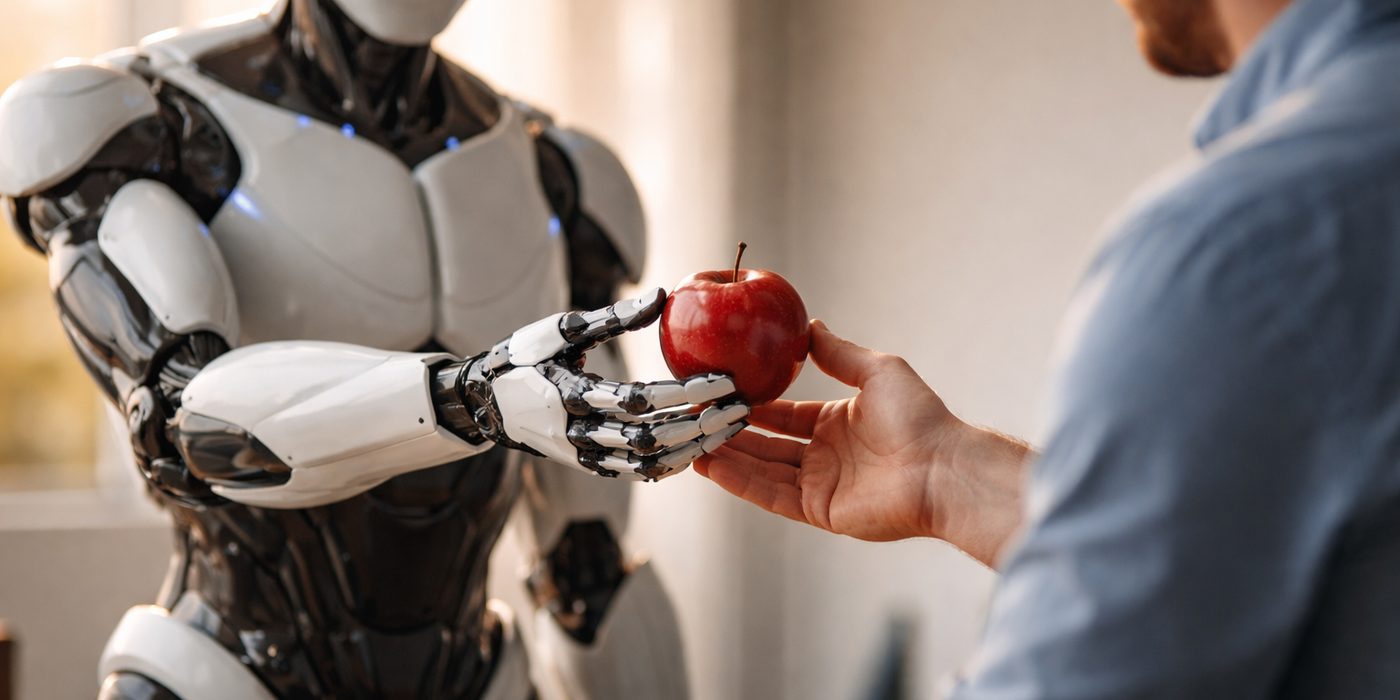
The test was almost insultingly simple. Pick up an apple. Hand it over. No cuts, no hidden operator, no second take. When Elon Musk argued that most humanoid robot demonstrations to date have been staged, he reached for exactly this kind of everyday task to explain what a credible demo should look like, and Figure AI chief executive Brett Adcock decided to take him at his word. Rather than trading statements, Adcock had his company run the scenario and show it, a direct response from the leader of one of Tesla's most visible Optimus competitors. It is a rare moment in a sector where rivals usually trade funding announcements, not experiments.
The backdrop matters. Humanoid robotics has spent the past several years in a cycle of polished videos that raise as many questions as they answer. Teleoperation, where a human pilot drives the robot through a motion-capture rig or VR headset, is a legitimate research technique and a common way to collect training data. The trouble comes when teleoperated footage is presented, explicitly or by omission, as autonomous behavior. Edited cuts, favorable lighting, and rehearsed environments compound the problem. Musk's critique is not new in spirit, and it carries irony, since Tesla's own Optimus showings have drawn the same scrutiny from skeptics who spotted remote-operation cues in earlier public events.
What Figure chose to demonstrate is a deliberate counterpunch on the company's own terms. The firm builds around its Helix vision-language-action model, which it positions as a unified system for perception, language understanding, and whole-body control, and it has repeatedly framed its work as end-to-end learned behavior instead of scripted routines. An apple handoff tests several things at once: object recognition under variable conditions, grasp planning for a deformable-looking, irregular surface, compliant force control so the fruit is neither dropped nor crushed, and a safe release into a human hand. None of it is individually exotic. Doing all of it reliably, unscripted, and on camera is another matter.
For engineers and investors, the real story is less the apple than the standard being set. Humanoid valuations have been built on promises of general-purpose labor, and the gap between a viral clip and a repeatable, shift-length deployment remains wide. A single successful take proves capability, not reliability. The metrics that actually decide commercial viability are mean time between interventions, task success rate across hundreds of consecutive attempts, cycle time against a human worker, and recovery behavior when something goes wrong. Public demos rarely report any of these. By inviting a rival's test on rival terms, Figure has implicitly raised the bar, and that bar now applies to Tesla, Agility Robotics, Apptronik, 1X, and the well-funded Chinese entrants alike.
There is also a competitive subtext worth reading closely. Musk has long argued that Tesla's advantages in manufacturing scale, battery supply, and real-world AI training from its vehicle fleet give Optimus a structural edge that startups cannot match. Figure's counter is that credibility compounds: customers placing pilot orders, including in automotive plants, want evidence of performance, and a company willing to show unedited behavior earns trust that a production roadmap alone cannot. Whether a single exchange moves buyer sentiment is doubtful. But the sector is maturing to the point where verification, not vision, is becoming the scarce asset, and demo transparency could become a competitive differentiator as procurement teams grow more sophisticated.
What to Watch Watch whether Tesla responds with its own unedited Optimus footage, ideally showing continuous operation instead of a short clip, and whether Figure publishes longer-duration or multi-attempt results that report success rates and intervention counts. Track any new commercial deployment disclosures from Figure and its automotive pilot partners through early 2027, since customer-reported uptime will carry more weight than any demo. Also monitor whether industry bodies or large buyers begin requesting standardized autonomy disclosures, such as labeling teleoperated segments, as a condition of pilot contracts.