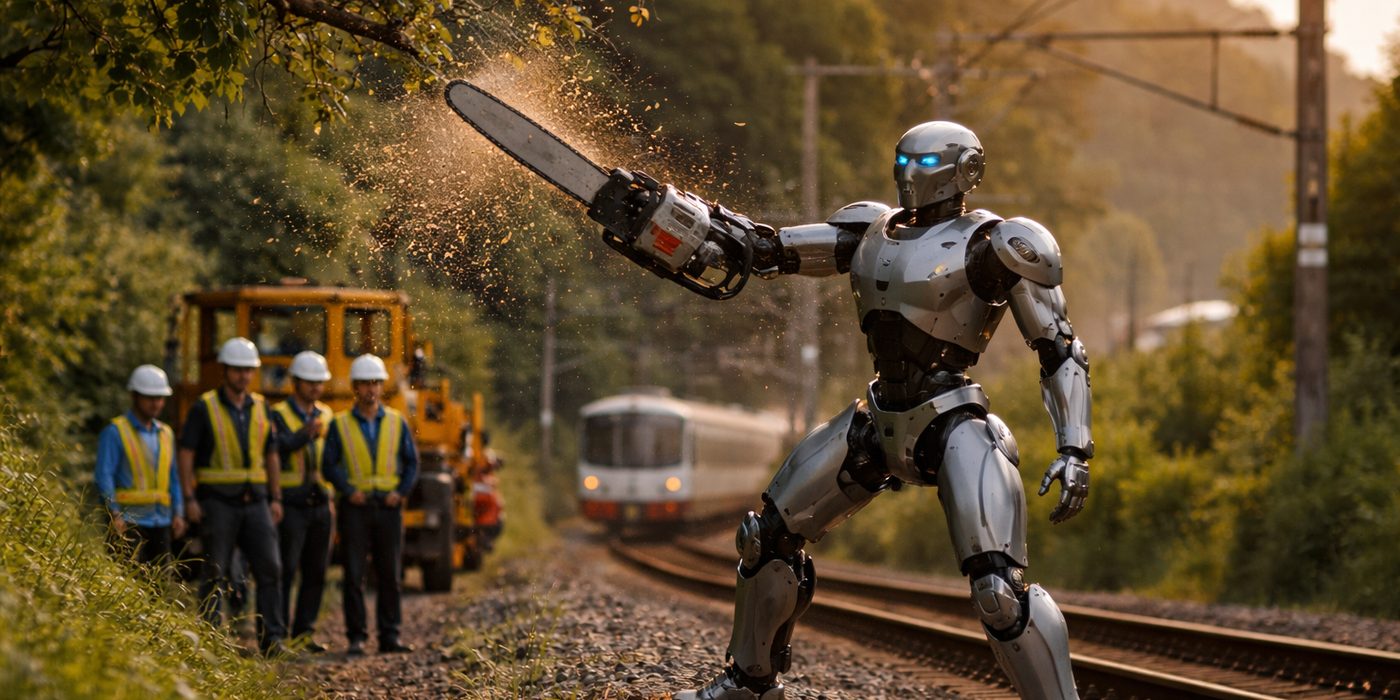
Vegetation is one of the quietest threats to a railway. A branch that drifts a few centimeters too close to the overhead line or the track corridor can trigger delays, damage equipment or, in the worst cases, cause an accident. Japan's rail operators know this well, and a humanoid robot with a chainsaw where one hand should be is now being shown on national television as a possible answer. The footage, picked up by Tom's Hardware UK, depicts the machine trimming branches that had begun encroaching on railway lines. It looks like something from a horror film. It is also, by the logic of industrial maintenance, a fairly sensible idea.
The task itself explains the design. Tree trimming along rail corridors is among the more hazardous jobs in infrastructure upkeep, combining power tools, work at height and live-line proximity, often in narrow windows between train services. Human crews working these conditions face real injury risk, and Japan's demographic reality makes the problem structural. The country's construction and maintenance workforce is shrinking and graying, and rail operators have publicly worried for years about how to staff nighttime track work. A platform that can be sent to do the dangerous cutting while people supervise from a safer distance addresses a genuine operational pain point, not a hypothetical one.
What the broadcast reportedly emphasized, and what matters most to engineers, is the autonomy layer. A chainsaw is an unforgiving end effector. It kicks back, binds in wet wood and throws debris, and a branch under tension can swing unpredictably when severed. Doing this safely without a human steering every cut demands perception that can identify which limbs are the problem, plan a cut sequence that accounts for how wood will fall, and modulate force in real time as the blade loads up. These are manipulation and planning challenges that sit well beyond pick-and-place logistics, where most humanoid pilots have clustered so far. The public details on the robot's sensing, compute and control architecture remain thin, and the source coverage leaves several basic questions open: who built it, how much of the work was genuinely autonomous rather than teleoperated, and how many hours it has run outside a staged demonstration.
Those gaps are the part serious buyers will press on. Humanoid robots have a long record of looking capable on camera and struggling with the repeatability, uptime and certification demands of real infrastructure work. Rail is an especially demanding customer. Operators in Japan work under tight safety regimes, equipment entering track-side environments is scrutinized, and any machine swinging a cutting tool near energized lines will need to clear safety cases that a trade-show prototype never faces. Still, the choice of application is telling. Industry attention has been dominated by factory and warehouse humanoids from US and Chinese players, yet a Japanese deployment aimed at utility-style maintenance suggests the nearest commercial wins may be in unglamorous, high-risk niches where the alternative is a person in a harness.
What to Watch The first thing to track is whether the developer behind the chainsaw robot is identified and whether it discloses a pilot with a named Japanese rail operator, since a customer name would separate a viral demo from a commercial program. Watch for any published safety documentation or autonomy-versus-teleoperation breakdown through the end of 2026, because that detail determines whether this is a labor-replacement tool or a remote-operation aid. Also follow Japan's rail operators and infrastructure maintenance firms for tender notices or trial announcements covering vegetation management in the coming quarter. Finally, note whether competing humanoid makers respond with heavy-tool demonstrations of their own, which would confirm that hazardous maintenance is becoming a recognized market segment.