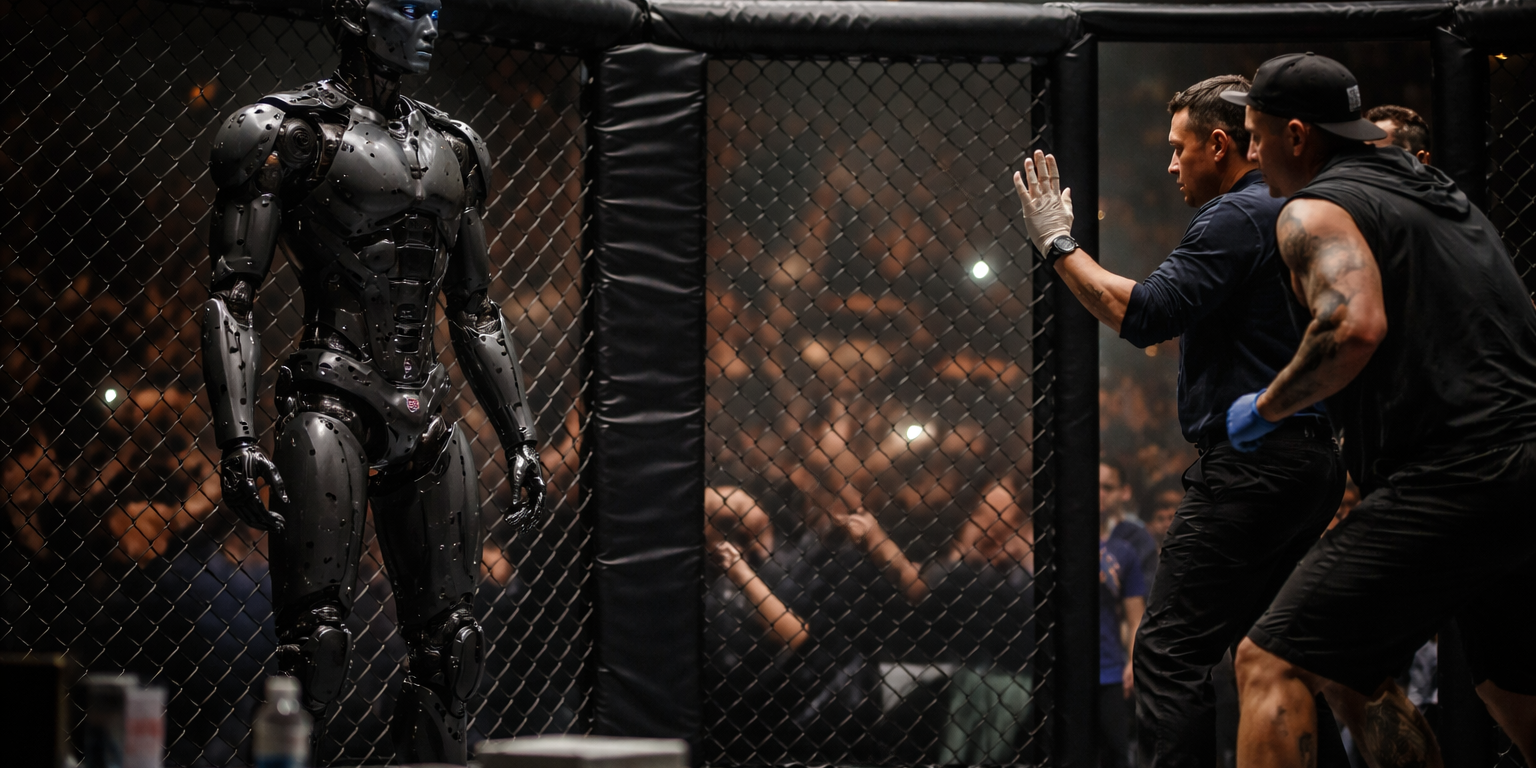
A fighting ring in California has become the first documented collision between combat-sports regulation and humanoid robotics, and the regulator won. The California State Athletic Commission stepped in after a robotics startup staged a bout in which a human opponent faced a humanoid machine inside a cage, according to reporting by Tom's Hardware UK. The commission responded with a cease-and-desist order. The details of the demonstration, including the startup's identity, the robot's specifications, and the exact terms of the match, have not been fully disclosed in the source reporting, which limits what can be verified about the machine's capabilities or the safety protocols in place that night.
The commission's reaction makes more sense once you understand what it actually governs. The California State Athletic Commission licenses and oversees professional boxing, kickboxing, and mixed martial arts in the state, setting rules on everything from medical clearance and ringside physicians to weight classes and officiating. Every one of those provisions assumes a human body on both sides of the contest. A robot has no weight class, no medical history, no concussion protocol, and no license to revoke. When a humanoid stepped into a regulated ring, it effectively stepped outside the entire statutory structure, which is likely why the agency moved fast rather than debating jurisdiction.
For the startup, the appeal of the stunt is easy to read. Humanoid robotics remains a field where attention converts to capital, and few images travel as far as a machine squaring off against a person. Companies including Tesla, Figure AI, Agility Robotics, and Unitree have all leaned on viral demonstrations, from factory-floor walkthroughs to martial-arts clips, to build mindshare in a sector where commercial revenue still trails the hype by a wide margin. Staged confrontations sit at the extreme end of that playbook. They promise clicks and funding conversations. They also invite precisely the kind of regulatory scrutiny that sober pilot programs with automotive and logistics customers are designed to avoid.
The engineering reality matters here, and it is where the story gets sharper for technical readers. Current humanoids are not built for adversarial physical contact with a moving human. Bipedal platforms balance on narrow support polygons, and their control stacks are tuned for predictable payload handling and walking, not for absorbing unscripted strikes. Actuator torque and speed have improved, but a fall remains the dominant failure mode, and a fall near a person is a safety event. Any credible fight demonstration therefore raises questions about what was scripted, what was teleoperated, and what the robot was actually doing autonomously. Without answers, the exhibit says more about marketing than about the state of the art in dynamic balance and whole-body control.
The larger lesson for the industry is about liability and perception, not the fight itself. Insurers, standards bodies, and enterprise buyers are all watching how humanoid makers handle human-robot proximity, and ISO work on safety for collaborative and legged systems is still maturing. A regulator shutting down a robot bout inside a licensed venue hands skeptics a concrete anecdote that conflates entertainment stunts with deployable products. It also previews a pattern: as humanoids move into public-facing settings, state and local agencies built for other purposes will reach for whatever authority they have. Developers who pursue public demonstrations will need legal review and venue-appropriate permissions the way they already need safety cases for factory pilots.
What to Watch
First, watch whether the California State Athletic Commission publishes the cease-and-desist text or issues formal guidance on non-human participants, which would set a precedent other states could copy. Second, track whether the startup responds publicly with technical details about the robot, including whether it operated autonomously or under teleoperation, and whether it secures funding or faces investor pushback over the episode. Third, monitor how other humanoid makers, including Unitree, Figure AI, and Agility Robotics, frame their own public demonstrations through the end of 2026, particularly any shift toward pre-cleared venues and documented safety protocols. Finally, keep an eye on safety-standards activity from ISO and national regulators, where language on legged robots in public spaces could harden into compliance requirements in the coming quarters.