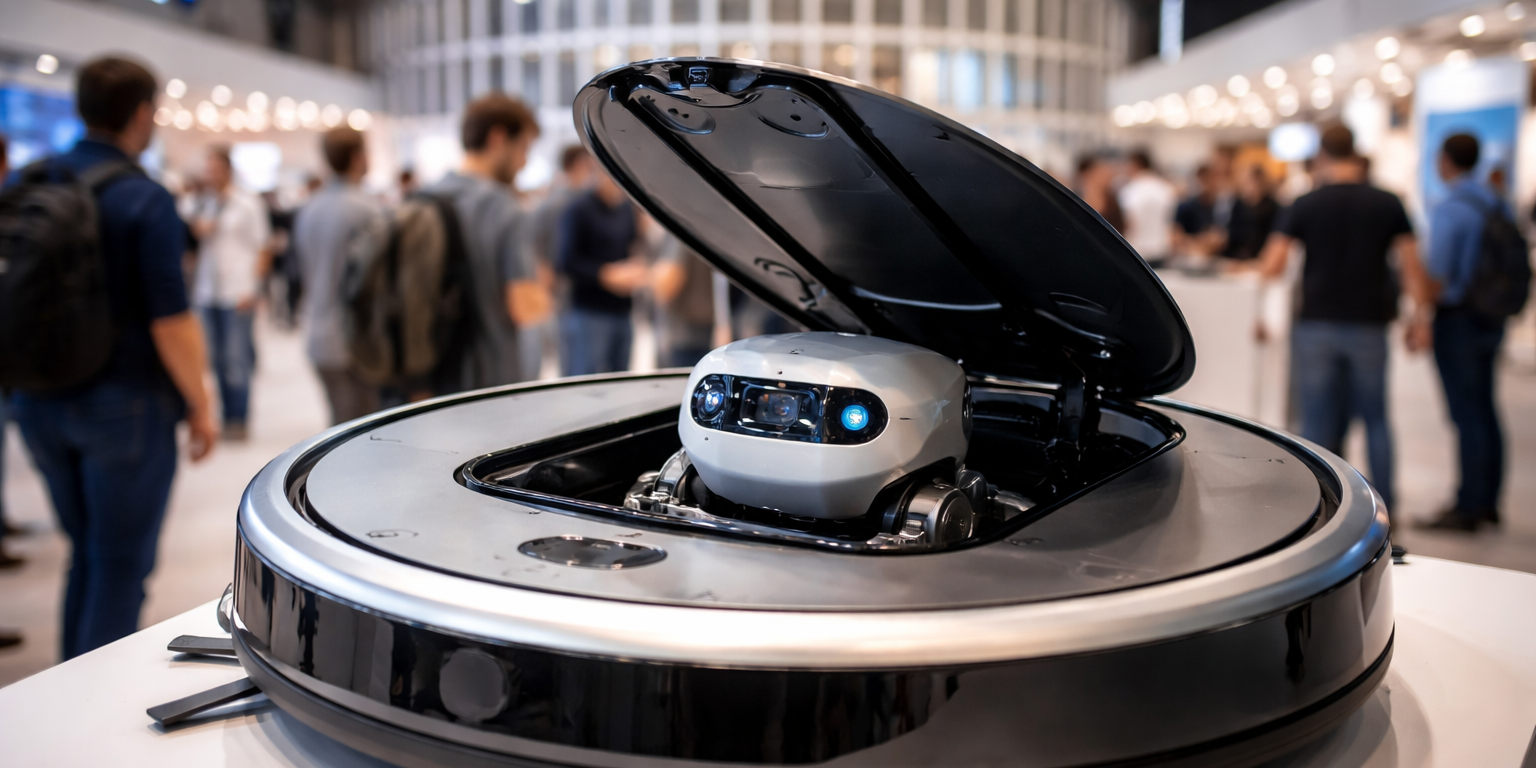
A compact robot emerges from a docking bay built into a standard Roomba chassis, rolls toward a baseboard corner, and begins detailed cleaning work its parent unit cannot physically accomplish. iRobot demonstrated this nested robotic system, dubbed Roomba Duo, at IFA 2026 in Berlin last week, marking the company's first public test of multi-agent household automation since its acquisition by Amazon completed in 2024. The prototype addresses a persistent limitation in floor cleaning robotics: even the most capable vacuum struggles with tight corners, furniture legs, and the narrow gaps where walls meet floors. Rather than ask consumers to buy, charge, and store multiple specialized robots, iRobot engineered a solution where a secondary unit lives inside the primary robot's chassis until needed. The company ran live demonstrations on the IFA show floor but offered no timeline for commercialization, a signal this remains an early-stage design study rather than a near-term product launch.
The technical challenge centers on coordination and power management. Both robots must navigate independently while sharing situational awareness, which requires real-time communication protocols more sophisticated than current Roomba models employ. The auxiliary unit, roughly one-third the diameter of the primary vacuum, carries its own battery, sensors, and cleaning mechanism. It exits through a motorized panel when the main robot encounters an obstacle it cannot navigate around, completes the detail work, then returns to dock and recharge while the primary unit continues its broader cleaning pattern. iRobot declined to specify battery capacity, runtime for the smaller unit, or the algorithmic approach used to decide when deployment is necessary. Industry observers note these details will determine whether the system delivers genuine utility or becomes a maintenance burden. Amazon's resources provide iRobot access to advanced computer vision and edge AI capabilities developed for warehouse robotics, though the company has not confirmed which Amazon technologies, if any, inform the Duo's navigation stack.
Consumer robotics companies have explored multi-robot systems before, typically with mixed results. Samsung demonstrated a similar concept in 2019 pairing a standard robotic vacuum with a smaller mopping unit, but never brought it to market. Roborock currently sells separate vacuum and mop robots that can coordinate through a smartphone app, though they require individual purchase and management. The nested approach attempts to eliminate the complexity of deploying multiple devices while preserving specialization benefits. iRobot's position as the dominant player in robotic vacuums gives it unusual latitude to experiment with concepts that would represent significant financial risk for smaller competitors. The company sold approximately 4.2 million Roomba units in 2025, maintaining roughly 35 percent market share in North America despite increased competition from Chinese manufacturers. Whether consumers will pay a premium for nested functionality depends largely on price positioning, which iRobot has not disclosed. Current high-end Roomba models retail between $800 and $1,100. A nested system would likely command $1,200 or more, assuming it reaches production.
The broader robotics industry continues pushing toward heterogeneous robot teams, particularly in industrial and logistics settings, where specialized machines collaborate on complex tasks. Amazon's warehouses already deploy multiple robot types, from Kiva drive units moving shelves to robotic arms sorting packages. Applying that multi-agent philosophy to consumer environments introduces variables industrial settings do not face: unpredictable layouts, pets, children, and the expectation of autonomous operation without expert oversight. iRobot's nested design attempts to package coordination complexity into a single product, reducing the cognitive load on users while maintaining the efficiency gains of specialized robots. The concept also sidesteps thorny questions about interoperability standards that arise when different manufacturers' robots must communicate. If the Duo reaches production, it would represent a vertically integrated solution to multi-robot household management, controlled entirely through iRobot's software ecosystem. That approach aligns with Amazon's broader smart home strategy, which favors closed platforms where the company controls the entire technology stack from sensors to cloud services.
What to Watch: iRobot typically follows IFA concept demonstrations with patent filings within 60 to 90 days, which will reveal technical details the company withheld in Berlin. Monitor whether the Duo's auxiliary unit shares sensor architecture with Amazon's Astro home robot, launched in late 2024, as component reuse would significantly reduce manufacturing costs and accelerate potential commercialization. Watch for competitive response from Roborock and Ecovacs, both of which have the engineering resources to develop similar nested systems if iRobot signals serious intent to bring this concept to market before the 2027 holiday shopping season.