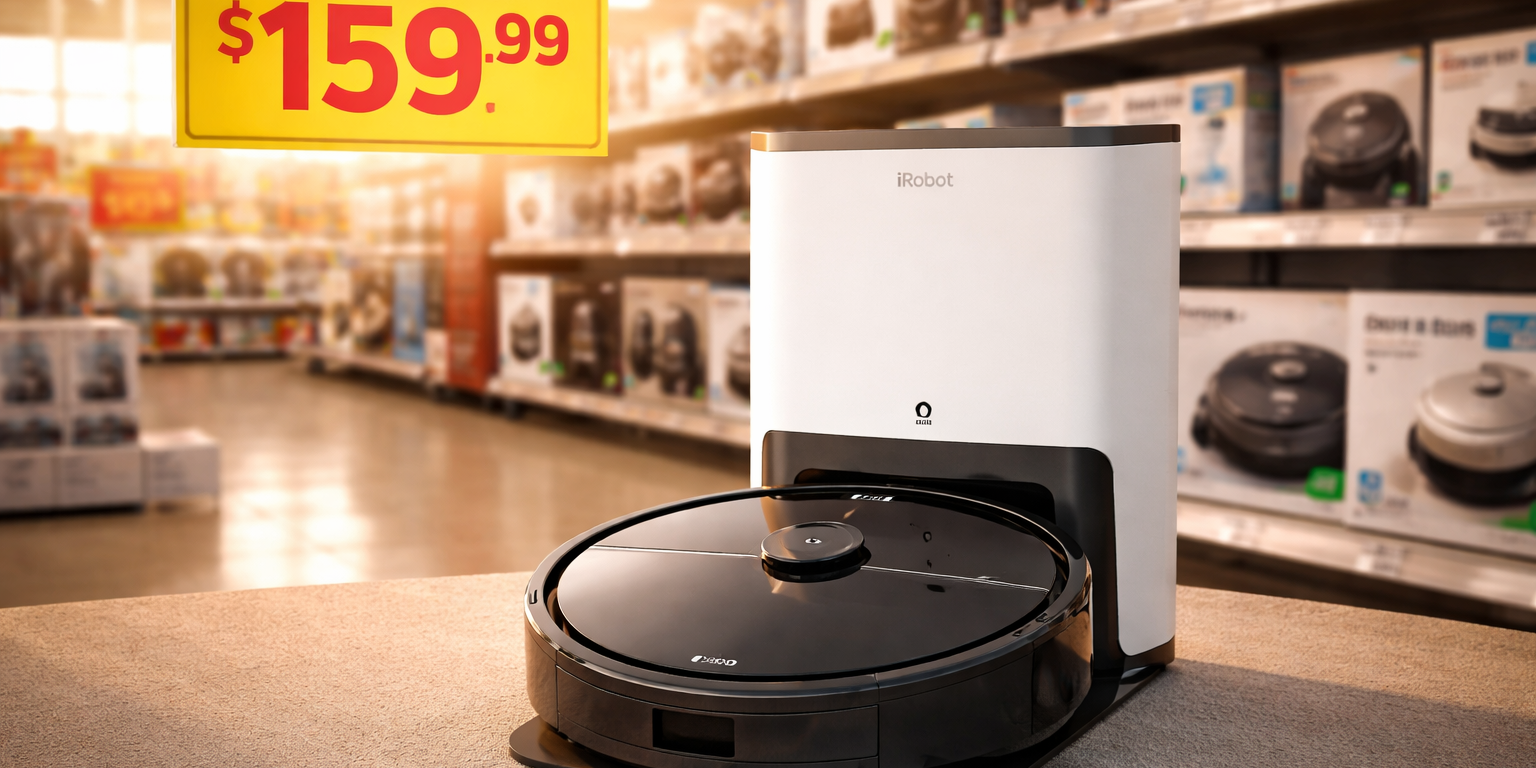
The Roomba Max 775 generates 68 decibels during standard operation, roughly 12 decibels louder than competitor models in the $400-$600 price bracket where iRobot has positioned this unit. That acoustic profile, documented in independent laboratory testing by Gizmodo's consumer division, represents the most significant engineering compromise in a product otherwise designed to compete directly with Roborock's Q series and Ecovacs' mid-range Deebot offerings. For iRobot, a company that spent two decades defining the category it created, the Max 775 signals both capability and constraint. The hardware performs its core function effectively. The noise suggests cost optimization forced choices that premium buyers may reject.
Bedford-based iRobot has operated in survival mode since European regulators blocked its sale to Amazon in January 2024, citing antitrust concerns around Amazon's smart home ecosystem dominance. The company laid off 350 employees that quarter, roughly 31 percent of its workforce, and has since cycled through two restructuring plans aimed at reducing annual operating expenses by $150 million. Chairman and CEO Colin Angle, who co-founded iRobot in 1990 as a MIT spinout focused on planetary rovers and military reconnaissance bots, stepped down in May 2024. His successor, former CFO Glen Weinstein, inherited a company with $200 million in cash reserves, declining shelf space at major retailers, and Chinese competitors selling comparable navigation technology at half the price. The Max 775 enters this market as a test of whether brand equity built over 25 years can sustain premium pricing when the underlying sensor arrays, SLAM algorithms, and brushless motors have become broadly commoditized. Roborock shipped 3.2 million units globally in 2025, according to IDC estimates. iRobot shipped 2.1 million, its lowest annual volume since 2017.
The technical specifications reveal strategic choices about where iRobot allocated its engineering budget. The Max 775 uses a Qualcomm QCS405 processor, the same system-on-chip found in multiple competing models, running iRobot's proprietary navigation stack built on visual SLAM rather than the LIDAR systems that dominate premium tiers. The decision to skip LIDAR reduces bill-of-materials cost by an estimated $40 to $60 per unit, but forces reliance on front-facing cameras and floor-tracking sensors that perform adequately in well-lit spaces and struggle in dim hallways or beneath furniture. Suction power measures 2400 pascals, placing it in the middle of the competitive range. Battery capacity reaches 5200 milliamp-hours, delivering roughly 110 minutes of runtime on hardwood floors and 75 minutes on medium-pile carpet. The dock lacks auto-empty functionality, a feature now standard on most models above $500. Gizmodo's testing confirmed the unit handled pet hair effectively, navigated multi-room floor plans without significant errors, and returned to its charging base reliably across 40 cleaning cycles. The acoustic issue stems from the main fan assembly, which spins at higher RPM than necessary to compensate for relatively narrow air channels in the dust collection system. That's a mechanical engineering decision driven by manufacturing cost, not a fundamental limitation of the robot's capabilities.
The consumer robotics vacuum segment generated $6.8 billion in revenue globally during 2025, with unit growth slowing to 8 percent year-over-year as market penetration in North America and Western Europe exceeded 22 percent of addressable households. Growth now concentrates in commercial applications, where autonomous floor care units serve warehouses, hospitals, and retail spaces with minimal human oversight. iRobot has limited presence in that channel. Its brand strength remains concentrated in residential markets where Chinese manufacturers have steadily eroded price premiums through aggressive e-commerce distribution and feature parity. Roborock, Ecovacs, and Dreame collectively held 41 percent of global unit share in 2025, up from 28 percent in 2022. iRobot's share dropped from 34 percent to 19 percent over the same period. The Max 775 aims to recapture buyers in the crucial $400-$700 segment, where purchase decisions hinge less on brand legacy and more on real-time performance comparisons visible in online reviews and YouTube teardowns. Whether competent execution suffices when competitors deliver equivalent results at $349 remains the open question. For context, Roborock's Q7 Max regularly discounts to $380 and runs quieter.
What to Watch: iRobot reports third-quarter 2026 earnings on November 7, which will reveal whether the Max 775 and its companion models drove sequential revenue growth or merely cannibalized sales from higher-margin units. Retail inventory data from Circana will show whether Best Buy and Target expand or contract shelf space for iRobot products heading into the critical fourth-quarter shopping season. Additionally, monitor whether iRobot announces partnerships with commercial facility management companies, a strategic shift Weinstein mentioned during the September analyst call but provided no concrete timeline. Any acquisition interest from appliance manufacturers like SharkNinja or Bissell would likely surface before year-end if the company's cash position continues deteriorating.