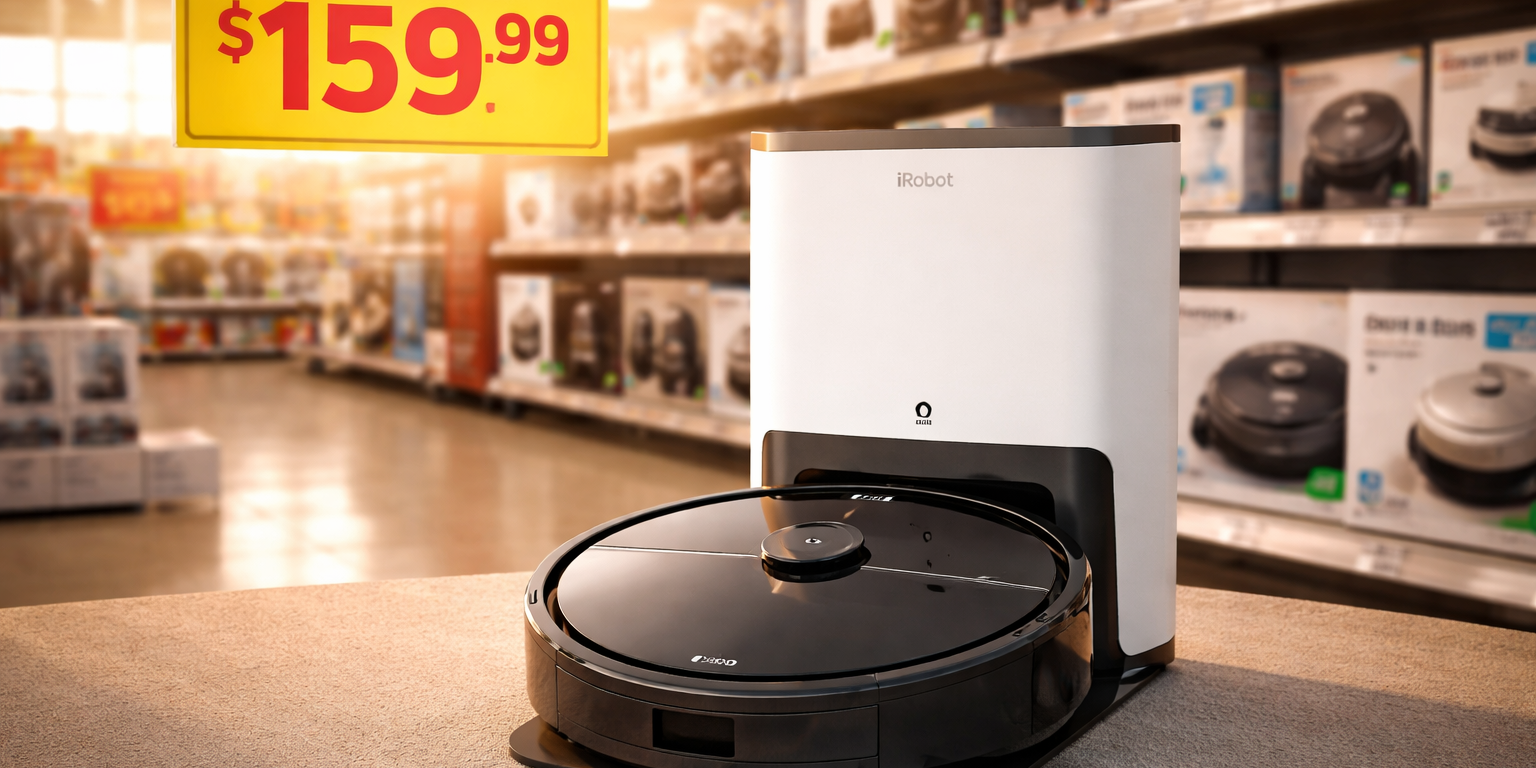
A Roomba with auto-empty capability for $159.99 represents something the consumer robotics industry hasn't seen before: premium brand technology at budget-brand pricing. Woot began offering the iRobot Roomba Combo 2 Robot Vacuum and Mop with AutoEmpty Dock at that price point this week, a figure that undercuts nearly every major competitor in the category and sits $40 below what Eufy and Ecovacs typically charge for models without self-emptying functionality. The fire sale pricing suggests iRobot's private equity owners are clearing inventory aggressively as they reposition the brand following the company's sale to Axon Enterprises in late 2025 after Amazon's failed acquisition attempt.
The Roomba Combo 2 launched in early 2024 at $599, positioned as iRobot's entry-level combination unit targeting consumers who wanted both vacuuming and mopping without stepping up to the $1,000-plus Roomba Combo j9 series. The model features a four-stage cleaning system, edge-sweeping brush, and a removable mop pad that the robot automatically lifts when it detects carpet. The AutoEmpty dock holds 60 days of debris and uses enclosed disposal bags, technology iRobot pioneered in 2019 with the i7+ that forced competitors to follow suit. When it debuted, the Combo 2 received mixed reviews from engineering teardown specialists who noted its navigation relied on floor-tracking sensors rather than the lidar or camera systems that Chinese manufacturers had standardized across their product lines. That technological gap widened through 2025 as Roborock's S8 Pro Ultra and Dreame's L20 Ultra added obstacle recognition, automated mop pad washing, and heated drying stations while maintaining price points between $600 and $800.
The current fire sale follows a pattern emerging across iRobot's distribution channels. The company reduced its workforce by 31% in January 2026 after Axon Enterprises completed its $1.1 billion acquisition, shifting focus from consumer products to commercial and defense applications where Axon saw strategic alignment with its autonomous systems portfolio. Former iRobot engineers familiar with the transition told trade publications that Axon's management prioritized government contracts over retail channels, viewing the consumer vacuum business as a cash-generating legacy asset rather than a growth platform. The Roomba brand still commands 43% market share in the United States according to NPD Group data through Q2 2026, but that figure dropped from 61% in 2022 as Chinese competitors gained retail distribution through Amazon, Walmart, and Target. The Combo 2's current pricing likely aims to defend that eroding position while liquidating units manufactured before the ownership transition.
Broader market dynamics make the $159.99 price point particularly significant for component suppliers and contract manufacturers. The Roomba Combo 2 contains roughly $85 worth of parts at 2024 pricing, including a brushless DC motor from Nidec, lithium-ion cells from Samsung SDI, and a microcontroller from STMicroelectronics. Selling complete units with docking stations below $200 forces margin compression across the entire supply chain, pressuring Chinese manufacturers who built business models around 35-40% gross margins at $300-400 retail prices. Roborock's stock dropped 8% on the Shenzhen exchange when the Woot sale went live, suggesting investors expect competitive pricing pressure through the holiday quarter. The development matters beyond consumer markets because the same motor, battery, and sensor technologies appear in commercial cleaning robots, warehouse automation systems, and last-mile delivery bots where cost reduction directly impacts deployment economics. When iRobot moves premium technology to budget pricing, it establishes new baseline expectations for what autonomous mobile robots should cost across categories.
What to Watch: Track whether Amazon reinstates Prime-exclusive deals on Roomba inventory through Q4 2026, which would signal continued close coordination between the retailer and iRobot despite Amazon's failed acquisition. Monitor Roborock and Ecovacs earnings calls in November 2026 for commentary on North American pricing strategy and whether they match iRobot's aggressive discounting. Watch for announcements from Axon regarding which iRobot consumer product lines continue production beyond 2027 and which get discontinued as the company pivots toward government contracts.