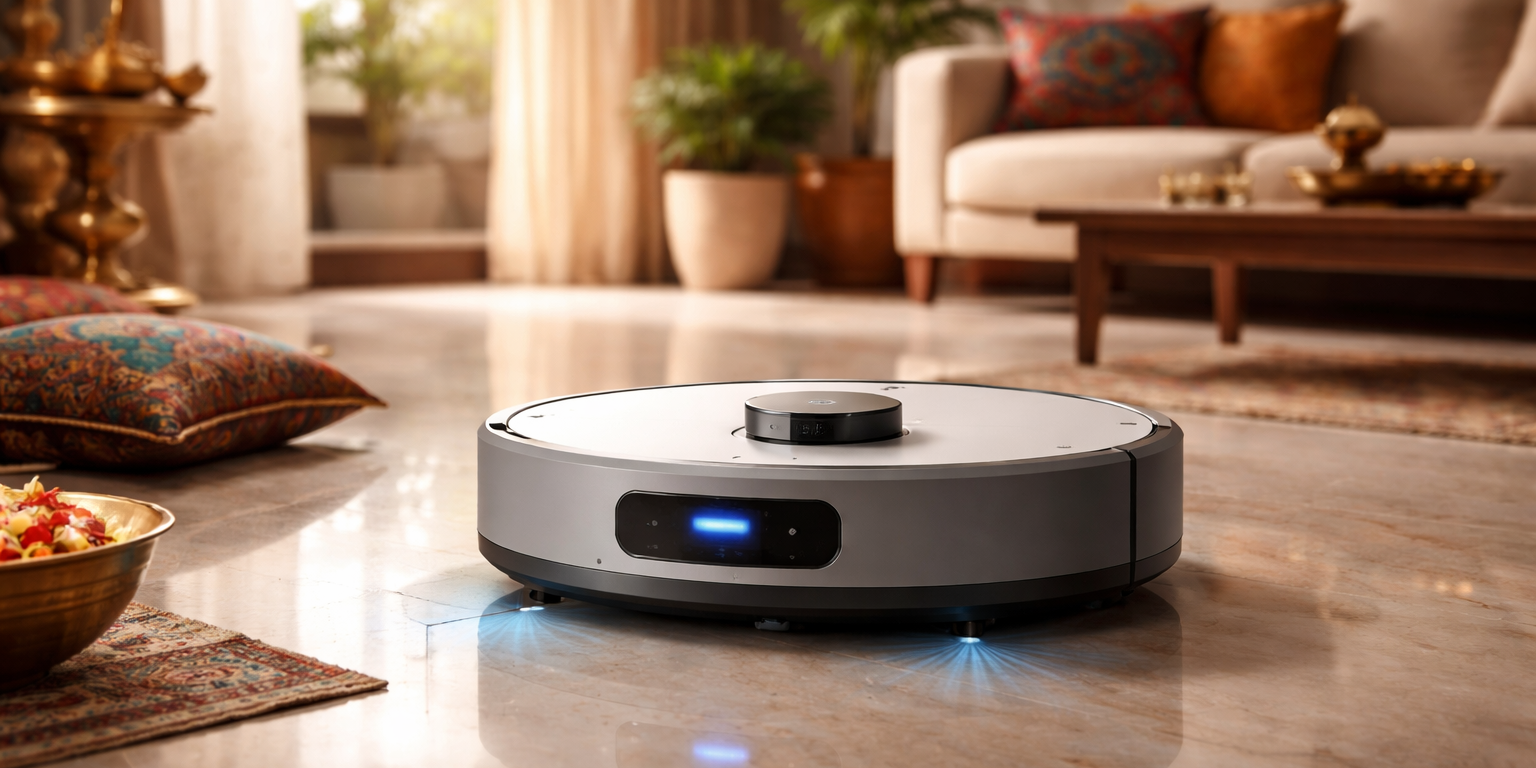
Dreame Technology, the Chinese home robotics manufacturer that has grown rapidly since spinning out from Xiaomi's ecosystem in 2017, has brought its X60 Ultra Complete robot vacuum to India. The device enters a market where robotic floor care remains a small but expanding segment, with urban households increasingly adopting autonomous cleaning systems as disposable incomes rise and awareness of smart home technology spreads beyond early adopters. Dreame's move follows similar launches by iRobot, Ecovacs, and Roborock in the subcontinent over the past three years, signaling sustained interest in the region despite infrastructure challenges and price sensitivity that have historically limited robotics penetration.
The X60 Ultra Complete carries the full suite of sensors and actuators that have become standard in premium robot vacuums: LIDAR for mapping, multiple cliff sensors, carpet detection, and dual rotating mops alongside vacuum suction. Dreame positions the model as a complete solution with a self-cleaning base station that handles dirt disposal, mop washing, and water refilling without user intervention for extended periods. The company has not disclosed unit economics, but similar flagship models from competitors in India typically retail between ₹60,000 and ₹90,000, placing them well above mass-market vacuum cleaners but below dedicated household staff costs in metropolitan areas. That pricing calculus matters in a country where labor remains relatively inexpensive and the value proposition of automation hinges on convenience rather than pure cost savings.
Dreame Technology operates as a subsidiary of Xiaomi but maintains its own research and development operations in Suzhou and Shenzhen, with manufacturing concentrated in mainland China. The company has steadily expanded beyond its initial Xiaomi-branded products to establish Dreame as a standalone brand in Europe, North America, and now Asia-Pacific markets. In India specifically, Dreame faces entrenched competition from established players like iRobot's Roomba line and Ecovacs, which have spent years building service networks and brand recognition. The X60 Ultra Complete's success will depend heavily on distribution partnerships, after-sales support infrastructure, and the company's ability to navigate import duties and local regulatory requirements that have complicated market entry for several Chinese technology firms in recent years.
Broader industry dynamics favor the launch timing. Global shipments of robot vacuums have grown from approximately 4 million units in 2016 to an estimated 21 million units in 2025, with Asia-Pacific representing the fastest-growing regional segment according to data from multiple market research firms. India's contribution remains modest but climbing, particularly in tier-one cities where apartment living and dual-income households create conditions favorable to automation. The X60 Ultra Complete's emphasis on intelligent navigation and autonomous operation aligns with broader trends in consumer robotics toward systems that require minimal human oversight once configured. Whether Dreame can convert that technical capability into sustained market share depends on factors well beyond the hardware itself, including mobile app localization, Hindi language support, and integration with regional smart home ecosystems that may differ from Western markets. The company's willingness to invest in local presence, rather than treating India as an export afterthought, will determine whether this launch represents a genuine commitment to the region or simply an opportunistic brand extension.
What to Watch: Track Dreame's retail partnerships and service center rollout across major Indian cities through Q4 2026, particularly whether the company establishes its own service infrastructure or relies on third-party networks. Monitor pricing adjustments as local inventory builds and competitors respond; the premium robot vacuum segment in India has proven elastic to discounting during festival shopping periods. Watch for announcements around domestic assembly or manufacturing partnerships, which could shift Dreame's cost structure and regulatory positioning if the company pursues deeper localization beyond simple market entry.