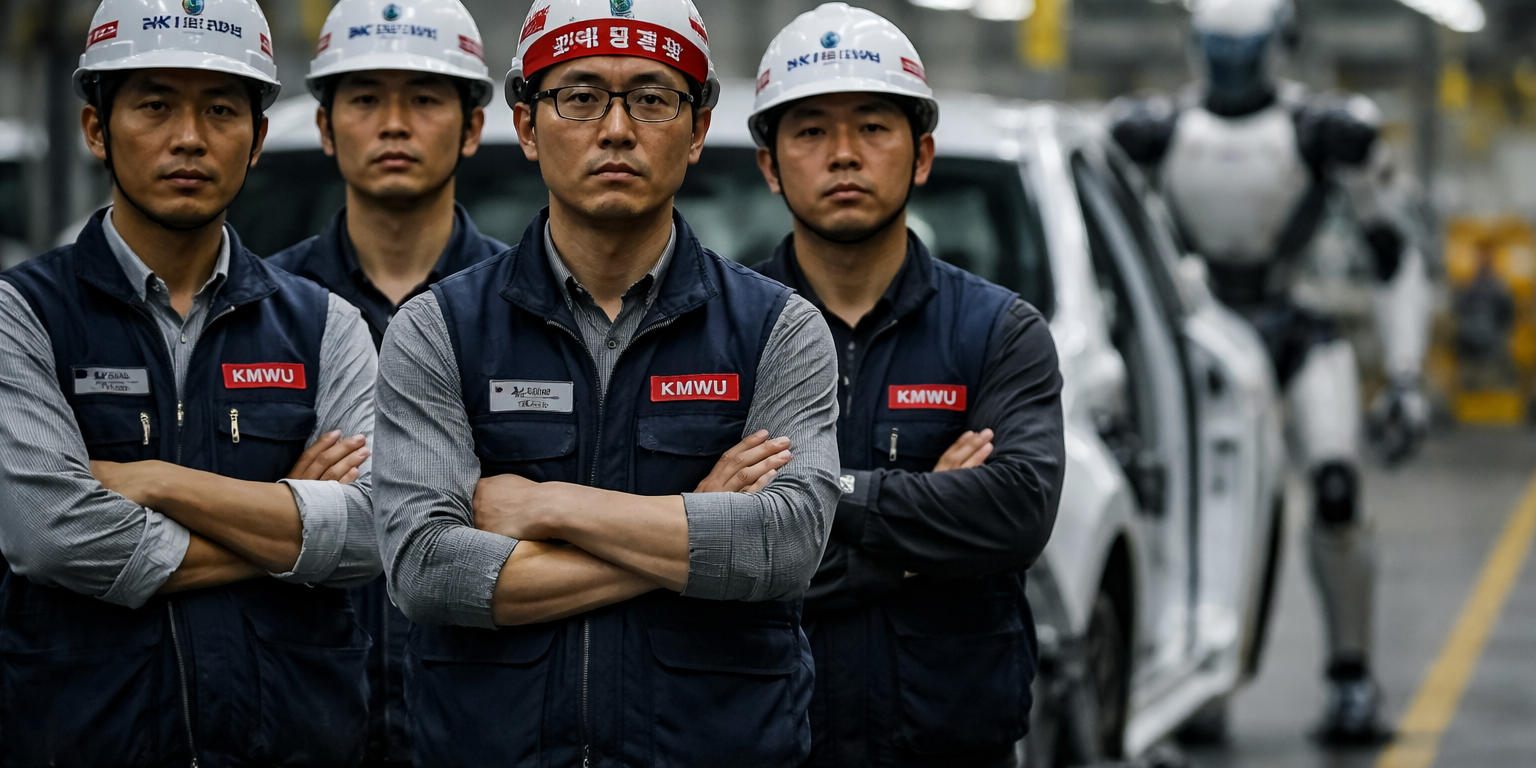
Tens of thousands of unionized workers at Hyundai Motor's Ulsan manufacturing complex in South Korea — the world's largest single automotive plant — staged rolling partial strikes from July 15 to 17, with further four-hour stoppages set for July 20-22, after 15 rounds of wage negotiations failed. The Korean Metal Workers Union (KMWU), representing roughly 39,000-40,000 Hyundai employees, is calling it the first auto-industry strike explicitly triggered by planned humanoid robot deployment, according to the Wall Street Journal.
Wage and bonus demands remain on the table -- the union is pushing to convert hourly pay to fixed monthly salaries, raise the retirement age from 60 to 65, and secure a profit-sharing bonus equal to 30% of consolidated net profit. Hyundai has offered a smaller package of pay increases, bonuses, and company shares, which union leadership rejected as insufficient. But the union's core, and most novel, demand is a consent requirement: no Boston Dynamics Atlas robot may enter a Hyundai Korean factory without a prior labor-management agreement. Atlas has not yet been assigned a single task at any Korean plant.
Hyundai acquired majority ownership of Boston Dynamics from SoftBank for roughly $880 million in 2021. At a JPMorgan investor session, Hyundai Motor Group disclosed plans to deploy more than 25,000 Atlas units across Hyundai and Kia factories, representing about 83% of a 30,000-unit annual production target by 2028. The first deployment is planned for the non-union Metaplant America facility in Georgia starting in 2028, with Kia's Georgia plant following in 2029; Hyundai's roadmap starts Atlas on parts sequencing before extending to component assembly and heavier tasks over time. Atlas stands roughly 190 cm tall, weighs about 90 kg, and can lift up to 110 pounds.
The Ulsan strike marks a shift for organized labor confronting humanoid robotics specifically, as distinct from earlier disputes over traditional robotic arms and automated guided vehicles at manufacturers like GM and Volkswagen. Because humanoids are built to work in spaces designed for people, they can be deployed without the facility redesign -- and negotiating time -- that traditional automation required. Other automakers, including BMW, Mercedes-Benz, and Stellantis, are piloting humanoid programs from Figure, Apptronik, and Agility Robotics respectively, though none has yet triggered a comparable labor action.
What to Watch: Hyundai and the KMWU resumed negotiations the week of July 20. The Journal estimates the strike could disrupt production of roughly 5,000 vehicles and cut sales revenue by about $135 million. Watch for how the consent-right demand is resolved -- it's the first real test of whether unions can secure a say over humanoid deployment before, rather than after, robots arrive on the floor.
UPDATE (July 21, 2026): Hyundai Motor's Global PR team contacted RoboticsIntl regarding this article. Hyundai states that the union's current demands center on wages, bonuses, and retirement age extension, and that potential robot deployment at Korean facilities is not currently part of labor-management discussions. The company says its near-term focus is deploying Atlas at the Metaplant America facility in Georgia, with decisions on deployment at other sites -- including in Korea -- to be made in consultation with local employees and workforce representatives. Hyundai maintains it would be inaccurate to characterize the current strike as caused by, or primarily driven by, Atlas. The company says it remains committed to constructive engagement with the union toward an agreement supporting both employees and the company.
Multiple outlets, including the Wall Street Journal, report the union's core demand is a consent requirement before any Atlas robot enters a Korean plant. RoboticsIntl will continue to follow this story as it develops.