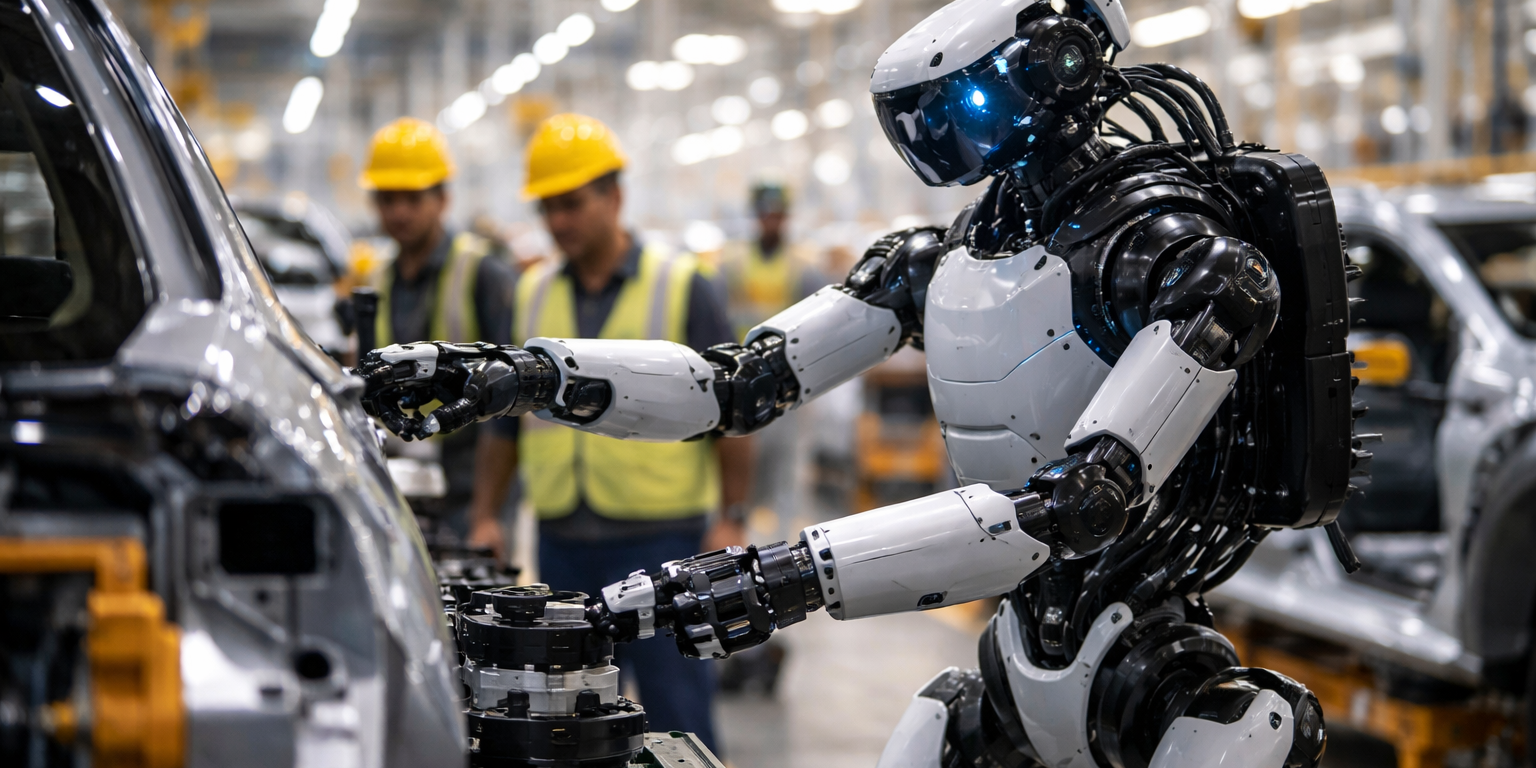

A bipedal robot design from Hugging Face carries a bill of materials under $2,500, using standard servo motors and 3D-printed structural components instead of the custom machining and specialized actuators that push commercial humanoids into six-figure territory. The company released complete CAD files, actuator specifications, and control software through its existing repository infrastructure, marking its first hardware project after building a business around democratized access to machine learning models. The design covers only the lower body — legs, hip assembly, and balance control systems — leaving torso and manipulation hardware for future releases or third-party development. Hugging Face structured the release like its software repositories, with version control and community contribution pathways already in place.
The price gap between this platform and commercial systems reflects fundamentally different component choices. Boston Dynamics' Atlas and Agility Robotics' Digit rely on harmonic drive actuators that cost $3,000 to $8,000 per joint, delivering high torque density and precise position control through gear reduction ratios above 100:1. Hugging Face's design specifies brushless motors with planetary gearboxes available from hobby robotics suppliers for $150 to $400 per unit. These lack the torque-to-weight ratios and backdrivability of harmonic drives, constraining the robot to gentler accelerations and potentially limiting operation to flat, predictable surfaces. The control software compensates through trajectory planning that keeps the center of mass well within the stability region, trading dynamic capability for reliability with cheaper hardware. Published test footage shows walking speeds around 0.3 meters per second on laboratory floors, compared to the 1.5 meters per second Atlas achieves on rough terrain.
Accessible hardware historically accelerates distributed experimentation in ways that concentrated, expensive platforms cannot match. Drone development between 2010 and 2015 followed this pattern after open-source flight controllers and cheap brushless motors brought quadcopter projects under $500. Hundreds of university teams and hobbyist developers contributed improvements to stabilization algorithms, sensor fusion techniques, and autonomous navigation systems. Those advances fed back into commercial products from DJI, Skydio, and Amazon Prime Air, compressing development timelines that might have stretched across decades with only corporate labs working on proprietary platforms. Humanoid robotics faces similar bottlenecks today. Carnegie Mellon, MIT, and Stanford operate perhaps a dozen commercial humanoid platforms combined, limiting parallel experiments on locomotion algorithms. A $2,500 platform lets a single university robotics program deploy ten units for the cost of one Digit robot, testing gait variations or learning approaches across hardware simultaneously.
The platform's research utility depends on whether servo-grade actuators provide sufficient performance for meaningful algorithm development. Walking on flat laboratory floors requires relatively modest torque and position accuracy, making the hardware adequate for testing basic balance controllers or reinforcement learning approaches to gait generation. Stair climbing, outdoor terrain, or dynamic motions like jumping demand the torque margins and control bandwidth that harmonic drives provide, potentially limiting this platform's relevance to a subset of humanoid research questions. Several academic labs building their own low-cost bipeds — including Oregon State's CASSIE and Agility's early prototypes — ultimately concluded that actuator performance determines which problems you can meaningfully study. Hugging Face released performance specifications showing 20 Newton-meters of continuous torque at the hip and 15 at the knee, approximately 40 percent of what Atlas delivers, which positions the platform somewhere between a pure simulation tool and a field-deployable system. The control software includes simulation environments where researchers can test algorithms before deploying to hardware, acknowledging that physical experiments will be constrained.
What to Watch: Hugging Face has not announced timing for upper body designs, but community discussion in the project repository suggests third-party arm and manipulation hardware within 90 days. University adoption numbers will emerge through academic publications citing the platform, likely appearing in preprints by June 2025. Actuator suppliers including T-Motor and ODrive may release robotics-specific products if order volumes justify dedicated product lines, potentially improving the performance ceiling for budget humanoid platforms within six months.