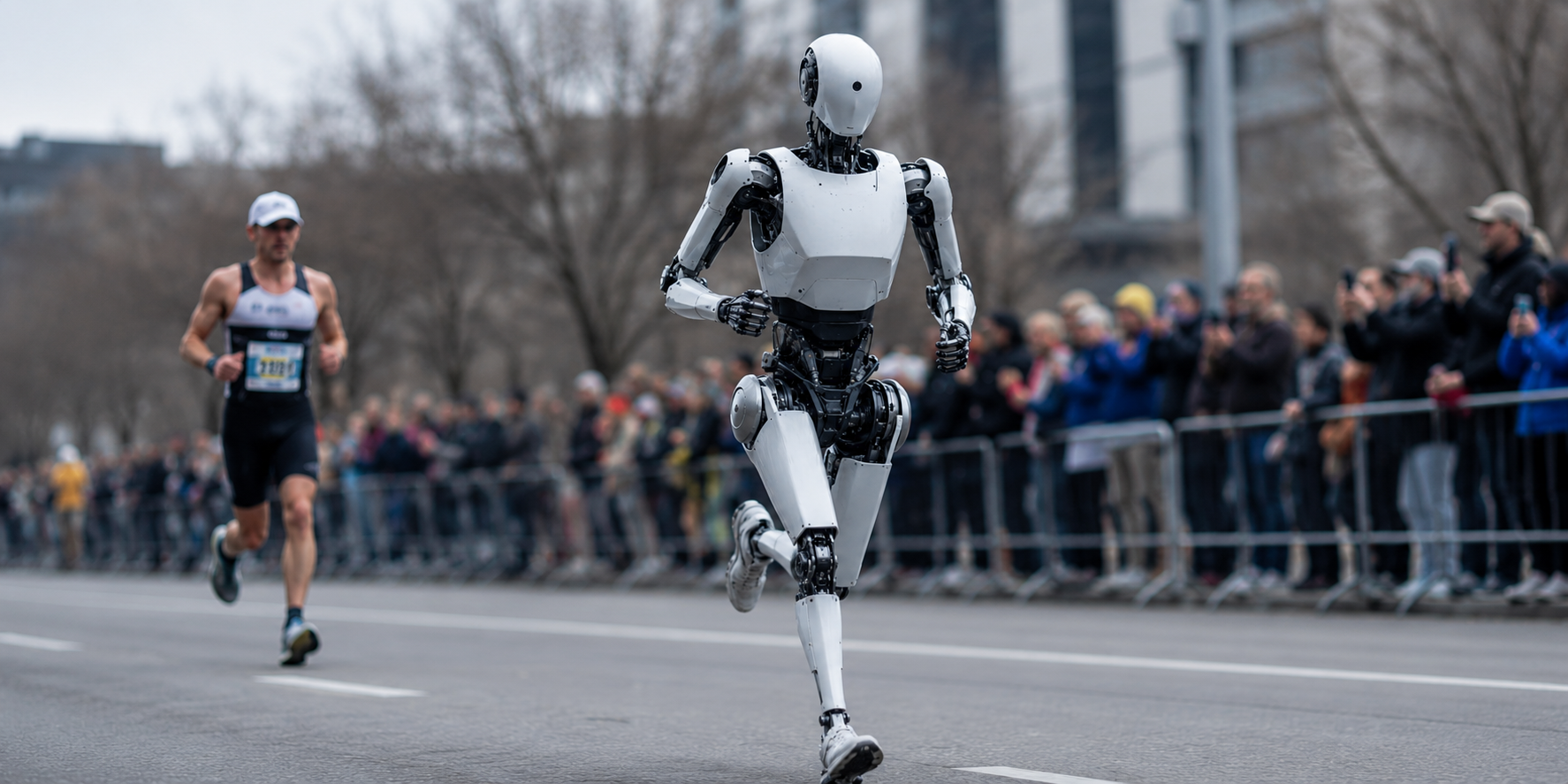
Honor Lightning crossed the half-marathon finish line in 50 minutes and 26 seconds on April 19, 2026, running 13.1 miles faster than any human has ever managed. The time demolishes Kibiwott Kandie's human world record of 57:32, set in 2020, and represents a staggering leap beyond the best robotic performance from just a year earlier, which took nearly two hours and fifty minutes to complete the same distance. While competitors like Unitree deployed ice-filled cooling backpacks in desperate attempts to prevent thermal shutdown during the race, Honor's engineering team appears to have solved the fundamental power density and heat management problems that have plagued bipedal platforms since the field's inception. The result isn't just a publicity stunt. It demonstrates that humanoid robots have crossed a threshold in sustained dynamic performance that many researchers privately doubted would arrive before 2030.
Thermal management, not artificial intelligence or control algorithms, has constrained real-world humanoid deployment for the past decade. Boston Dynamics' Atlas can perform backflips because those maneuvers last seconds. Sustained running over kilometers generates heat that overwhelms conventional cooling architectures within minutes, forcing robots to throttle actuator performance or shut down entirely. Unitree's reliance on external cooling during the April event confirms what industry engineers already knew: most humanoid platforms today operate within minutes of thermal limits during high-output tasks. Honor's ability to complete 50 minutes of sustained running without supplemental cooling suggests either a fundamental breakthrough in actuator efficiency, a novel heat dissipation architecture, or both. The company has not published technical specifications, but thermal imaging from the event, according to observers present, showed remarkably even temperature distribution across the robot's frame throughout the run, suggesting active thermal management integrated into the structural design rather than bolted-on cooling systems.
The performance gap between 2025 and 2026 robot times hints at something beyond incremental improvement. A two-hour reduction in half-marathon completion time represents the kind of discontinuous jump that typically signals either new actuator technology or major advances in energy storage. Lithium-ion batteries, even at current best-in-class energy densities around 300 Wh/kg, struggle to provide the power-to-weight ratio needed for sustained bipedal running without adding mass that defeats the purpose. Solid-state batteries, which several Chinese manufacturers have moved into volume production for automotive applications over the past eighteen months, offer energy densities approaching 500 Wh/kg with superior discharge rates. Honor has manufacturing relationships with Contemporary Amperex Technology Co. Limited, which began shipping semi-solid-state cells to select partners in late 2025. If Honor Lightning runs on next-generation battery chemistry, the implications extend far beyond robot athletics. Every logistics, manufacturing, and service robot currently constrained by shift length and charging cycles would become a candidate for redesign.
Honor itself remains something of an enigma in Western robotics circles. The company, best known for smartphones and consumer electronics under parent company Shenzhen Zhixin New Information Technology, announced its humanoid robotics division only in August 2025. The Lightning platform made its public debut in January 2026 at a Shenzhen press event that drew minimal international coverage. Yet eight weeks later, the same platform outran the cumulative output of Boston Dynamics, Tesla Optimus, Figure AI, and Unitree in a standardized endurance test. This pattern—Chinese firms moving from announcement to deployed capability in timelines that surprise U.S. and European competitors—has repeated across quadrupeds, industrial arms, and now humanoids. Capital availability explains part of the gap. Humanoid robotics ventures in China have raised more than $3 billion in aggregate since 2024, according to venture tracking firm PitchBook, compared to roughly $2.1 billion for U.S.-based companies in the same period. But capital alone doesn't account for thermal management breakthroughs or integration speed. Supply chain proximity does. Honor can iterate on actuator designs with Shenzhen-based motor manufacturers in days, not months. Battery chemistry refinements happen in adjacent buildings, not across continents.
The broader robotics industry now faces a calibration problem. If a platform introduced eight months ago can achieve sustained locomotion performance exceeding human capability, the timelines and assumptions underlying current development roadmaps need revision. Warehouse automation providers planning 2027 deployments of humanoid picking systems assumed robots would move at human speeds with human-like endurance. If robots can move faster and longer without breaks, the economic calculations change. Labor cost comparisons shift. Facility designs optimized for human work cadences become suboptimal. Tesla has discussed Optimus production volumes in the millions by 2030. Figure AI recently demonstrated a ten-hour autonomous warehouse shift. But neither has published endurance performance metrics comparable to what Honor demonstrated in April. The question is no longer whether humanoids can match human workers in basic tasks. The question is how quickly they'll surpass human physical performance across enough dimensions to reshape labor markets.
What to Watch: Honor has scheduled a technical briefing for May 15, 2026, in Shenzhen where the company is expected to disclose actuator specifications and thermal architecture details. Unitree's next-generation H2 humanoid, currently in beta testing, will likely incorporate lessons from the April marathon event when it ships in Q3 2026. Several U.S. robotics firms have accelerated partnerships with solid-state battery developers since the race results became public; announcements are likely before the IEEE International Conference on Robotics and Automation in June. Boston Dynamics has remained conspicuously silent on endurance performance targets for its commercial humanoid platform, expected to launch in 2027.