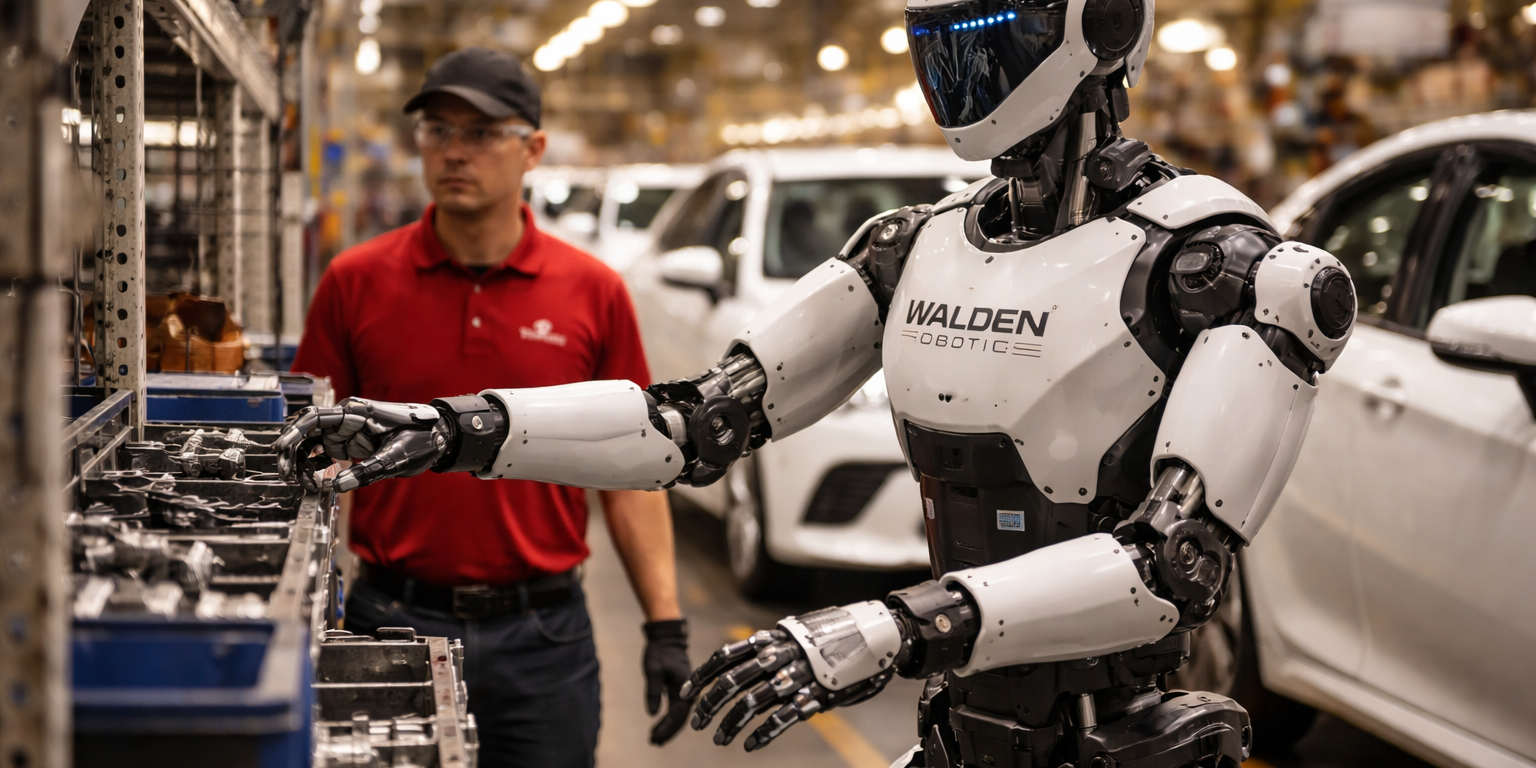
Google DeepMind released Gemini Robotics 2 this week, framing the system as an intelligence layer designed to power commercial robots entering service deployments rather than a research demonstration. The timing coincides with pilot programs from humanoid makers including Figure AI, Apptronik, and 1X Technologies scheduled to expand from dozens of units to hundreds across warehouse and manufacturing facilities before year-end. Unlike previous foundation models released primarily for academic study, DeepMind positions this iteration as infrastructure for OEMs and integrators building production systems.
The company disclosed few technical specifications in the announcement, avoiding publication of benchmark scores, training dataset composition, or inference latency figures that would allow direct comparison to competing systems from OpenAI, Tesla, or Sanctuary AI. Industry observers note this marks a shift from DeepMind's traditional approach of detailed technical papers accompanying major releases. The sparse disclosure suggests commercial partnerships may carry confidentiality requirements, or that Google seeks to avoid direct feature-by-feature comparisons while partners conduct internal evaluations. Representatives did not respond to requests for clarification on model architecture, parameter count, or whether the system shares core infrastructure with the consumer-facing Gemini 2.0 released earlier this year.
Several robotics companies confirmed active evaluation of the platform under non-disclosure agreements signed in recent months, though none would discuss specific capabilities or implementation timelines on the record. Sources at two humanoid manufacturers indicated the intelligence layer handles multi-modal perception, natural language task specification, and motion planning, but relies on partner-provided low-level control systems for balance, locomotion, and manipulator kinematics. This architectural division resembles arrangements Tesla established with Optimus pilot customers and the approach Nvidia outlined in Project GR00T demonstrations at GTC in March. The model's ability to generalize across different robot morphologies remains unclear, with early testing focused primarily on humanoid form factors and mobile manipulators rather than specialized industrial systems.
Industry implications extend beyond Google's immediate commercial prospects. The release intensifies pressure on robotics startups that previously differentiated on AI capabilities to demonstrate value in hardware design, manufacturing cost structure, or vertical-specific tuning. Investors have poured $4.7 billion into humanoid robotics companies since January 2024, with many business models predicated on proprietary AI moats that may erode if foundation model providers offer comparable capabilities as infrastructure services. Boston Dynamics, which ships Atlas primarily as a research platform, faces questions about whether its decades of locomotion expertise translates to commercial advantage if customers can license sophisticated intelligence from hyperscalers. Physical AI, the San Francisco-based startup that raised $400 million at a $2.4 billion valuation in April, explicitly structured its pitch around owning the full stack from silicon to software—a strategy that looks prescient as vertically-integrated players gain traction. The shift toward intelligence-as-a-service could accelerate hardware commoditization, particularly for general-purpose platforms lacking specialized sensors, actuators, or environmental hardening.
What to Watch: DeepMind will likely announce commercial partnerships at the Actuate conference in San Francisco on August 18-19, where several humanoid manufacturers hold speaking slots. Monitor Figure AI's earnings call in September for commentary on AI partnerships following the company's March announcement of OpenAI integration. Track whether Tesla opens its humanoid training infrastructure to third parties at the IROS conference in Pittsburgh starting September 27, which would signal broader industry movement toward separated intelligence and embodiment layers.