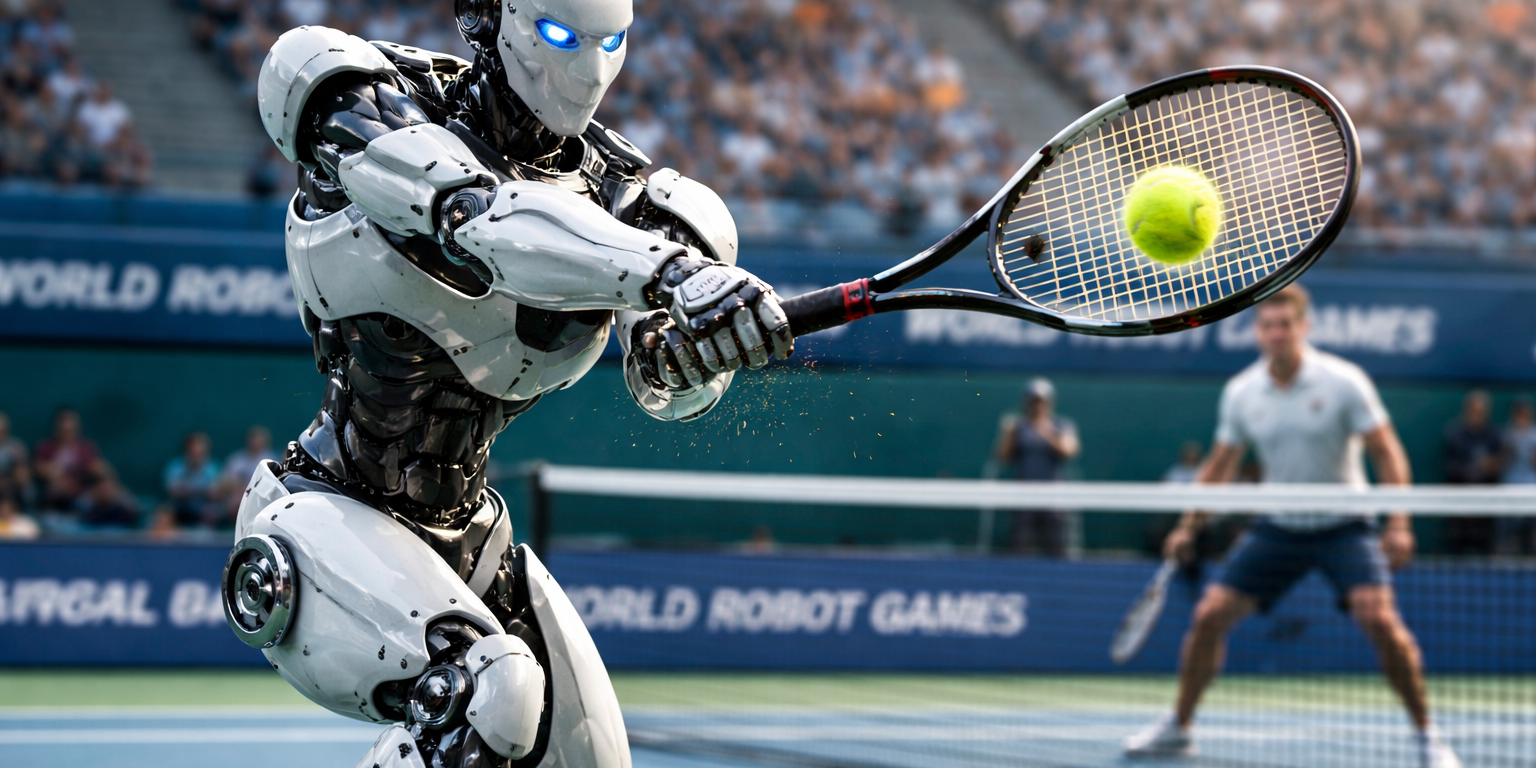
More than 100 consecutive rallies separated Beijing-based Galbot's humanoid robots from their human opponents before the exchange broke down during a live tennis match staged August 23 at the opening ceremony of the second World Humanoid Robot Games. The company claims the sustained rally represents a world record for autonomous humanoid tennis, a feat that required the machines to track high-speed projectiles, reposition themselves across the court surface, and execute forehand and backhand strokes without pre-programmed sequences. The demonstration aired to a global audience and positions Galbot alongside a growing cohort of Chinese robotics firms targeting sports applications as a proving ground for dynamic mobility and real-time perception systems.
The technical demands of autonomous tennis exceed those of most controlled industrial tasks. A regulation tennis ball travels at speeds approaching 70 miles per hour during recreational play, faster still in competitive settings. Humanoid platforms must process visual data quickly enough to predict ball trajectory, calculate intercept points, and coordinate bipedal locomotion across an uneven or textured surface while maintaining balance through rapid directional changes. The fact that Galbot's systems sustained triple-digit rally counts suggests the company has solved latency problems that typically plague vision-to-motion pipelines in untethered humanoid hardware. Most publicly demonstrated humanoid sports capabilities to date, including soccer and basketball trials from Boston Dynamics and Agility Robotics, have involved slower-moving objects or shorter interaction sequences.
Galbot has not disclosed the specific sensor suite, compute architecture, or control algorithms powering the tennis-playing units. The company's prior work centers on service and entertainment applications, a category where Chinese manufacturers have outpaced Western counterparts in commercial deployments over the past three years. The World Humanoid Robot Games, held in Beijing for the second consecutive year, functions as both a competitive showcase and a recruitment platform for the country's rapidly expanding robotics sector. Participants include industrial giants like UBTECH and emerging ventures backed by state-linked venture funds. Staging the tennis demonstration during the opening ceremony signals Galbot's intent to position itself as a credible player in dynamic manipulation and real-time autonomy, capabilities that translate directly to warehouse automation, eldercare, and disaster response markets.
The milestone arrives as multiple humanoid developers worldwide race to demonstrate general-purpose dexterity in unstructured environments. Tesla's Optimus program recently showcased object sorting and basic assembly tasks. Figure AI has focused on warehouse logistics partnerships with BMW and other automakers. Sanctuary AI emphasizes teleoperation-to-autonomy workflows in retail settings. None have publicly demonstrated sustained athletic performance at the rally counts Galbot claims, though Boston Dynamics' Atlas platform has executed parkour sequences and gymnastic routines that require similar real-time balance recovery. The difference lies in continuous interaction with an external agent. Tennis demands predictive modeling of an opponent's behavior, not just obstacle avoidance or pre-scripted choreography. Whether Galbot's system can generalize beyond tennis to other adversarial or collaborative tasks remains an open question, but the rally count provides a quantifiable benchmark that competitors will now attempt to exceed.
What to Watch: Galbot has not announced commercial availability or pricing for the tennis-capable units, but technical specifications and partner announcements typically follow high-profile demonstrations within 60 to 90 days. Watch for competing claims from UBTECH, which has demonstrated soccer and ping-pong capabilities in humanoid form factors, and from international players like Agility Robotics, whose Digit platform targets similar dynamic environments. The third World Humanoid Robot Games, likely scheduled for summer 2027, will reveal whether the 100-rally threshold becomes a standardized benchmark for evaluating real-time autonomy across the industry.