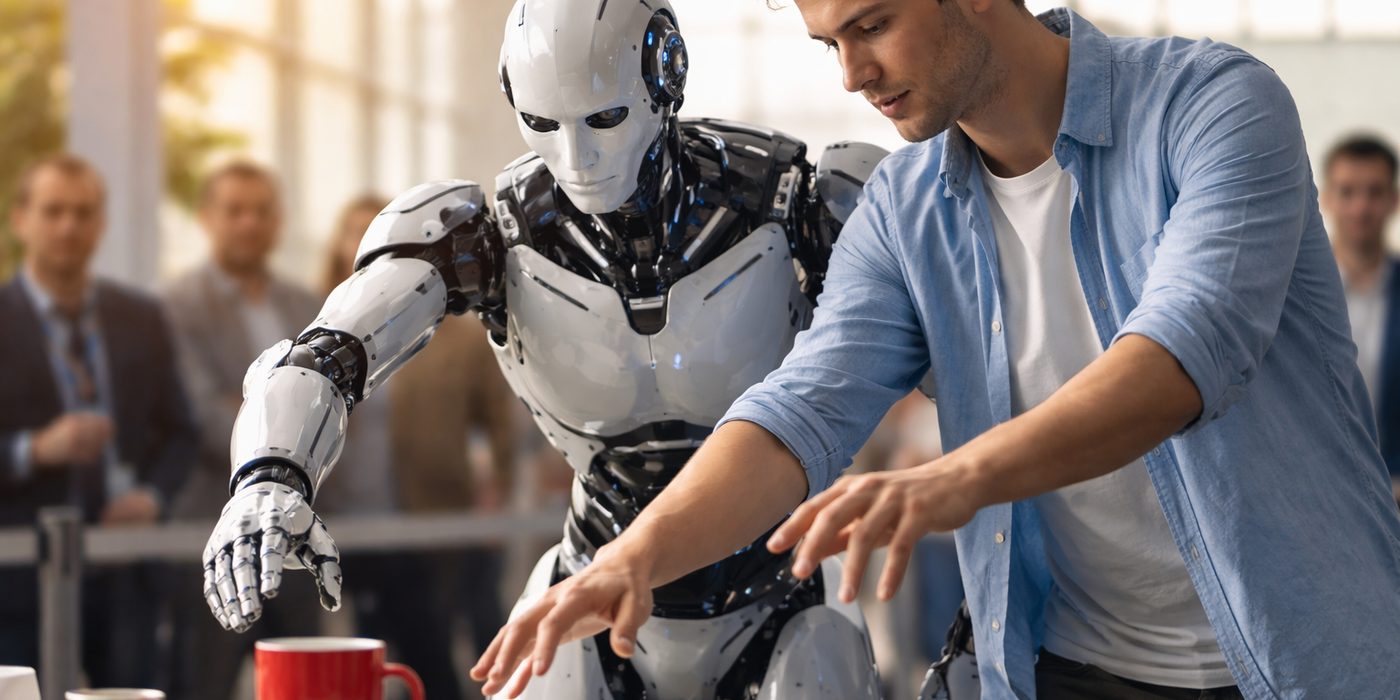
The most consequential line in Galbot's award entry is not the prize category. It is the absence of a piece of equipment. According to the company's submission, the ET1 humanoid learns skills from human demonstration without motion capture, the suit-and-camera-rig apparatus that has become the default, and expensive, way to teach humanoid robots to move like people. The entry earned Galbot a Best of Innovation designation in robotics at the CES Innovation Awards 2027, one of the highest tiers in the Consumer Technology Association's program ahead of the Las Vegas show in January 2027. The honor is a judged-entry award, not a field-performance benchmark, and the distinction matters when reading what it proves.
To understand why a robotics engineer would care about the omission, consider how humanoid training works today. Teleoperation rigs, optical mocap stages, and wearable sensor suits generate the demonstration data that imitation-learning policies consume. Every one of those methods carries a cost in hardware, operator hours, calibration, and floor space, and every one introduces a bottleneck between a human showing a task and a robot reproducing it. Companies from Tesla to Figure AI to Chinese rivals such as UBTech and Unitree have all wrestled with how to collect enough high-quality manipulation data to make a general-purpose body useful. A method that sidesteps the capture stage would, in principle, let operators teach tasks the way a supervisor shows a new hire: by doing the job once in front of them.
Galbot is not a newcomer to the pressure that comes with that ambition. The Beijing company has positioned itself as a builder of embodied-AI systems aimed at commercial settings rather than research labs, and it has attracted substantial venture backing in a funding climate where Chinese humanoid makers have raised capital at a pace that has drawn scrutiny from regulators and analysts alike. What the award entry describes, learning from demonstration without mocap, fits a broader shift in the field toward vision-driven policy learning, where models infer motion and intent from video and sensor streams instead of relying on instrumented ground truth. The published summary, however, offers no accuracy figures, no task success rates, and no data on how many demonstrations the ET1 needs to acquire a new skill.
That gap is the thing a skeptical investor should sit with. Demonstration-based learning is easy to show on a stage and difficult to deliver in a warehouse, where lighting changes, objects vary, and a policy that works nine times in ten still fails the customer. The relevant questions are quantitative. How many human demonstrations does a new task require? How well does a learned skill transfer to a slightly different shelf height or a differently shaped tote? What happens to performance when the demonstrator is a different person than the one who trained the model? Awards committees evaluate novelty and design; buyers evaluate uptime and cost per task. Those are different scorecards, and the ET1 has so far been graded on the first.
Still, the recognition carries commercial weight in a market that rewards visibility. CES remains the most-watched consumer and enterprise technology showcase in the world, and Best of Innovation designations tend to translate into press attention, distributor inquiries, and leverage in partnership talks. For Galbot, which competes in a crowded humanoid field against better-known Western names and a fast-moving domestic cohort, that attention is a form of currency. The larger implication is about where the industry's bottleneck sits. If training data, rather than actuator quality or battery density, is now the binding constraint on humanoid usefulness, then the companies that crack cheap, scalable skill acquisition will set the pace for everyone else, and the competitive map redraws around software and data rather than hardware alone.
What to Watch Watch for Galbot's CES 2027 booth in Las Vegas in January, where live demonstrations will show whether the no-mocap learning claim holds under unscripted conditions and how many demonstrations a new task actually requires. Track whether the company publishes task success rates, transfer results, or a technical paper detailing the learning method, since the current claim rests on a summary rather than disclosed benchmarks. Monitor announcements of paying commercial deployments in retail, logistics, or manufacturing through the first quarter of 2027, along with any new funding round that would reveal how investors are valuing demonstration-learning against teleoperation-heavy competitors such as Figure AI and Tesla's Optimus program.