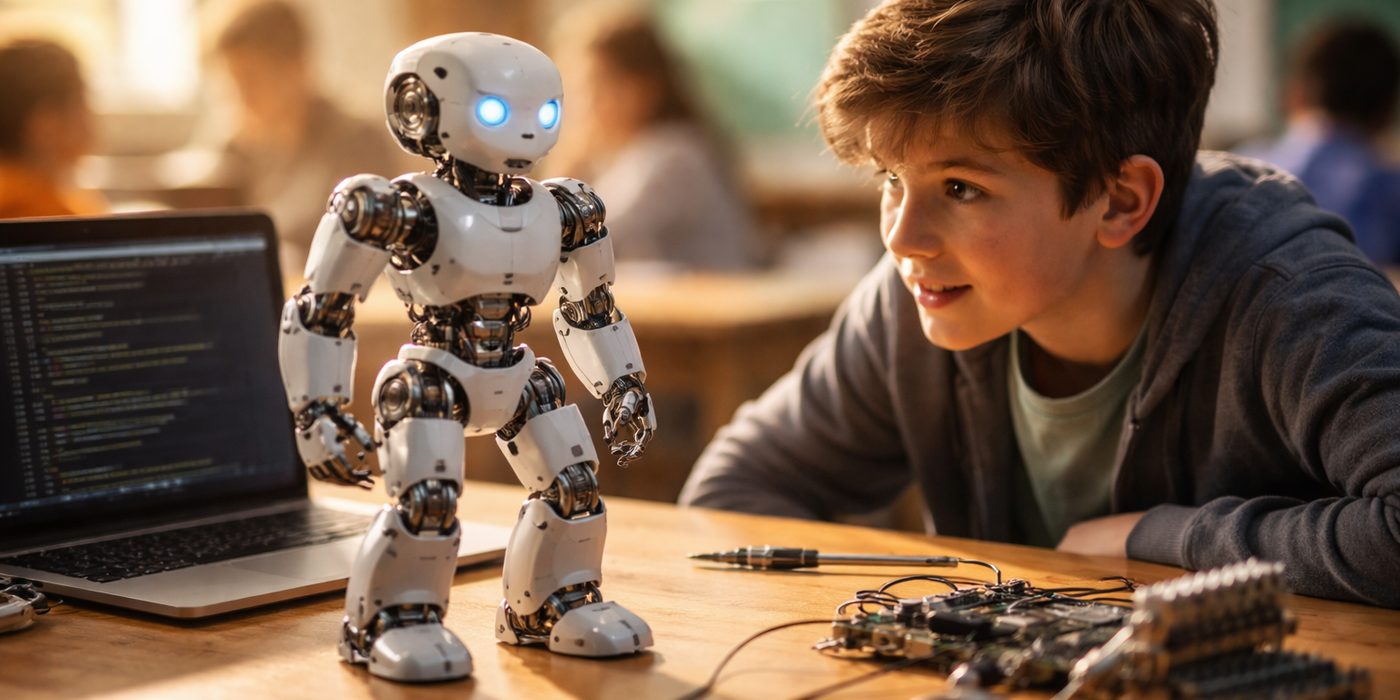
A deposit of $200 buys a place in line for a humanoid robot that does not yet have a delivery date. That is the offer from StarBot Robotics, the Santa Barbara company taking reservations for Spark, a three-foot humanoid built in the United States and priced from $7,999. The company is pitching it at two audiences: schools that want a physical robot students can program, and developers who want a small bipedal platform on the desk rather than a six-figure research machine in a lab. No ship window has been published, and no technical specification sheet of the kind engineers expect has accompanied the announcement.
The pricing is the story. For most of the last decade, a humanoid with any claim to real articulation meant a budget in the tens of thousands at minimum, and often far more. Research-grade platforms from established vendors have long sat out of reach for all but well-funded university labs and corporate R&D groups. Spark's $7,999 entry point puts it in a band that a school district's equipment line, a maker space, or a single engineer's discretionary budget can plausibly absorb. It also puts StarBot in direct comparison with the small humanoids coming out of China, where Unitree and others have spent two years compressing both cost and size, and where the price floor keeps dropping.
That comparison is where the American-built label either earns its keep or doesn't. StarBot is leaning on domestic manufacturing as a differentiator, and for a certain buyer it carries weight. Public school procurement, federally funded university programs, and defense-adjacent research groups increasingly face restrictions or at least heightened scrutiny around hardware sourced from certain foreign suppliers. A small humanoid that can be bought without that paperwork has a real, if narrow, market. The harder question is whether US assembly can hold a price near $8,000 once volume, component sourcing, and warranty costs are accounted for. Domestic production of actuators, the single most expensive element of any legged robot, remains thin, and StarBot has not said where its joints, batteries, or compute come from.
The education angle is the more defensible half of the pitch, and also the more crowded one. Classroom robotics is a market with entrenched incumbents and a long history of products that dazzle at launch and gather dust by spring. Teachers need curriculum, durable hardware, repair channels, and software that works on managed school networks, not just an impressive demo video. Developers want something different: open interfaces, documented APIs, and a reasonably capable onboard computer. Serving both with one three-foot platform is a hard balance. A reservation system with a $200 deposit is a sensible way to gauge which audience shows up first, and the answer will shape whether StarBot becomes an education company or a developer-tools company. Neither is a bad outcome. But they imply very different software roadmaps, and the company has not yet said which it intends to prioritize.
What to Watch
The first marker is whether StarBot publishes a delivery date and a full specification sheet, including degrees of freedom, battery life, onboard compute, and payload, since a $7,999 price means little without them. Watch for a developer SDK or public documentation, which would signal how seriously the company is courting engineers over educators. Track the pricing of comparable small humanoids from Unitree and other vendors through the 2026 holiday buying season, because any further price cuts there will squeeze Spark's value case. Finally, look for the first named school district, university, or distributor partner; a single credible institutional customer would say more about Spark's prospects than the reservation count ever will.