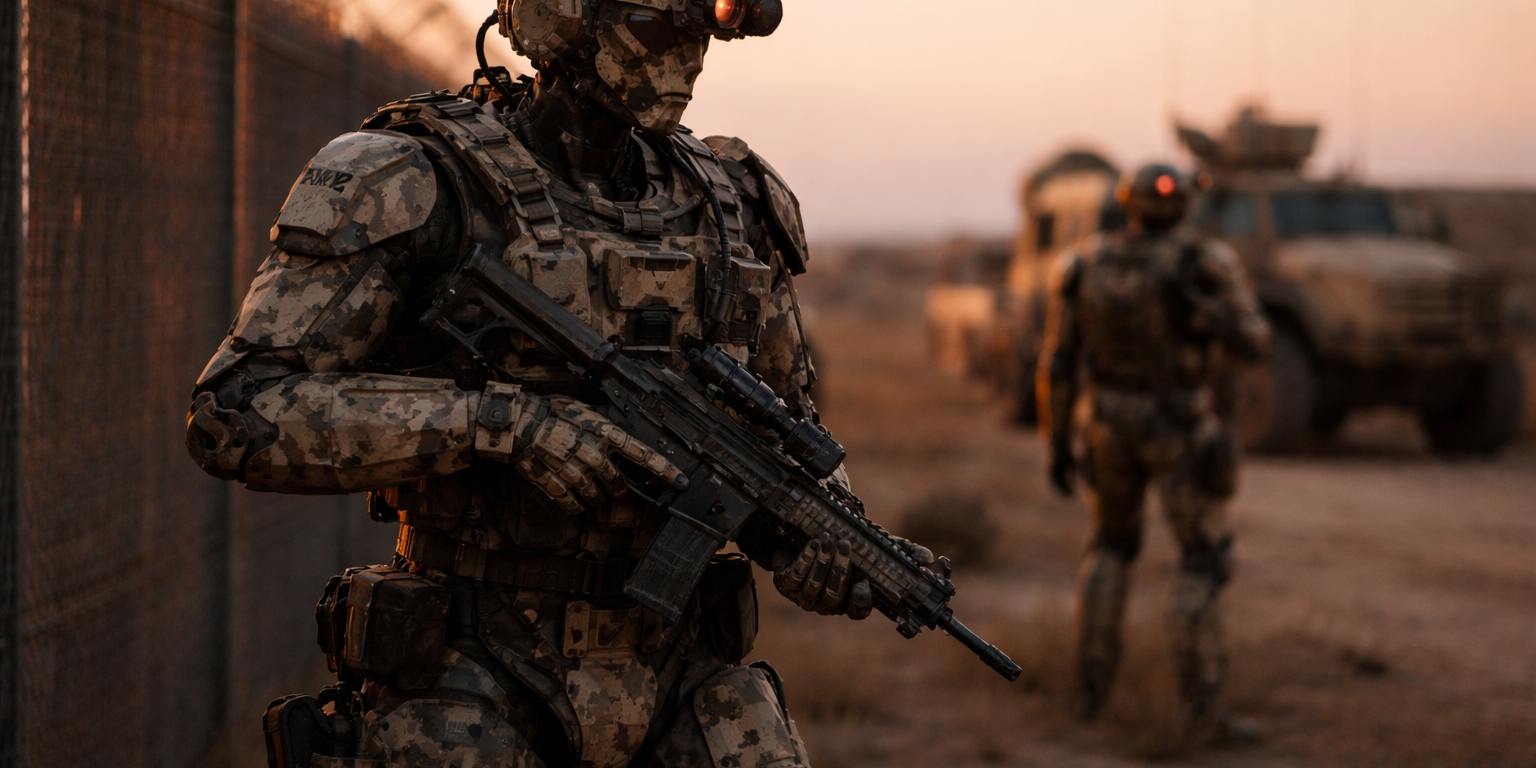
Foundation Robotics holds $24 million in active Department of Defense contracts for its Phantom humanoid war robot, a platform built around AMD Ryzen AI processors rather than the NVIDIA Jetson modules that power most commercial humanoid platforms. The company disclosed the contract value as it transitions from field trials to mass production, a shift that places AMD's embedded AI silicon in direct competition with NVIDIA for military-grade autonomous systems. The Phantom stands 5 feet 9 inches tall, weighs 132 pounds, and is designed for reconnaissance, perimeter security, and logistics operations in contested environments. Foundation has not disclosed per-unit pricing, but defense industry sources estimate the Phantom costs between $180,000 and $240,000 per unit depending on sensor and communications packages.
Foundation Robotics emerged from stealth in late 2024 with backing from Andreessen Horowitz and Lux Capital, raising $42 million in a Series A round led by a16z's American Dynamism fund. The company was founded by former Boston Dynamics engineers Marcus Chen and Priya Navarro, who left in 2023 after disagreements over Boston Dynamics' policy against weaponized applications of its Atlas and Spot platforms. Foundation explicitly targets military and law enforcement customers, a positioning that sets it apart from Figure AI, 1X Technologies, and Apptronik, all of which focus on commercial and industrial deployments. The company operates a 47,000-square-foot facility in Huntsville, Alabama, adjacent to Redstone Arsenal, and employs 83 people as of June 2026. It has delivered 14 Phantom units to the Army Research Laboratory for evaluation and expects to ship 60 additional units to an undisclosed Special Operations Command customer by December 2026.
The decision to build the Phantom around AMD Ryzen AI processors reflects both technical and strategic considerations. AMD's Ryzen AI 300 series, introduced in mid-2024, integrates a neural processing unit capable of 50 TOPS (trillion operations per second) alongside x86 CPU cores and RDNA graphics. Foundation's chief technology officer, Elias Volk, told RoboticsIntl.com that the architecture allows the Phantom to run transformer-based perception models locally without requiring constant connectivity to cloud infrastructure, a critical requirement for operations in communications-denied environments. The Ryzen platform also supports DirectML and ONNX Runtime, enabling Foundation to deploy models trained on standard datacenter hardware without architecture-specific retraining. NVIDIA's Jetson AGX Orin, by contrast, delivers 275 TOPS but requires CUDA-specific optimization and costs approximately $1,800 per module compared to AMD's sub-$600 pricing for equivalent Ryzen AI configurations. Foundation runs a custom Linux distribution built on Ubuntu 24.04 LTS with real-time kernel patches, and the software stack includes ROS 2 Jazzy for middleware, MuJoCo for simulation, and proprietary vision and manipulation modules.
The broader defense robotics market is fracturing along hardware and policy lines as commercial humanoid developers avoid military applications while specialized defense contractors pursue autonomous platforms with limited public disclosure. Anduril Industries has shipped an undisclosed number of its Anvil autonomous ground vehicles to Ukraine, and Shield AI's V-BAT autonomous VTOL aircraft has logged over 30,000 flight hours in operational environments. Boston Dynamics maintains its policy against weaponization even as Hyundai, its parent company, supplies military vehicles to South Korea. Figure AI CEO Brett Adcock has stated publicly that Figure will not pursue defense contracts, a stance echoed by 1X Technologies CEO Bernt Børnich. The vacuum creates an opening for startups willing to navigate the political and ethical scrutiny that accompanies autonomous weapons development. Foundation Robotics has not disclosed whether the Phantom includes lethal capabilities, but defense procurement documents describe the platform as compatible with modular payload interfaces that can accommodate sensors, communications equipment, or unspecified effectors. The company's investor base includes several venture firms with active defense portfolios, including Lux Capital, which backed Anduril and Hadrian, and Shield Capital, which focuses exclusively on national security technology.
What to Watch: Foundation Robotics is expected to announce a Series B funding round in Q3 2026, with reports suggesting Founders Fund and General Catalyst are conducting due diligence. The Army's xTechROBO competition results, scheduled for release in September 2026, may include additional contracts for Foundation or competing platforms from Ghost Robotics and Sarcos Robotics. AMD is likely to announce defense-specific Ryzen variants with enhanced security features and extended temperature ranges at its Advancing AI event in November 2026.