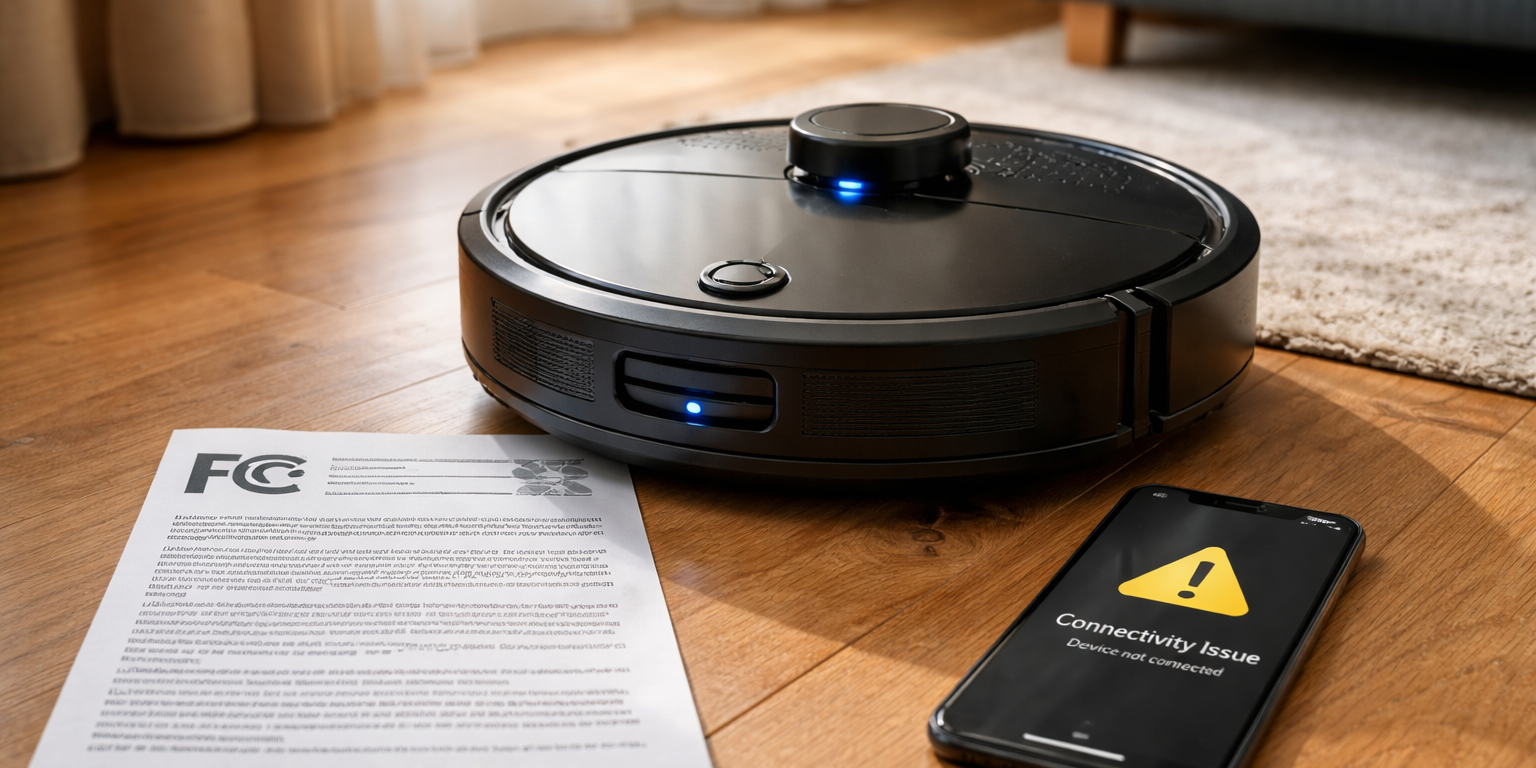
Robot vacuum manufacturers face an unexpected compliance burden after the Federal Communications Commission published guidance extending foreign equipment restrictions to consumer robotics products. The clarification of Section 2.903, issued as part of the agency's ongoing implementation of the Secure and Trusted Communications Networks Act, brings devices like iRobot Roomba units, Ecovacs Deebot models, and Roborock vacuums under the same national security framework previously applied to cellular base stations and networking gear from companies designated as threats to U.S. communications infrastructure. The guidance does not ban specific products outright but requires manufacturers to certify that covered components do not originate from entities on the FCC's Covered List, which currently includes five Chinese companies: Huawei Technologies, ZTE Corporation, Hytera Communications, Hangzhou Hikvision Digital Technology, and Dahua Technology.
The FCC's interpretation hinges on how broadly it defines "communications equipment." Any device capable of transmitting data over radio frequencies or internet protocols now falls within scope if it connects to a network, a threshold that captures nearly every consumer robot sold in North America. Robot vacuums communicate via WiFi or Bluetooth to mobile applications for scheduling, mapping, and remote control. Lawn maintenance robots like those from Husqvarna and Worx use GPS and cellular connectivity for boundary definition and theft prevention. Home security robots from companies including Amazon's Astro rely on cloud infrastructure for video processing and voice interaction. The guidance clarifies that the FCC considers the cumulative connectivity and data transmission capabilities of these devices, not merely their primary function, when determining whether authorization rules apply.
Compliance requires manufacturers to submit detailed documentation tracing the origin of chips, sensors, communications modules, and software to the FCC during the equipment authorization process. For companies that design in the United States or Europe but manufacture in China, as most consumer robotics firms do, this creates a documentation challenge. iRobot, acquired by Amazon for $1.7 billion in August 2022, manufactures Roomba vacuums in Malaysia and China. Ecovacs, headquartered in Suzhou, produces its entire Deebot line domestically in China. Roborock, another Chinese manufacturer with significant U.S. market share, operates production facilities in Shanghai and surrounding provinces. While none of these companies appear on the Covered List, their supply chains intersect with Chinese component suppliers that may use semiconductors, wireless modules, or firmware tools from covered entities. The FCC has not published detailed guidance on how deeply manufacturers must audit subcomponent origins, leaving companies to interpret the requirement conservatively.
Industry observers note the timing aligns with broader federal scrutiny of Chinese robotics and artificial intelligence in consumer applications. The Commerce Department added several Chinese AI companies to its Entity List in late 2025, restricting their access to advanced U.S. semiconductors. The Treasury Department proposed new rules in early 2026 requiring disclosure of foreign ownership in companies developing autonomous systems. The FCC's guidance does not create new statutory authority but applies existing law more expansively, a regulatory approach that avoids the public comment period required for formal rulemaking. Consumer robotics companies now face a patchwork of overlapping requirements across multiple agencies, each with different definitions of covered technology and distinct compliance pathways. The Federal Trade Commission separately opened an investigation into data collection practices by robot vacuum manufacturers in June 2026, examining how mapping data, video streams, and usage patterns flow to cloud servers and whether consumers understand the privacy implications.
What to Watch: The Consumer Technology Association plans to file formal comments by September 15, 2026, requesting clearer component-level guidance and safe harbor provisions for manufacturers that use only commercially available chips. iRobot indicated it will publish a supply chain transparency report before the 2026 holiday season. Meanwhile, at least three U.S.-based robotics startups, including Matic (which raised a $24 million Series A in March 2026), are marketing domestic manufacturing as a compliance differentiator for enterprise and government customers concerned about regulatory risk.