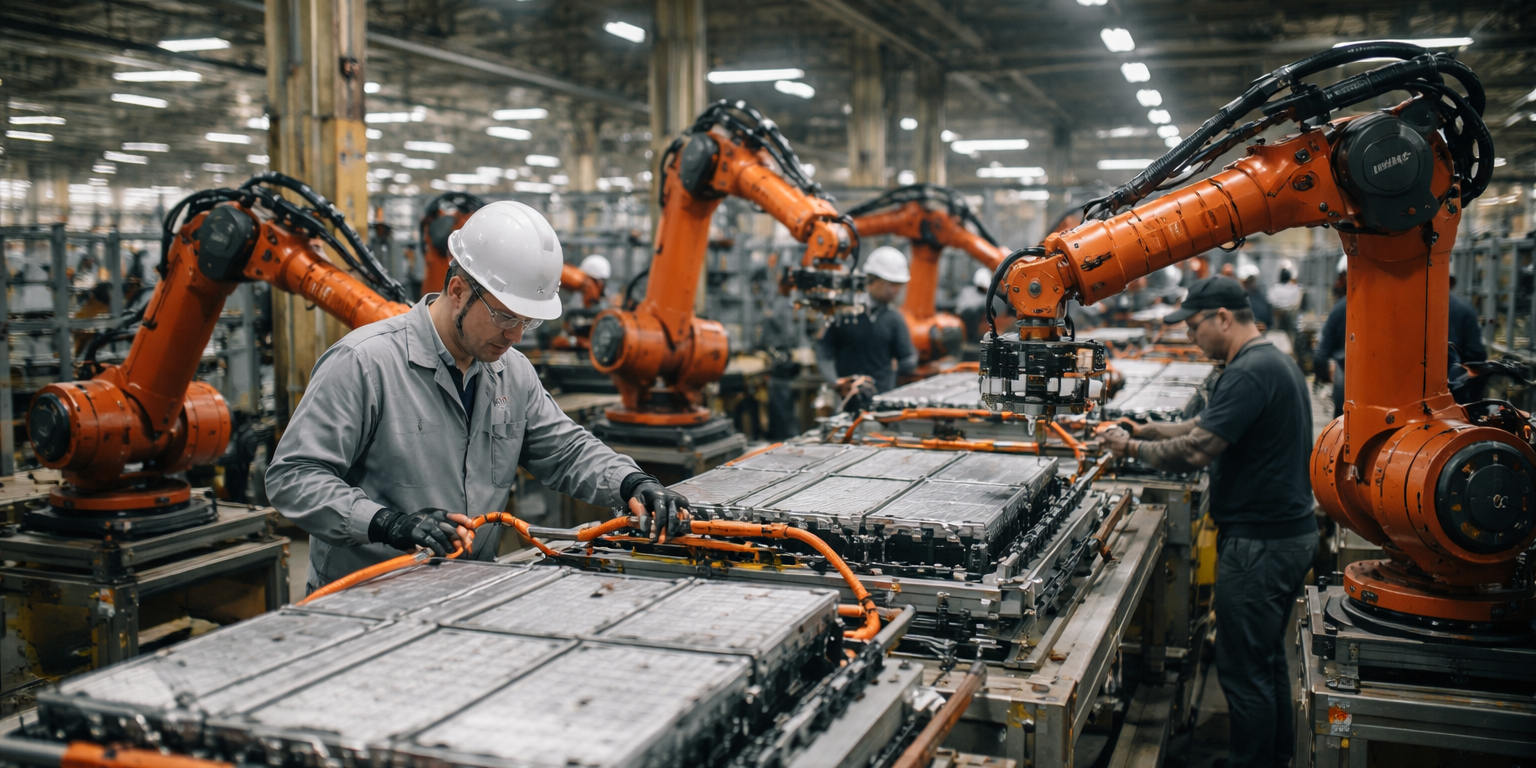

A robot on a factory floor can weld the same joint 10,000 times without error. Ask it to adapt when a part arrives two millimeters off-spec, and the production line stops. FANUC, the Rochester Hills manufacturer that supplies roughly one-third of the world's industrial robots, announced May 19 it will integrate Google's AI agent technology to address exactly that limitation. The partnership targets what both companies describe as Physical AI—systems where foundation models make real-time decisions about physical tasks rather than simply generating text or images. FANUC operates more than 850,000 robots across automotive plants, electronics assembly lines, and general manufacturing facilities. Google brings foundation models trained on massive datasets, plus reinforcement learning techniques developed through DeepMind. The deal positions Google against industrial AI startups and established automation software vendors while giving FANUC a differentiated offering as competitors like ABB, KUKA, and Yaskawa expand their own AI capabilities.
The technical division of labor appears designed to keep FANUC's core competency—motion control and safety systems—intact while layering Google's AI on top for higher-level reasoning. FANUC has spent decades perfecting servo motors, encoders, and closed-loop control systems that position robot arms within fractions of a millimeter. Those systems will continue handling real-time motion planning and emergency stops. Google's AI agents will sit above that layer, interpreting sensor data, making decisions about task sequencing, and adjusting to variations in parts, lighting, or tool wear. Neither company disclosed whether the AI runs locally on FANUC controllers or requires cloud connectivity, a critical detail for manufacturers wary of network dependency in production environments. The architecture likely mirrors approaches seen in warehouse robotics, where cloud-based planning systems send high-level commands to edge devices that execute motion safely. FANUC's customer base includes automotive manufacturers running lights-out shifts where network outages cannot halt production, so any cloud dependency will face scrutiny.
Manufacturing automation has long operated on a programming paradigm: engineers define every motion, decision point, and error recovery sequence before a robot performs its first production cycle. A single production line might require months of programming by specialists who command hourly rates exceeding $200. Changeovers—switching a line from one product variant to another—can take days or weeks as programmers rewrite routines and test edge cases. Large language models and reinforcement learning offer a different approach. Rather than explicitly programming each step, engineers could describe tasks in natural language or demonstrate them physically, then let the AI agent generate and refine the control logic. Google has demonstrated similar capabilities in research settings, including work where robots learned manipulation tasks through a combination of simulation, real-world trial and error, and transfer learning from language models. The economic case is straightforward: if AI agents can cut programming time by 50 percent or enable changeovers in hours instead of days, manufacturers gain flexibility to run smaller batches and respond faster to demand shifts. Automotive suppliers, which often produce dozens of part variants on the same line, represent an obvious early market.
The stakes extend beyond FANUC and Google. ABB invested in Covariant, a warehouse robotics AI company, before Covariant's recent acquisition by Amazon. KUKA has partnered with NVIDIA on AI-enabled robot programming tools. Yaskawa has developed vision-guided systems that adjust to part variations. Universal Robots, the Danish collaborative robot manufacturer, has emphasized ease of programming as a core selling point, positioning non-AI simplicity against AI-driven complexity. If FANUC's Google-powered agents prove reliable in high-volume production—a tougher test than warehouse picking or bin sorting—the competitive pressure on other robot manufacturers will intensify. Industrial software companies face pressure too. Siemens, Rockwell Automation, and Schneider Electric all sell programming and simulation tools for robot cells. Foundation model-based agents could disintermediate portions of that software stack, particularly if Google prices the AI capability as a subscription service bundled with FANUC hardware. The partnership also signals Google's broader ambition in physical AI, following DeepMind's robotics research and Google Cloud's manufacturing analytics offerings. Unlike consumer applications where occasional errors frustrate users but rarely cause physical damage, factory robots operate near human workers and handle materials worth thousands of dollars per unit. Reliability thresholds are unforgiving.
What to Watch: Track whether FANUC and Google announce specific customer deployments or pilot programs within the next 90 days, particularly in automotive or electronics manufacturing where part variability and changeover speed matter most. Watch for technical disclosures about cloud versus edge deployment, which will reveal how the companies balance AI capability against network dependency concerns. Monitor whether competitors like ABB, KUKA, or Yaskawa announce similar partnerships or in-house AI agent development, indicating the collaboration has shifted industry expectations about AI's readiness for production environments.