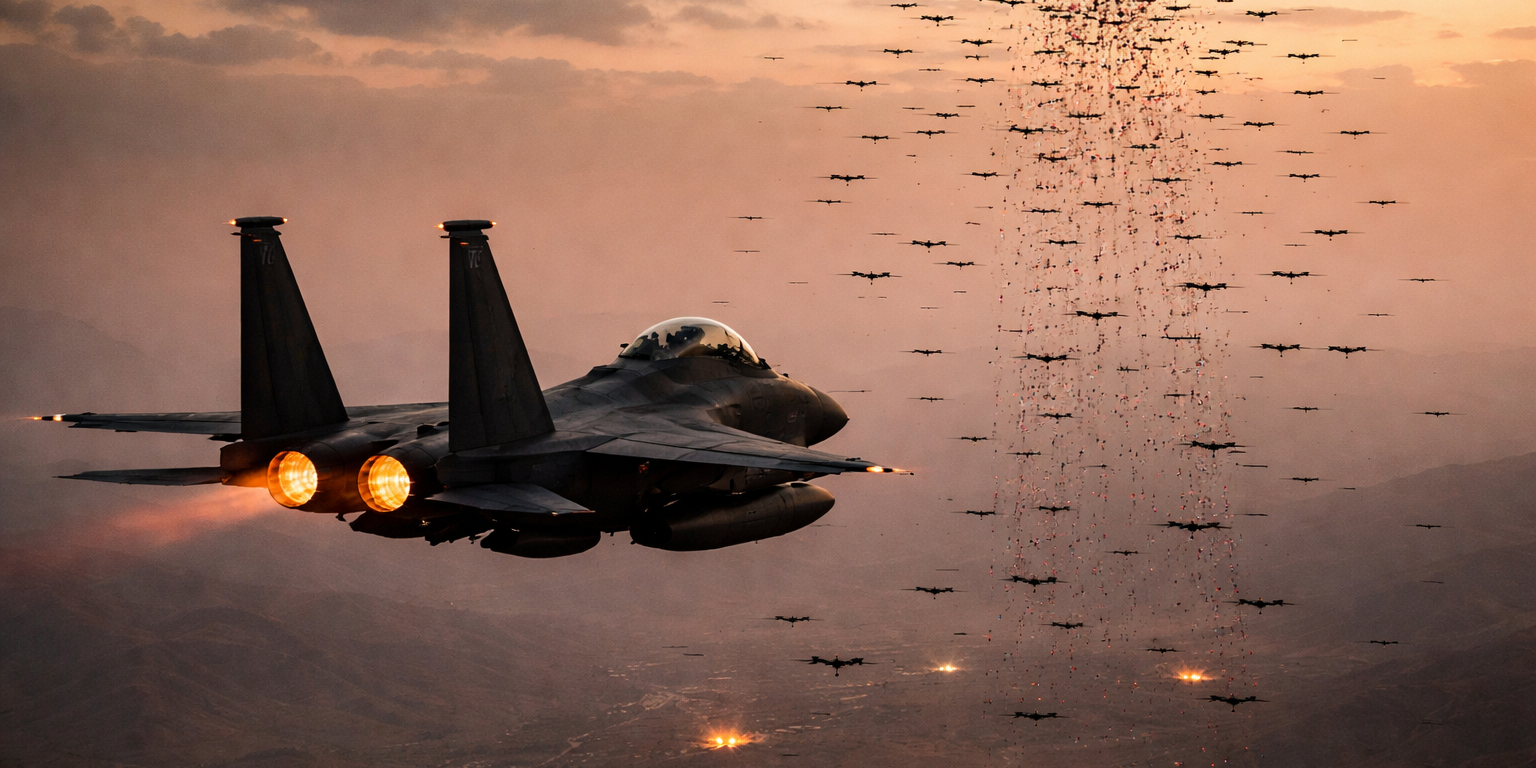
A U.S. Air Force F-15E Strike Eagle pilot reported seeing a swarm of drones arranged in what sources described as a jellyfish-like pattern moments before the aircraft went down over Iran, according to accounts emerging from the incident. One source with knowledge of the pilot's debriefing characterized the aerial formation as resembling a minefield, suggesting a deliberate spatial distribution designed to saturate a volume of airspace rather than concentrate firepower at specific coordinates. The description marks one of the first detailed pilot observations of coordinated drone swarm tactics deployed in active air defense operations, offering a rare window into how autonomous or semi-autonomous systems are being arrayed against manned aircraft in contested environments.
The jellyfish analogy points to a vertical deployment pattern, with drones potentially stacked at varying altitudes and lateral positions to create overlapping sensor coverage or kinetic threat zones. This differs from the linear or grid formations typically associated with drone operations in lower-threat reconnaissance missions. Military aviation experts note that such a configuration would complicate evasion maneuvers, as any deviation from planned flight paths to avoid one drone could bring the aircraft into engagement range of another. The spatial density of the formation, described as a minefield, suggests Iran may be fielding loitering munitions or interceptor drones in quantities sufficient to create persistent aerial barriers rather than relying on point defense systems. The tactic mirrors concepts explored in U.S. Defense Advanced Research Projects Agency studies on denied area suppression, though operational deployment of such systems at scale has remained largely theoretical in Western military planning until now.
Iran has invested heavily in unmanned systems since international sanctions and arms embargoes limited access to advanced manned fighter platforms. The country's defense industry has showcased dozens of indigenous drone models over the past decade, ranging from small quadcopters to turboprop-powered strike platforms like the Shahed-129. However, the coordination required to deploy a swarm in a structured formation over a specific airspace volume represents a significant leap in command and control infrastructure. Each drone must maintain positional awareness relative to others in the formation while responding to dynamic threats, a challenge that typically requires either robust communications links or sophisticated onboard processing. Western analysts have long debated the maturity of Iran's drone autonomy capabilities, with some assessments suggesting reliance on pre-programmed waypoints rather than real-time adaptation. The pilot's account, if accurate, indicates either a breakthrough in Iranian swarm coordination algorithms or support from an external technology supplier with more advanced capabilities.
The operational implications extend beyond the immediate loss of one aircraft. Air superiority planning has historically assumed that defensive systems occupy fixed positions or follow predictable trajectories, allowing strike packages to identify and exploit gaps in coverage. A swarm that can be rapidly deployed to create an aerial denial zone upends those assumptions, particularly if the drones are expendable enough to be employed in large numbers without prohibitive cost. Each F-15E carries a replacement value exceeding $100 million when accounting for avionics upgrades and weapons systems, while estimates place Iranian loitering munitions production costs between $20,000 and $200,000 per unit depending on sophistication. The cost-exchange ratio favors the defender by orders of magnitude, a dynamic that could force changes in mission planning, platform selection, and the broader calculus of acceptable risk in contested airspace. Defense contractors with counter-swarm technologies under development, including Raytheon's Coyote interceptor and Leonardo DRS's kinetic defeat systems, may see accelerated interest from program offices reassessing threat models in light of this incident.
What to Watch: Monitor U.S. Central Command statements for any official acknowledgment of drone swarm encounters and whether tactical guidance to aircrews operating in the region gets updated. Track whether Northrop Grumman, Lockheed Martin, or other prime contractors announce accelerated timelines for integrating counter-swarm sensors or directed energy weapons on existing fighter platforms. Watch for any disclosed changes to aerial refueling routes or combat air patrol altitudes that would indicate revised threat assessments. Iran's defense ministry rarely publicizes operational successes immediately, but state media announcements over the next 60 to 90 days may offer clues about which drone models were involved and whether the formation tactic becomes a repeatable element of their integrated air defense strategy.