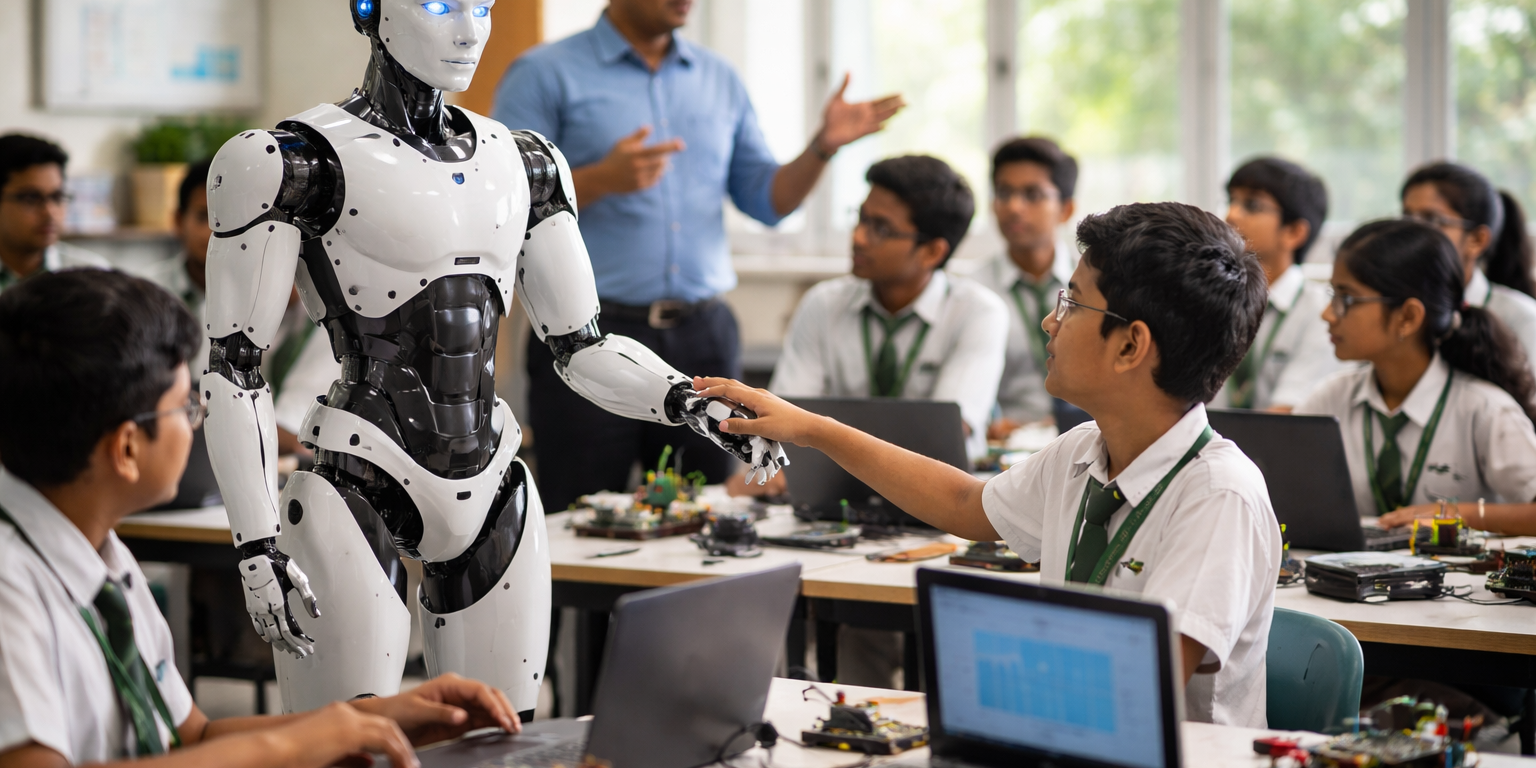
A humanoid robot now stands in a secondary school classroom in Kolkata, part of a lab deployment at Delhi Public School Ruby Park that signals how India's revised education policy is forcing hardware decisions at the institutional level. The school opened its AI-Robotics Lab earlier this month, equipping the facility with the humanoid unit alongside workstations for programming and sensor integration projects. The lab serves students from middle school through senior secondary grades, with lesson plans built around hands-on interaction with the robot rather than purely theoretical instruction. School administrators framed the investment as compliance with National Education Policy 2020 requirements, which call for technology and vocational training to be woven into core curricula rather than treated as elective coursework.
The policy shift has created a procurement wave across Indian schools, particularly those affiliated with the Central Board of Secondary Education and the Council for the Indian School Certificate Examinations. Both boards have issued updated guidelines for computer science and applied learning courses, effectively mandating that schools provide access to robotics hardware and AI development tools. DPS Ruby Park's lab is one of at least a dozen similar deployments reported across Kolkata since the start of 2026, as schools race to meet accreditation standards that now explicitly reference robotics capabilities. The humanoid robot at DPS Ruby Park was not identified by model or manufacturer in available reporting, leaving open questions about whether schools are standardizing around specific platforms or sourcing units opportunistically. The lack of disclosed technical specifications also makes it difficult to assess whether these deployments involve research-grade hardware or lower-cost educational models designed specifically for classroom environments.
The broader context here involves a tension between policy ambition and infrastructure reality. India's National Education Policy 2020 calls for universal access to technology education, but school budgets and teacher training programs have not kept pace with the mandate. Delhi Public School Ruby Park operates as a private institution, which gives it more financial flexibility than government-run schools facing the same curriculum requirements. The gap between private and public sector capacity to deploy robotics labs is likely to widen as accreditation pressures increase, particularly in tier-two and tier-three cities where vendor support networks remain thin. The humanoid robot at DPS Ruby Park represents a specific bet on embodied AI as a teaching tool, rather than limiting instruction to software simulation or screen-based programming exercises. That choice reflects a broader debate in educational robotics about whether physical hardware accelerates learning or simply adds cost without measurably improving outcomes. Early research from institutions like MIT and Carnegie Mellon suggests that hands-on interaction with robots does improve retention in STEM subjects, but those studies focused on university-level coursework rather than secondary education.
Kolkata's school deployments also carry implications for the Indian robotics supply chain. Educational institutions purchasing humanoid robots in volume create a market segment distinct from industrial automation or research applications, with different price sensitivity and support requirements. If CBSE and CISCE schools continue to adopt robotics labs at the current rate, India could see the emergence of education-specific hardware suppliers or localized assembly operations designed to meet school budget constraints. The DPS Ruby Park lab is notable not because it represents cutting-edge technology, but because it illustrates how regulatory mandates drive adoption in sectors that would otherwise lack organic demand for robotics. The National Education Policy 2020 does not specify particular hardware platforms or vendors, leaving schools to navigate procurement independently. That decentralized approach may foster experimentation, but it also risks creating incompatible ecosystems where students trained on one platform struggle to transfer skills when moving between institutions or into industry roles.
What to Watch: Monitor whether CBSE and CISCE issue more specific technical guidelines for robotics labs before the next accreditation cycle in late 2026, which could drive standardization around particular hardware platforms. Track public-sector school deployments in West Bengal and neighboring states to gauge whether government budgets can support similar infrastructure investments. Watch for Indian robotics startups or education technology firms to announce partnerships with school boards, potentially positioning themselves as preferred suppliers for the education vertical.