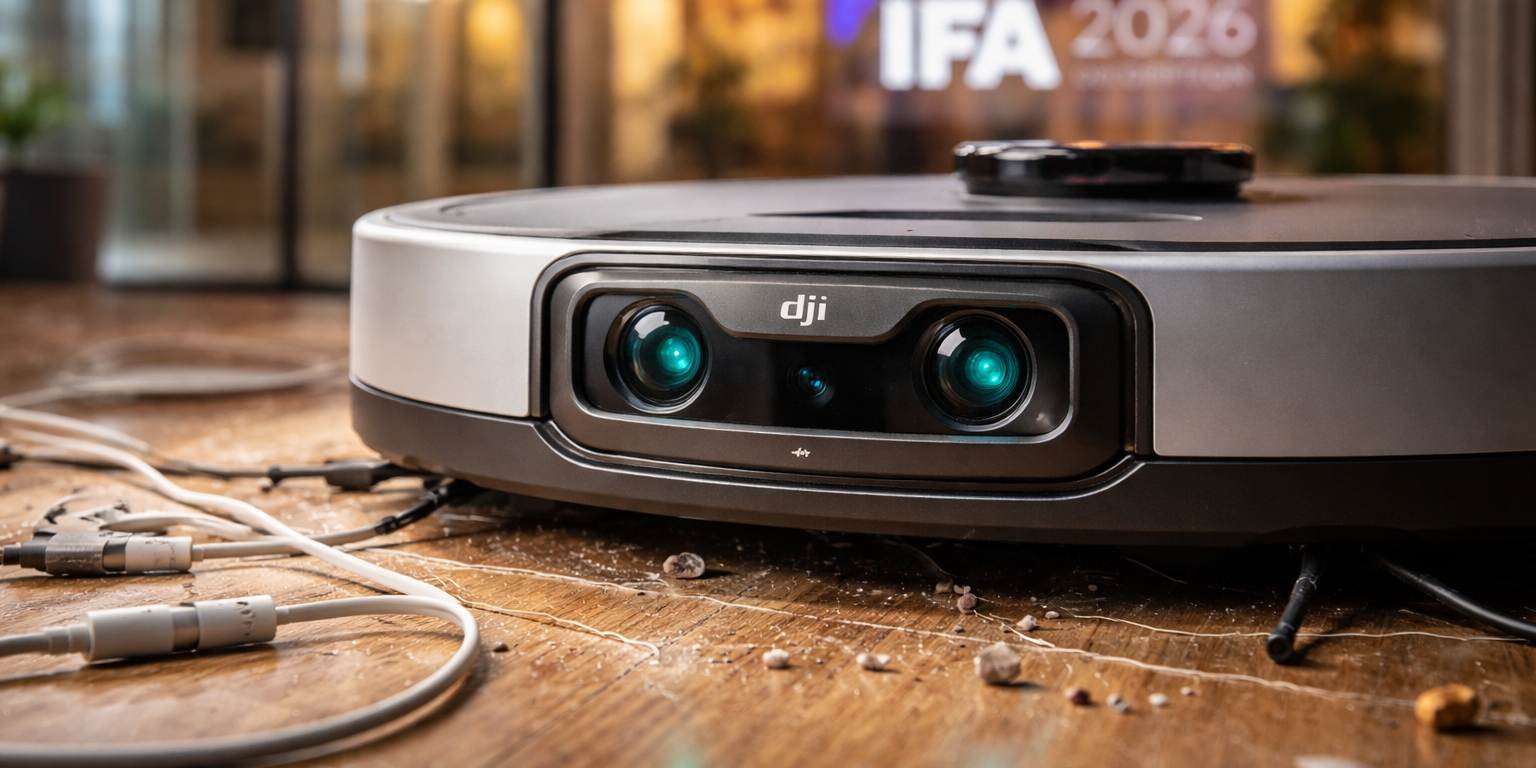
A smartphone charging cable measures roughly 3 millimeters in diameter. DJI's ROMO 2 perception stack, demonstrated at IFA 2026 in Berlin this week, can reliably detect objects down to 0.8 millimeters—thin enough to see the individual strands inside a frayed USB cord before a robot vacuum's brush roll does. That capability matters because cable entanglement accounts for an estimated 40 percent of all robot vacuum service calls in North America, according to warranty data analyzed by consumer electronics retailers. DJI, best known for building the cameras and obstacle avoidance systems that keep $10,000 cinema drones from flying into tree branches, now wants to solve the same problem for $400 floor cleaners.
The ROMO 2 series combines three sensing modalities into a single compute module smaller than a deck of cards. Stereo vision cameras provide depth perception across a 150-degree field of view. A structured light projector overlays infrared dot patterns onto surfaces, enabling millimeter-scale depth resolution at distances up to two meters. An onboard neural processing unit running at 8 TOPS handles sensor fusion and object classification in real time, without requiring cloud connectivity or data transmission back to external servers. DJI claims the entire stack draws less than 12 watts at peak load, a critical threshold for battery-powered home robots that already struggle to complete full-home cleaning cycles on a single charge. The company demonstrated the system detecting and routing around charging cables, shoelaces, pet toys smaller than a golf ball, and liquid spills—scenarios that reliably defeat current-generation robot vacuums relying on infrared time-of-flight sensors or monocular cameras.
DJI did not arrive at home robotics through household appliances. The Shenzhen-based company spent the last decade refining autonomous flight systems for its Mavic, Phantom, and Inspire drone lines, which collectively hold more than 70 percent global market share in the consumer and prosumer UAV segments. Those aircraft navigate three-dimensional airspace at speeds exceeding 40 miles per hour, avoiding obstacles as small as power lines and tree branches while maintaining stable video capture. Translating that sensing capability to ground-based robots required solving a different set of constraints. Drones operate in relatively uncluttered environments—open sky with occasional static obstacles. Home floors present dense fields of low-contrast objects in inconsistent lighting, often partially obscured by furniture or rugs. Cable detection proved especially difficult because thin cylindrical objects produce minimal infrared reflection and often blend into floor textures under standard RGB cameras. DJI's solution involved adding the structured light component, which projects thousands of infrared dots onto surfaces and measures their deformation to build high-resolution depth maps. The technique is common in facial recognition systems and industrial quality control but has seen limited deployment in consumer robotics due to cost and power requirements.
The company is not manufacturing robot vacuums itself. Instead, DJI is offering the ROMO 2 platform as a turnkey perception module for appliance manufacturers through its DJI Enterprise division. Prospective customers receive the sensor array, compute board, and a software development kit that includes pre-trained object detection models and sensor fusion algorithms. Manufacturers integrate the module into their own chassis designs and customize navigation behavior through DJI's API. Pricing was not disclosed, but industry sources familiar with component costs estimate the ROMO 2 adds $80 to $120 to per-unit manufacturing costs at volume production—a significant premium over the $15 to $25 bill of materials for basic time-of-flight sensors used in most current robot vacuums. That delta explains why early ROMO 2 adoption will likely concentrate in premium product lines above $600 retail, where consumers already pay for features like automatic dustbin emptying and multi-floor mapping. DJI announced partnerships with two unnamed appliance manufacturers at IFA, with product launches scheduled for the first quarter of 2027. One is described as a top-five global vacuum brand; the other is a Chinese manufacturer aiming to enter Western markets.
What to Watch: Product announcements from iRobot, Roborock, Ecovacs, and SharkNinja between now and CES 2027 in January—any of these brands could be DJI's unnamed launch partners. Competitor responses from perception specialists like Slamtec, which supplies LIDAR to mid-tier vacuum brands, and Luxonis, which offers modular vision systems for robotics developers. Manufacturing costs for structured light emitters, which remain a bottleneck for mass-market adoption below $400 retail price points. Early customer reviews focused on cable detection reliability when ROMO 2-equipped vacuums begin shipping in Q1 2027.