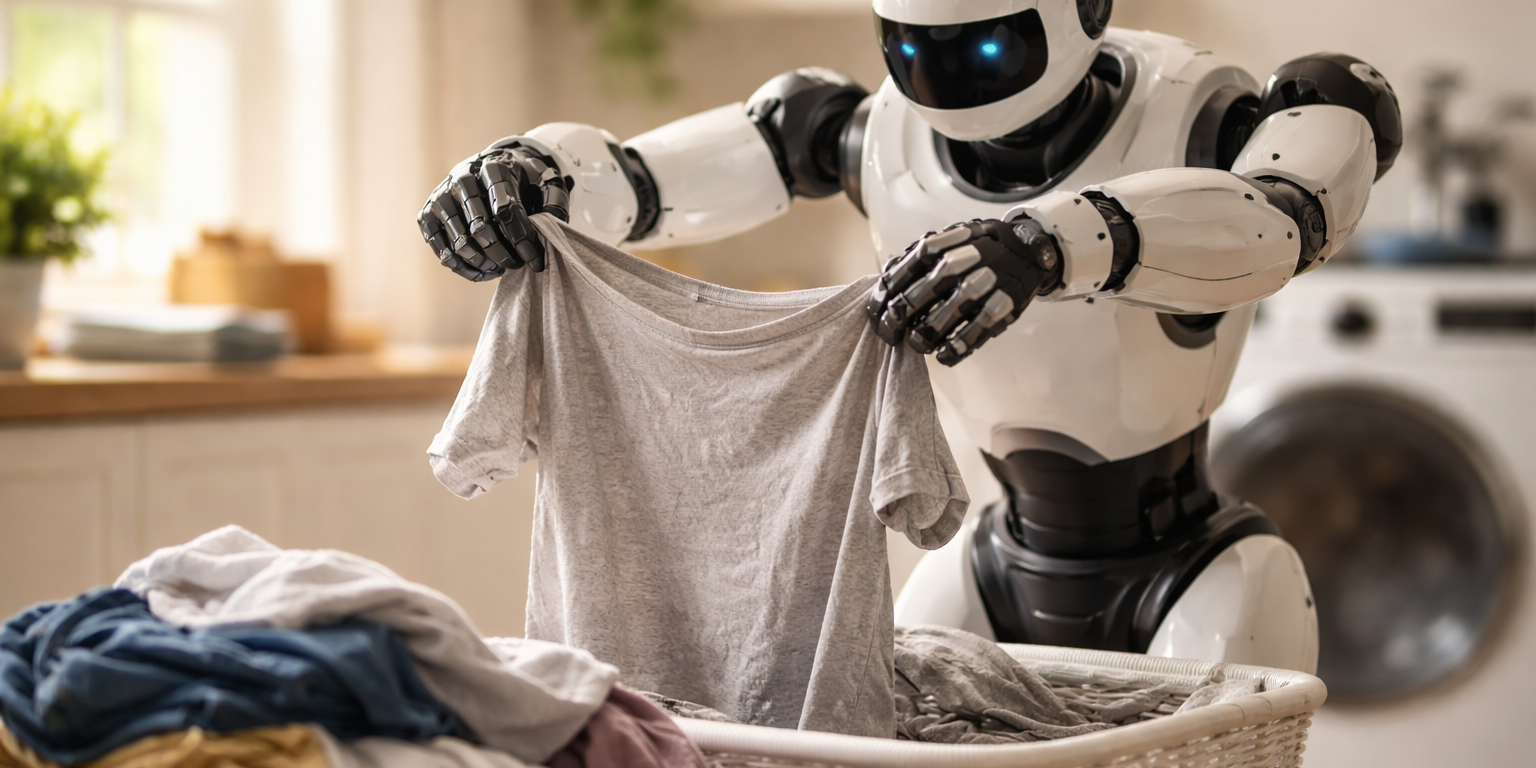
Weave Robotics this month began field trials of Isaac 1, a humanoid platform designed specifically around the laundry-folding task—joining at least three other unicorn-valued robotics firms that have made fabric manipulation central to their development roadmaps. The Isaac 1 uses a dual-arm configuration with custom end-effectors engineered to handle the compliance and variability of textiles, a materials challenge that has stymied general-purpose manipulation systems for decades.
The industry focus on laundry represents more than quaint domesticity. Engineers across the sector describe it as an ideal constrained environment that nevertheless contains nearly every manipulation challenge a home robot will face: deformable objects with infinite configurations, high-frequency task repetition that exposes control loop weaknesses, and user expectations calibrated to human-level performance. Physical AI Systems announced in March 2026 that its Atlas Home platform achieved 94 percent successful fold rates on mixed laundry loads during internal testing, a figure that would have been considered impossible with classical computer vision approaches. Boston Dynamics subsidiary Everyday Robotics—spun out and recapitalized at $1.8 billion valuation last year—has positioned laundry competence as the gateway milestone before expanding its Helper robot into meal preparation and general tidying tasks.
The technical demands explain why this seemingly simple chore attracts serious capital. Folding a T-shirt requires perceiving fabric edges under variable lighting and wrinkle states, planning grasp points that account for material stretch and drape, and executing smooth bimanual trajectories that human hands perform unconsciously. Current generation vision-language-action models can identify a shirt and describe folding steps, but translating that knowledge into reliable physical execution across cotton, polyester, fleece, and blended fabrics remains an open problem. Weave's approach layers foundation models trained on 200,000 hours of human folding demonstrations with real-time tactile feedback from force sensors embedded in Isaac 1's fingers—a hybrid architecture also adopted by Figure AI for its Figure 02 humanoid, though that platform targets warehouse soft goods handling rather than residential deployment.
The billion-dollar valuations behind these laundry-focused efforts stem from investor recognition that home manipulation represents a market measured in tens of millions of households, compared to the thousands of warehouses addressable by industrial automation. Khosla Ventures partner Sarah Chen told RoboticsIntl.com in June that her firm evaluates home robotics pitches based on "task completion rates in unstructured environments," with laundry serving as the proxy metric for general capability. That calculus has driven at least $4.3 billion into home manipulation startups since January 2025, according to PitchBook data. The companies pursuing this market—Weave, Physical AI, Everyday Robotics, and stealth-mode startup Ember Labs among them—share a common thesis: demonstrate competence on one frequent, frustrating household task, then expand the action repertoire through over-the-air model updates once the hardware sits in customers' homes. Laundry folding offers roughly 300 repetitions per household per year, generating continuous training data that warehouse robots, which handle predictable inventory, cannot match.
The technical progress comes with sobering realities about timeline and cost. None of the companies discussing laundry capability have announced commercial pricing, though industry observers expect first-generation home humanoids to debut above $25,000 per unit—a threshold that limits initial markets to high-net-worth early adopters and validation partners rather than mass consumer adoption. Reliability remains the harder constraint. Physical AI's 94 percent success rate, impressive in laboratory terms, translates to roughly three failures per fifty-item laundry load, an error frequency most households would find unacceptable for an appliance costing more than a used car. Weave has not disclosed Isaac 1's performance metrics, saying only that the system is undergoing trials with "select residential partners" in the San Francisco Bay Area through the end of 2026. The company raised $340 million in Series B funding in February at a $1.2 billion valuation, with Sequoia Capital and Lux Capital leading.
What to Watch: Weave Robotics is expected to release Isaac 1 benchmark data before year-end 2026, including task completion rates and cycle times that will provide the first direct comparison against Physical AI's published figures. Figure AI will demonstrate Figure 02's soft goods manipulation capabilities at Modex 2027 in March, potentially revealing whether warehouse-developed dexterity transfers to home textile tasks. Monitor whether any player announces pricing below $20,000, the threshold analysts consider necessary for premium consumer consideration, or partnerships with appliance manufacturers that could subsidize hardware costs through service subscriptions.