Every data center is, among other things, a forest of threaded rods hanging from the ceiling. Cable trays, conduit, cooling lines and power busways all need to be suspended from overhead anchors, and each anchor needs a hole drilled upward into concrete. Thousands of them. DALE, the downward drilling robot from August Robotics and DEWALT, has now been named to TIME's list of the 300 best inventions of 2026 in the Robotics category, a distinction that puts a decidedly unglamorous machine in front of a mainstream audience. The framing from TIME's editors centers on speed, precision and safety, which are the three variables that decide whether a construction robot gets bought or gets benched.
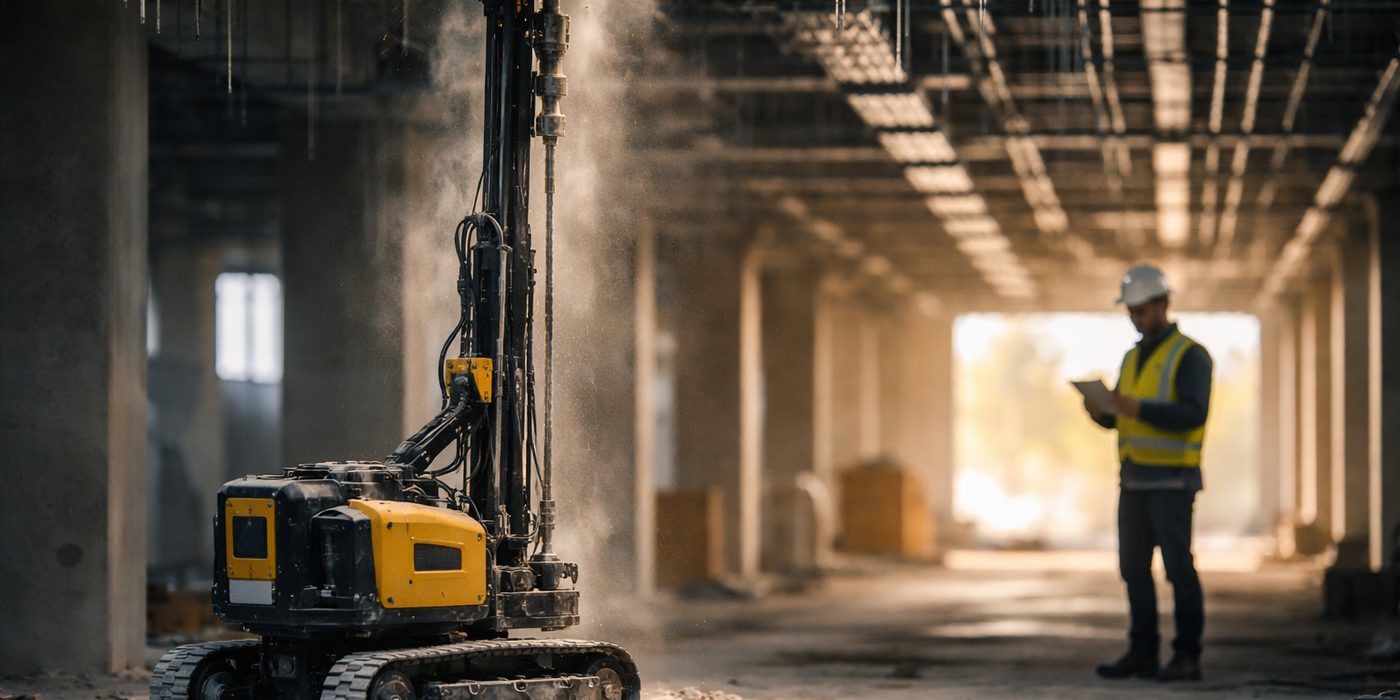
The task DALE targets is one the industry has quietly dreaded for decades. Overhead drilling means a worker standing on a lift or ladder, arms extended, a hammer drill pushing against gravity while concrete dust drops onto their face. Silica exposure, repetitive-strain injuries and falls are the documented costs. The robot's name signals the design inversion that makes it work: rather than fighting gravity, the system is described as a downward drilling robot, a phrase that reflects August Robotics' approach of automating the layout and drilling workflow in a way that keeps the heavy, dusty work off human shoulders. DEWALT brings the tooling, the dust-management expertise and, critically, the distribution relationships with contractors that a robotics startup rarely has on its own.
The detail that matters most for engineers and investors is the word fleet. DALE is billed as the first fleet-capable machine of its type, and that is a harder claim than it sounds. A single robot drilling holes is a demo. A coordinated group of them working across a slab alongside human trades, sharing a site model and a task queue, is a production system. Fleet operation demands reliable localization against a building information model, deconfliction between machines, and a workflow that survives the chaos of an active job site where rebar, debris and other crews appear without notice. Construction has historically punished robots that assume a tidy environment. The fact that DALE is pitched around multi-unit deployment suggests the vendors believe the localization and coordination stack is mature enough to sell on throughput rather than novelty.
The data center focus is not incidental. Hyperscale build schedules are compressed, labor is scarce, and the overhead infrastructure density in a single hall can run to tens of thousands of anchor points. Developers racing to bring AI compute capacity online treat schedule slip as a direct revenue loss, which changes the economics of automation: a robot that saves weeks matters more than one that merely saves wages. It also explains why a narrow, single-purpose machine can find a commercial footing faster than a general-purpose humanoid. Construction robotics has seen a quiet shake-out in recent years, with surveying rovers, rebar-tying systems and layout-marking robots each carving out defensible niches. DALE fits that pattern, and the TIME recognition is as much a vote for the single-task, high-repetition thesis as it is for this particular product.
The broader signal is about channel power. A robotics startup partnering with an established tool brand under the Stanley Black & Decker umbrella gains something money alone rarely buys: credibility with the superintendents and electrical contractors who actually decide what goes on a job site. For investors, that pairing lowers the go-to-market risk that has sunk many promising construction-tech companies. For competitors, it raises the bar. Rivals building overhead-drilling or layout robots now face a better-distributed incumbent with a publicly validated product. Whether the accolade converts into purchase orders is a separate question, but in a sector where trust is slow to earn, a TIME listing and a recognizable tool brand shorten the sales cycle.
What to Watch Track whether DEWALT and August Robotics announce named data center contractors or hyperscale customers for DALE through the fourth quarter of 2026, since a disclosed multi-site fleet deployment would validate the fleet claim far more than any award. Watch for published productivity figures, specifically holes per hour per unit and the human-crew comparison, which have been conspicuously thin in coverage so far. Keep an eye on competing overhead-drilling and layout-robot vendors for pricing or partnership responses as 2026 closes, and on any OSHA or silica-exposure policy discussion that could tilt contractor economics further toward automation.