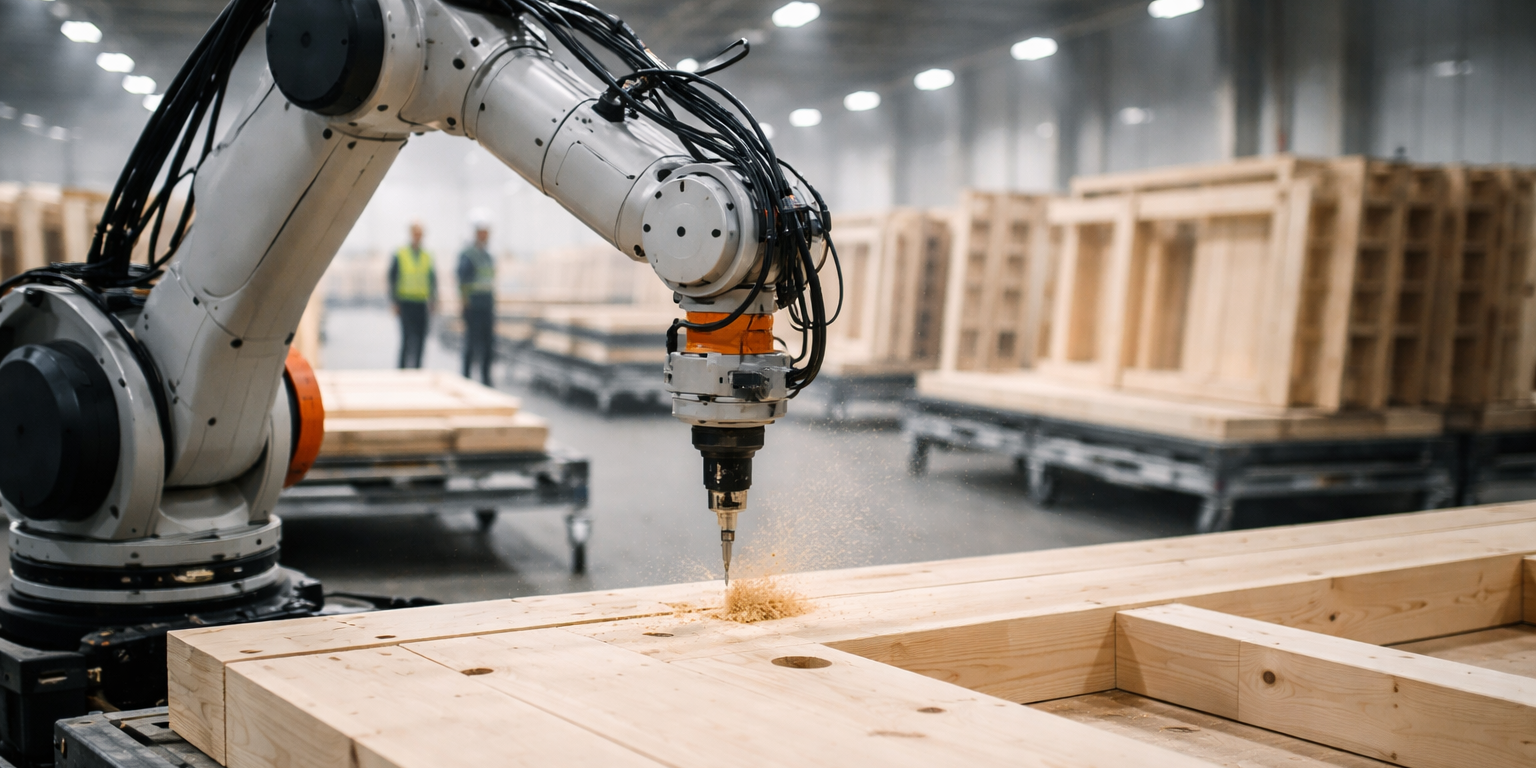
The U.S. housing industry needs to build 1.5 million new units annually to meet demand, yet construction employment has fallen 12 percent since 2019 despite rising wages. Automation has emerged as the most plausible path forward, but the robots delivering results bear little resemblance to the bipedal machines dominating venture capital pitches. Modular construction companies using industrial robotic arms in climate-controlled factories are shipping completed wall panels and structural components at volumes that would require three times the labor using traditional methods. The gap between what works today and what Silicon Valley is funding has never been wider.
Prefabrication facilities operated by companies like Autovol and Factory OS have deployed multi-axis robotic systems that handle repetitive tasks: cutting lumber to precise dimensions, drilling hundreds of holes for electrical conduit, applying adhesive beads for structural panels, and moving assemblies between workstations. These robots operate in environments designed around their capabilities, with standardized materials arriving on predictable schedules and quality control happening before components leave the building. A single facility in Tracy, California produces wall panels for 40 homes per week using a dozen robotic cells and 60 human workers, a ratio that would be impossible on a traditional construction site. The economics work because the factory runs two shifts, the robots never call in sick, and material waste drops below 3 percent compared to 15 percent for stick-built homes.
Humanoid robots designed for construction sites face obstacles that factory automation sidesteps entirely. Outdoor job sites present uneven terrain, unpredictable weather, constantly changing layouts, and materials that arrive damaged or out of spec. A bipedal robot capable of climbing scaffolding, operating power tools, and adapting to the chaos of residential framing would need to match or exceed human capabilities in manipulation, perception, balance, and decision-making under conditions that change hourly. No commercially available humanoid platform comes close. The dozen companies pursuing construction-focused humanoids have demonstrated controlled tasks like drywall installation and brick laying in structured test environments, but none has disclosed deployment timelines, customer pilots, or unit economics that would justify replacing a $28-per-hour framing carpenter with a machine that costs six figures and requires dedicated technical support.
The industry's actual automation trajectory runs through digital fabrication and assembly-line efficiency rather than general-purpose robots. Building information modeling software now generates machine instructions directly from architectural plans, eliminating the translation step where human error typically enters the process. CNC routers, robotic welders, and automated paint systems execute those instructions with precision measured in millimeters. Volumetric modular construction takes this further by assembling entire rooms in factories, complete with plumbing, electrical, and finishes, then trucking them to sites where cranes stack them into multi-story buildings in days rather than months. Marriott opened a 26-story hotel in New York using modules fabricated in Poland, each one built by robots and human workers in a production system that resembled automotive manufacturing more than traditional construction. The developer reported 20 percent time savings and defect rates one-fifth the industry average.
What separates viable automation from research projects is the willingness to redesign the product around the robot's strengths rather than forcing the robot to adapt to legacy methods. Prefab manufacturers specify engineered lumber that arrives in consistent dimensions, eliminating the variability that makes robotic handling difficult. They design wall panels with repeating patterns that allow a single robot program to handle hundreds of units. They accept the constraint that customization happens through configuration of standard modules rather than bespoke craftsmanship on every home. These compromises unlock the speed and cost advantages that make automation economically rational, but they require builders, architects, and buyers to accept homes that prioritize efficiency over infinite design flexibility. The companies scaling robotic construction have made that trade-off explicitly. The humanoid developers have not, instead promising machines that will slot into existing workflows without forcing anyone to change how they work.
What to Watch: Track module production capacity announcements from Autovol and Factory OS through Q4 2026 as both companies have indicated major facility expansions tied to multi-year contracts with national homebuilders. Monitor whether any humanoid robotics company discloses a paying construction customer or moves beyond staged demonstrations to sustained job site deployment. Watch for building code changes in California and Texas that would streamline permitting for prefabricated and robotically manufactured housing components, removing regulatory barriers that currently add months to project timelines.