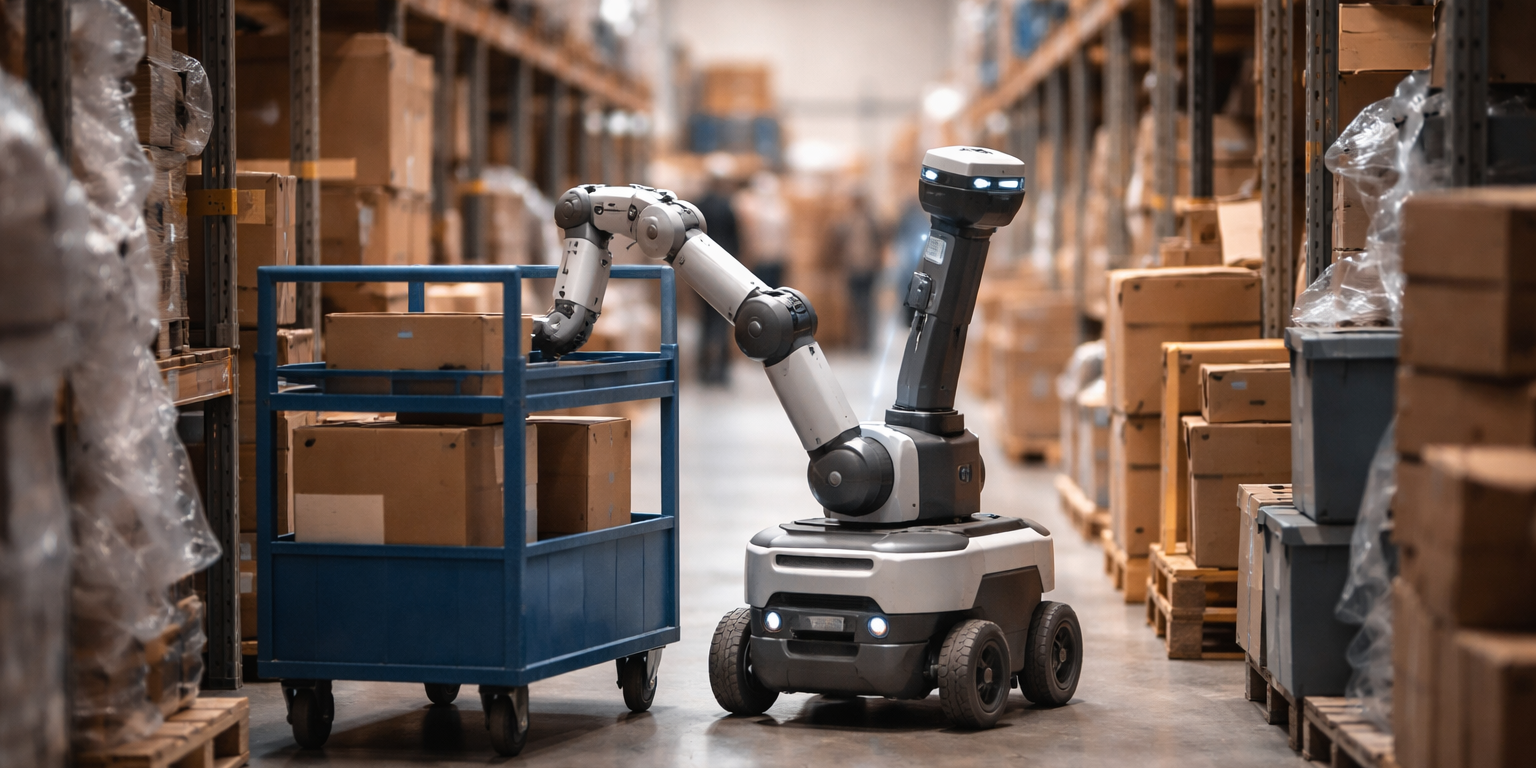
Proxie Gen 2 can now decide what to move and where to move it without waiting for a human dispatcher. Cobot, the Seattle-based company founded by former Amazon robotics executive Brad Porter, shipped the second generation of its mobile manipulation platform with what Porter calls autotasking—the robot's ability to recognize when inventory is staged and ready for transport, identify the correct destination using environmental context, and queue the work itself. The feature marks a technical threshold where mobile robots transition from tools directed by warehouse management systems to autonomous agents that interpret physical environments and make operational decisions independently.
Porter built his reputation over twelve years leading Amazon Robotics during the explosive growth period following the Kiva Systems acquisition. He left in 2020 to launch Cobot with the thesis that mobile manipulation—robots that combine navigation with physical object handling—would be the next productivity multiplier in facilities that Kiva-style goods-to-person systems couldn't reach. Proxie debuted in 2022 as a mobile robot designed to move carts and handle material in environments with inconsistent layouts, targeting the thousands of facilities too small or too dynamic for fixed automation. The first generation required task assignments from a fleet management interface or integration with warehouse management software. Gen 2 eliminates that dependency for a meaningful subset of workflows.
The autotasking system uses computer vision and spatial mapping to monitor staging areas where humans place completed subassemblies, packed goods, or materials awaiting the next production step. When the robot detects an item in a designated pickup zone—Porter didn't specify the exact triggering logic, but industry convention suggests weight sensors, visual confirmation, or both—it cross-references facility maps and operational rules to determine the delivery point. If multiple robots are active, the system arbitrates assignments based on proximity and current task load. The company claims this reduces the coordination overhead that has historically limited mobile robot ROI in facilities with high task variability. Rather than a human monitoring a dashboard and dispatching robots like a rideshare fleet, the robots circulate through predefined zones and react to work as it appears. The model works only in constrained environments with predictable staging patterns, but those conditions describe a substantial portion of discrete manufacturing and e-commerce distribution workflows.
Mobile manipulation remains expensive and technically complex compared to automated guided vehicles or autonomous mobile robots that navigate without manipulating objects. Proxie competes in a space with established players like Fetch Robotics, now part of Zebra Technologies, and newer entrants such as Standard Bots and Dexterity, though each targets slightly different manipulation tasks and facility types. The autotasking feature is notable because it addresses a labor model question, not just a technical one. Facilities adopting mobile robots typically retain human supervisors to monitor robot fleets, troubleshoot exceptions, and assign tasks dynamically as priorities shift during a production day. Reducing that supervisory load changes the economic equation—especially in operations running second and third shifts where supervisor labor costs are higher and task volumes may not justify a full management layer. If Proxie Gen 2 can operate multishift cycles with minimal oversight, it compresses payback timelines and opens markets in mid-sized facilities that couldn't previously justify the software integration and operational overhead of earlier-generation mobile robots.
Porter has not disclosed Proxie Gen 2 pricing, production volumes, or customer names, which makes market traction difficult to assess. Cobot raised a $100 million Series B in 2023 led by Accel, putting it among the better-capitalized startups in mobile manipulation, but the company has remained relatively quiet about deployments compared to peers who regularly announce customer wins. The robotics industry is littered with technically impressive demonstrations that failed to scale because integration costs or operational fragility made them uneconomical outside pilot programs. Autotasking is compelling in principle, but real-world performance depends on how the system handles edge cases—misplaced items, occluded staging zones, competing priorities—that make or break autonomous systems in production environments. The value proposition is clear: fewer humans coordinating robot fleets means lower operating costs and simpler scaling. Whether Proxie Gen 2 delivers that in practice will determine whether autotasking becomes an industry standard or remains a feature that works in controlled demos and struggles in chaotic facilities.
What to Watch: Monitor whether Cobot discloses tier-one customer deployments or production unit volumes over the next two quarters, which would signal commercial traction beyond pilot programs. Watch for competitive responses from Zebra Technologies and other mobile manipulation vendors who may add similar autotasking features to retain differentiation. Track whether third-party system integrators begin designing facility workflows around autotasking capabilities, a sign the feature is moving from novel to expected in request-for-proposal cycles.