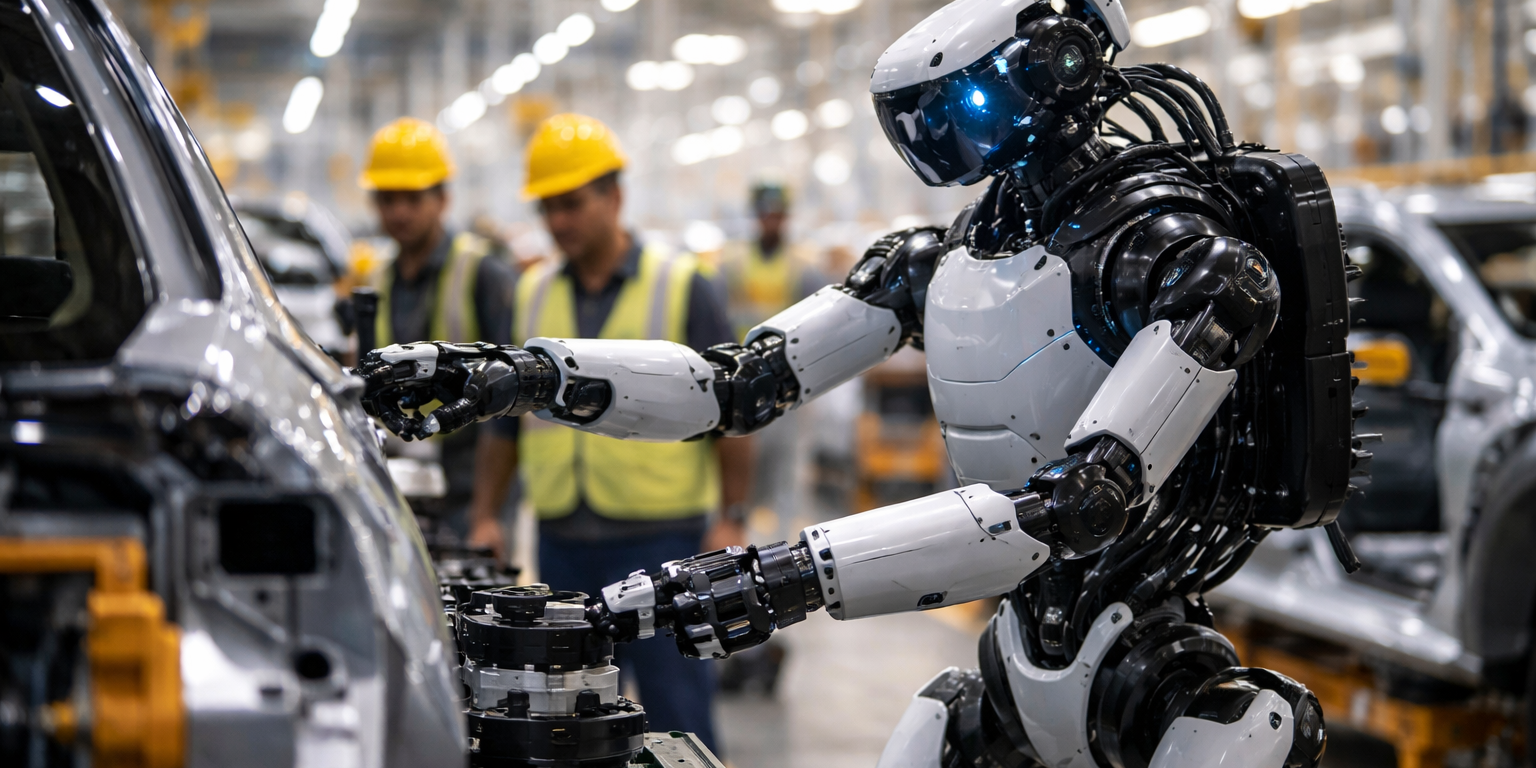
The Chinese government has elevated humanoid robotics to a strategic national technology priority, placing the sector alongside semiconductors and artificial intelligence in Beijing's industrial policy framework. The designation came through policy signals from multiple government agencies in recent weeks, indicating that robotics development will receive targeted research funding, manufacturing subsidies, and procurement preferences typically reserved for technologies deemed critical to national competitiveness. The move arrives as several Chinese robotics firms have demonstrated commercially viable humanoid platforms capable of warehouse work, manufacturing tasks, and service applications—achievements that reduce the technology gap with American competitors to a matter of months rather than years in some application areas.
This elevation of robotics reflects a calculated shift in Beijing's technology strategy. Previous industrial campaigns focused heavily on software, semiconductors, and digital infrastructure, sectors where China found itself constrained by export controls and supply chain vulnerabilities. Humanoid robotics demands a different capability set: integration of AI models with precision mechanical engineering, advanced materials, and high-volume manufacturing—domains where Chinese industry has built considerable strength over the past decade. The country produces roughly 52 percent of global industrial robots by unit volume, operates the world's largest deployment of automation equipment in its own factories, and has compressed development cycles for electromechanical systems through aggressive capital deployment. Unlike software, where American platforms maintain structural advantages, or advanced chips, where physics and equipment access create bottlenecks, humanoid robotics remains an open competitive field. Beijing appears determined to claim leadership before any competitor establishes an insurmountable position.
The policy designation will direct capital toward Chinese robotics companies through multiple channels simultaneously. State-backed venture funds, which already account for approximately 30 percent of Chinese technology investment by value, will receive guidance to prioritize robotics deals. Provincial governments will offer subsidies for robotics manufacturing facilities, land access, and preferential electricity rates—incentives that previously accelerated China's dominance in solar panels and electric vehicle production. Research institutions will see expanded funding for robotics programs, with emphasis on commercialization timelines rather than purely academic outputs. Companies like Unitree, which recently demonstrated a humanoid capable of backflips and dynamic movement, and Fourier Intelligence, whose GR-1 humanoid has entered pilot manufacturing programs, stand to benefit immediately. These firms have already undercut Western competitors on price—Unitree's quadruped robots sell for one-fifth the cost of Boston Dynamics equivalents—and humanoid platforms could follow similar pricing trajectories once production scales.
For Western robotics companies and their potential customers, this development carries immediate implications. Global manufacturers evaluating humanoid automation now face a decision point: commit to established but expensive Western platforms, or wait for Chinese alternatives that may arrive at substantially lower price points within 18 to 24 months. Boston Dynamics, Figure AI, and Agility Robotics have demonstrated technical capabilities that remain ahead of Chinese competitors in areas like dynamic balance and manipulation dexterity, but that lead narrows as Chinese firms iterate rapidly. Export control regimes will face new pressure as robotics technology increasingly intersects with national security considerations—humanoid robots capable of manufacturing and logistics work also possess potential military applications. Washington has already restricted exports of advanced AI chips to China, measures that slow but do not halt Chinese robotics development, since many applications run effectively on less sophisticated processors. The question for policymakers becomes whether to restrict robotics components, software, or complete systems, and how to enforce such restrictions when the technology embeds in industrial equipment traded globally. For investors, the dynamics recall previous technology races where Chinese industrial policy created domestic champions that eventually competed globally on price and scale, even when initially trailing on pure technical specifications.
What to Watch: Track capital deployment announcements from Chinese robotics firms over the next quarter, particularly Series B and C funding rounds that would support manufacturing scale-up. Monitor pricing announcements from Unitree and Fourier Intelligence as they move humanoid platforms from demonstration units to commercial availability, expected in Q2 and Q3 respectively. Watch for U.S. Commerce Department guidance on export controls for robotics components and AI training datasets, which could arrive before the end of Q2 following interagency review processes currently underway.