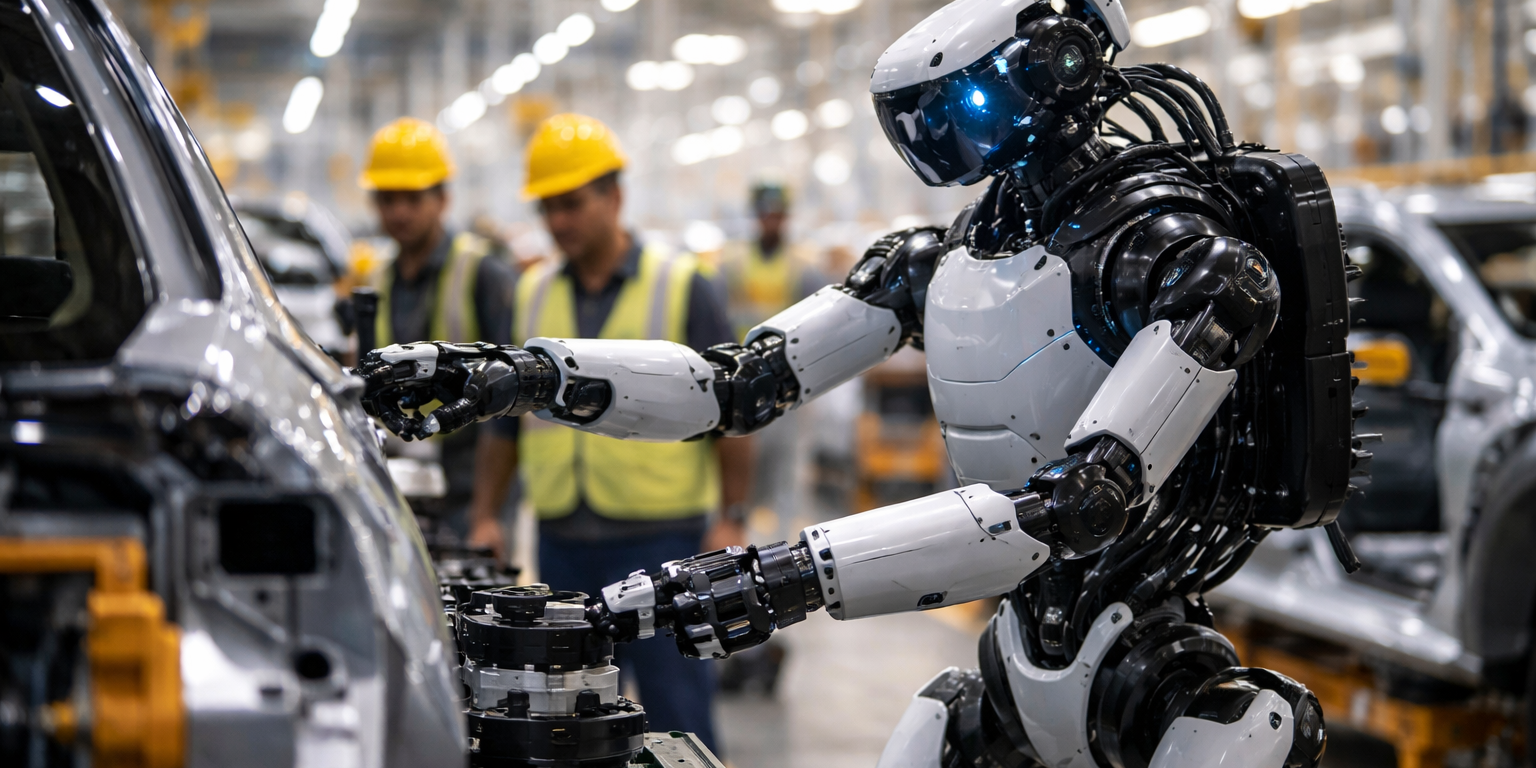
Boston Dynamics has opened a dedicated training facility for its electric Atlas humanoid robot inside Hyundai Motor Group's Metaplant America manufacturing complex in Bryan County, Georgia. The Robotics Metaplant Application Center represents the first time Boston Dynamics has established humanoid robot training operations embedded within an active automotive production environment, giving engineers direct access to the assembly lines, material flows, and environmental conditions Atlas will eventually navigate in commercial deployment.
The facility arrives eighteen months after Hyundai acquired Boston Dynamics and fifteen months after the company retired its hydraulic Atlas prototype in favor of an all-electric design optimized for industrial manipulation tasks. That timeline matters. Boston Dynamics spent decades perfecting dynamic locomotion for research and demonstration purposes. Now it faces the vastly different challenge of engineering humanoids that perform repetitive, economically justified tasks in factories where downtime costs thousands of dollars per minute. The Georgia center gives Boston Dynamics engineers a controlled environment to develop and validate those task primitives before humanoids disperse across Hyundai's global manufacturing network. Engineers at the facility are building what the company calls "manipulation libraries" libraries of pre-programmed movement sequences for common automotive assembly tasks like parts transport, bin picking, quality inspection positioning, and fixture loading. These libraries will serve as foundational building blocks that plant engineers can string together and customize for specific workflows without requiring deep robotics expertise.
Hyundai's Metaplant America, which began production in late 2025, manufactures electric vehicles including the Ioniq 5 and Genesis GV70 across a 2,923-acre site designed from the ground up around flexible manufacturing principles. The plant employs approximately 8,100 workers and has annual capacity of 300,000 vehicles. Embedding the Atlas training center within this operational facility gives Boston Dynamics access to real production cadences, material handling bottlenecks, and ergonomic challenges that cannot be replicated in laboratory settings. It also signals Hyundai's long-term commitment to humanoid integration across its manufacturing operations. The Korean automaker has publicly stated its intention to deploy humanoids for tasks currently performed by human workers in physically demanding or ergonomically problematic positions, particularly in paint shops, quality inspection stations, and parts logistics areas where repetitive overhead work or heavy lifting contributes to injury rates.
The strategic calculus behind humanoid deployment in automotive plants remains polarizing within the robotics industry. Traditional industrial automation companies argue that purpose-built fixed automation and collaborative arms already address most manufacturing tasks more reliably and at lower cost than humanoids. Boston Dynamics and its competitors counter that humanoids offer unprecedented flexibility in factories designed around human workers, eliminating the need for costly facility redesigns or dedicated automation cells. The Georgia training center will provide concrete data to test those competing claims. If Boston Dynamics can demonstrate Atlas humanoids performing genuinely useful work in a high-volume automotive plant at competitive cycle times and acceptable reliability, it will validate the humanoid value proposition in a way no demonstration video or pilot program has yet achieved. Conversely, if Atlas units struggle with the speed, precision, or uptime requirements of automotive production, the industry will have its answer about humanoid readiness for Tier 1 manufacturing.
What to Watch: Monitor Hyundai's quarterly earnings calls through the first half of 2027 for any disclosure of Atlas unit counts deployed in production roles at Metaplant America or other facilities. Watch for Boston Dynamics to publish case studies or technical papers detailing specific tasks Atlas has automated and the performance metrics achieved, particularly cycle times and mean time between failures. Track whether other automakers including Toyota, which has its own humanoid program, or Volkswagen announce similar embedded training facilities, which would signal broader industry confidence in the humanoid manufacturing thesis.