Nobody can write a course for a machine that will be obsolete before the course ends. That, in essence, is the argument coming out of Army Special Forces training leadership as the service builds out a new class of soldier, the robotics technician, whose defining skill is not mastery of any single platform but the ability to keep adapting as platforms change. The framing, reported by Defense One, pushes back on a common assumption in the drone boom: that the Army simply needs more pilots at the controls and more mechanics at the bench. The training chief's point is that battlefield autonomy blurs those lines, and that the person who keeps a system fighting may need to be part operator, part electronics repairer, part software troubleshooter, and part tactician.
The push did not emerge from a vacuum. Watching Ukraine and Russia iterate on first-person-view drones, loitering munitions, and electronic warfare countermeasures in cycles measured in weeks, U.S. planners have absorbed an uncomfortable lesson about procurement tempo. A quadcopter that survives the front line in spring can be rendered useless by a jamming update in summer. Conventional military occupational specialties, designed around stable equipment fielded over decades, were never built for that churn. The Army has spent the past two years experimenting with ways to put small unmanned systems at the squad and platoon level, and the human question has trailed the hardware question. Who fixes a drone at 2 a.m. when no contractor is within a hundred miles? Who decides the payload needs rewiring for a different mission?
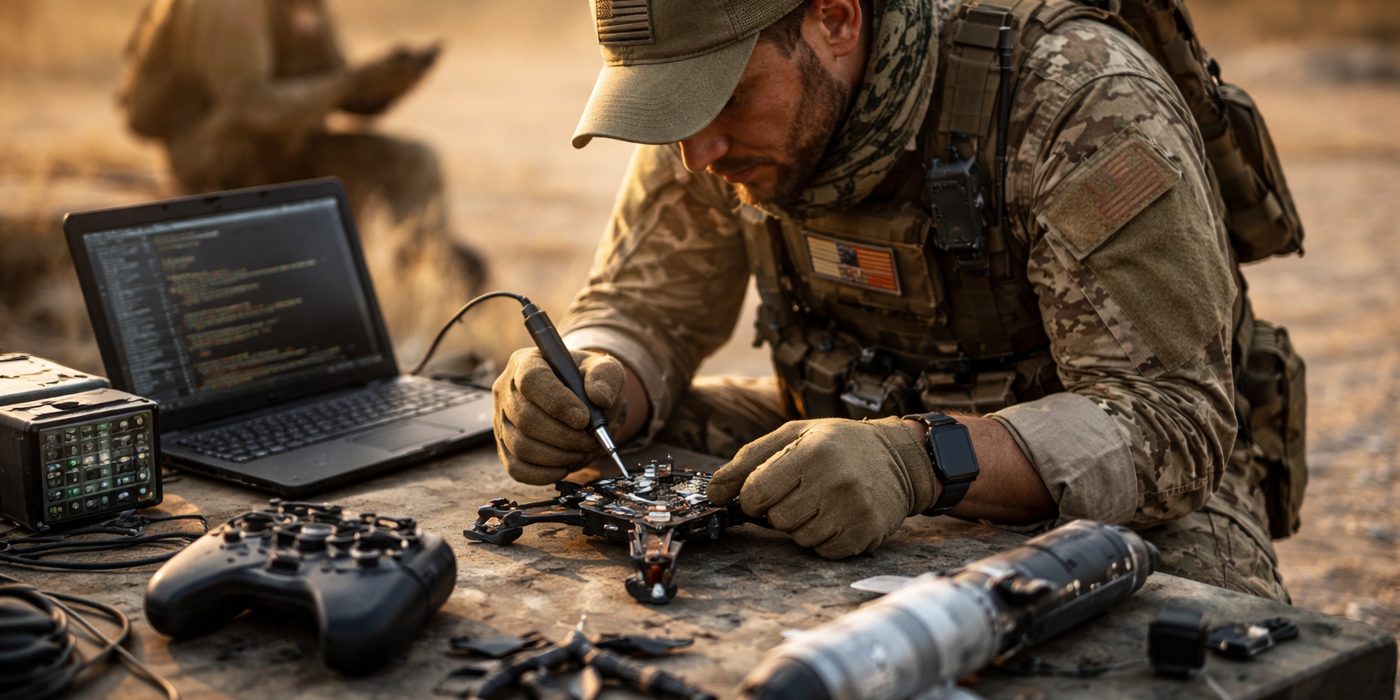
That is the gap the technician role is meant to fill, and it explains why the Special Forces community, long accustomed to small teams operating with minimal support, has been influential in shaping it. Special Forces soldiers have always been expected to improvise with whatever equipment is at hand, and the training chief's description of the job reflects that culture: troubleshoot, modify, and employ systems that may arrive with sparse documentation or none at all. The emphasis falls on fundamentals such as radio frequency behavior, power systems, flight dynamics, and basic programming, because fundamentals transfer across platforms while platform-specific knowledge does not. A technician who understands why a link drops can handle a new radio. One who memorized a menu cannot.
For the robotics industry, the more consequential detail may be what this implies about design priorities. If the Army is training soldiers to modify and repair systems in the field, then platforms that resist modification, rely on proprietary software locks, or require factory depot service become liabilities rather than assets. Modular payload bays, documented interfaces, commodity components, and software that can be updated at the edge start to look like competitive requirements, not engineering niceties. It also raises a workforce pipeline question that investors should not overlook. The people who can do this work are in demand across logistics, manufacturing, and agriculture, where autonomy is scaling too, and the Army is competing for the same scarce hybrid talent. How it recruits, certifies, and retains robotics technicians will shape how many autonomous systems it can realistically keep running.
What to Watch
Watch for how the Army formalizes the specialty over the coming quarter, including whether it assigns a dedicated occupational code, defines a certification pathway, or ties the role to specific unmanned systems programs. Track the next round of Army drone and counter-UAS procurement announcements in late 2026 for language favoring open architectures, right-to-repair provisions, and field-serviceable designs, since contract terms will reveal whether vendors are adjusting to the technician model. Keep an eye on training-focused solicitations and any partnerships with community colleges or industry on robotics technician curricula, which would signal how fast the service intends to scale. Finally, monitor lessons-learned reporting from ongoing conflicts, because every new electronic warfare countermeasure tests the adaptation thesis behind this entire effort.