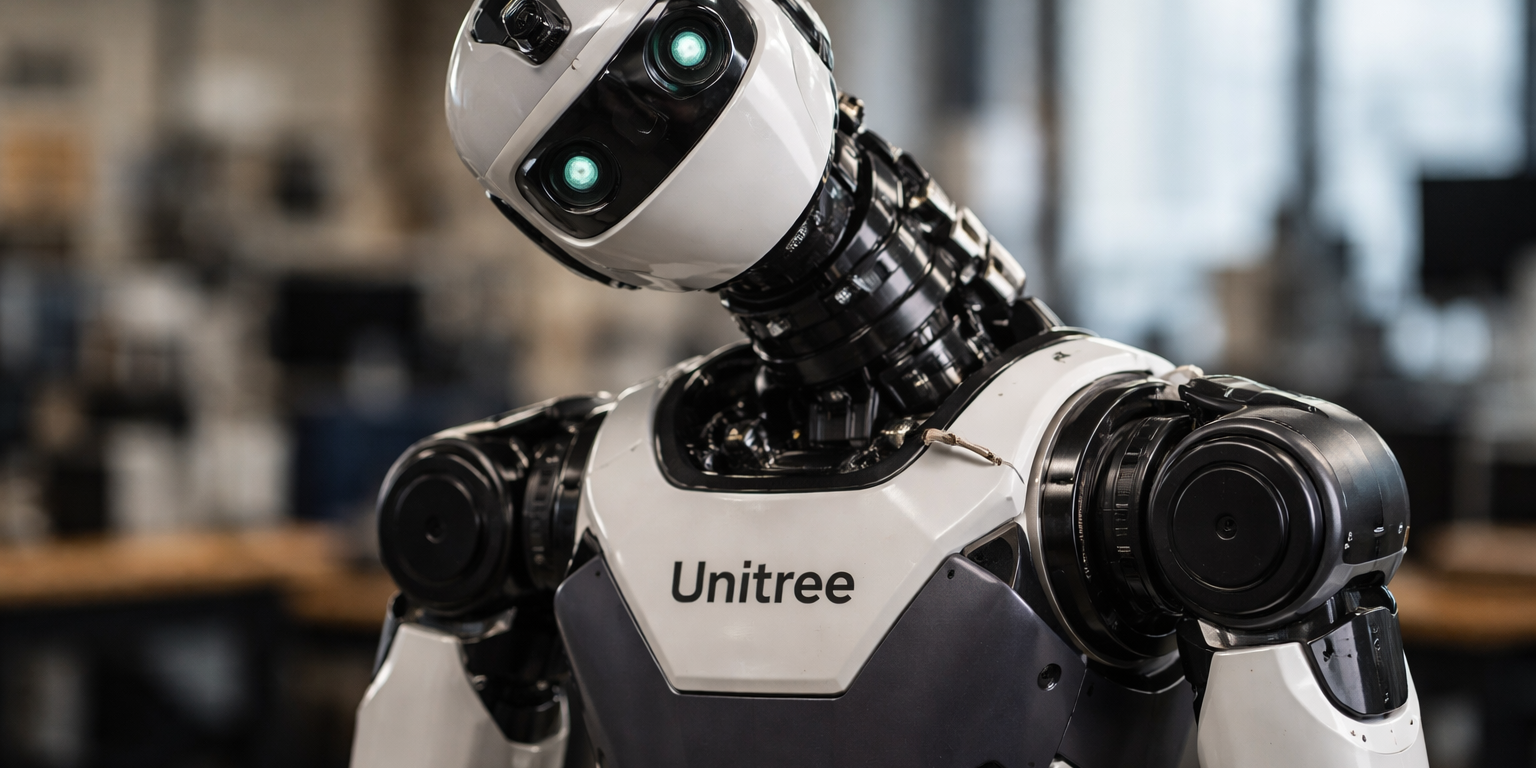
A Unitree Go2 quadruped now navigates environments and executes manipulation tasks using only monocular vision, powered by Alibaba's newly released Qwen-Robot model family. The Chinese tech giant disclosed the embodied AI system this week, its first public foray into vision-language-action models designed for deployment on physical robots rather than simulation environments. The single-camera constraint matters because it eliminates dependency on depth sensors, lidar arrays, or stereo camera rigs that add cost, power draw, and mechanical complexity to mobile platforms. Alibaba structured Qwen-Robot as a model series rather than a single architecture, with separate specialized models handling navigation, object manipulation, and world modeling tasks. That modular approach mirrors strategies from Google DeepMind's RT-2 and Physical Intelligence's π0 systems, where distinct models trained on different datasets handle different aspects of embodied reasoning. The Unitree Go2 serves as the reference platform, a significant choice given that quadruped's $1,600 price point and growing adoption in research labs worldwide.
Alibaba built Qwen-Robot atop its existing Qwen large language model foundation, extending the multimodal architecture to handle continuous sensorimotor control rather than discrete text generation. The navigation model processes camera frames to generate velocity commands and path plans in real-time, while the manipulation model translates natural language instructions into motor commands for grippers or end effectors. The world modeling component predicts future states of the environment based on current observations and planned actions, a capability crucial for tasks where the robot must anticipate how objects will move or fall. Alibaba has not disclosed the training datasets, parameter counts, or inference latency figures that would allow direct technical comparison to competing systems. The company demonstrated the system executing tasks including indoor navigation around obstacles, picking and placing objects, and following multi-step instructions that combine movement and manipulation. Those capabilities position Qwen-Robot alongside RT-2, which Google demonstrated on wheeled mobile manipulators last year, and Boston Dynamics' recent work integrating ChatGPT into Spot for navigation tasks.
The decision to target Unitree hardware specifically rather than develop proprietary robot platforms signals Alibaba's strategy of enabling third-party robotics companies rather than vertically integrating like Tesla with Optimus. Unitree ships thousands of Go2 units annually to universities, research institutions, and commercial developers, creating a built-in distribution channel for embodied AI models that can drop into existing fleets. The Go2 runs on NVIDIA's embedded computing modules with sufficient onboard processing for real-time inference, though Alibaba has not specified whether Qwen-Robot requires cloud connectivity for certain tasks or operates entirely at the edge. That architectural detail matters significantly for industrial deployment scenarios where network reliability constraints rule out cloud-dependent systems. Competitors including Physical Intelligence raised $400 million in January specifically to develop foundation models for robots, while Figure AI's $675 million Series B round in February valued that humanoid robotics company at $2.6 billion partly on the strength of its OpenAI partnership for embodied reasoning. Alibaba's entry escalates competition in a market where model providers and hardware manufacturers are still negotiating how value and revenue will split between software and physical platforms.
The vision-only approach carries both advantages and serious limitations that will determine Qwen-Robot's viability beyond controlled demonstrations. Monocular vision cannot directly measure depth, requiring the model to infer three-dimensional structure from motion parallax, learned priors about object sizes, and contextual cues. That works reliably for navigation in structured environments where floors are level and doorways are standard sizes, but fails rapidly in cluttered industrial settings, outdoor terrain, or anywhere precise distance estimation matters for manipulation. Meta's Habitat synthetic environment research showed that vision-only navigation agents achieve roughly 73% success rates on novel indoor routes compared to 91% for lidar-equipped systems, though real-world performance typically lags simulation by 15-20 percentage points. Alibaba presumably accepts those accuracy tradeoffs to hit aggressive cost targets, betting that applications in warehouses, retail stores, and campuses can tolerate occasional navigation failures that human supervision corrects. The manipulation component faces steeper challenges because grasping requires millimeter-scale precision that monocular vision struggles to provide, particularly for reflective, transparent, or textureless objects. Google's RT-2 relies on wrist-mounted RGB-D cameras for manipulation specifically because top-down monocular views cannot resolve the depth ambiguities that cause grasp failures.
What to Watch: Monitor whether Alibaba releases technical benchmarks comparing Qwen-Robot's navigation success rates and manipulation precision against RT-2, Physical Intelligence's π0, or academic baselines like CLIP-Fields. Watch for commercial licensing deals between Alibaba Cloud and robotics manufacturers beyond Unitree, particularly logistics companies deploying mobile manipulation platforms. Track any announcements of model quantization or edge optimization that would enable Qwen-Robot to run on lower-cost compute hardware than NVIDIA Jetson modules, critical for sub-$5,000 robot economics. Follow Unitree's product roadmap for potential co-designed hardware integrating Qwen-Robot as factory-installed software, which would signal deeper partnership beyond reference platform status.