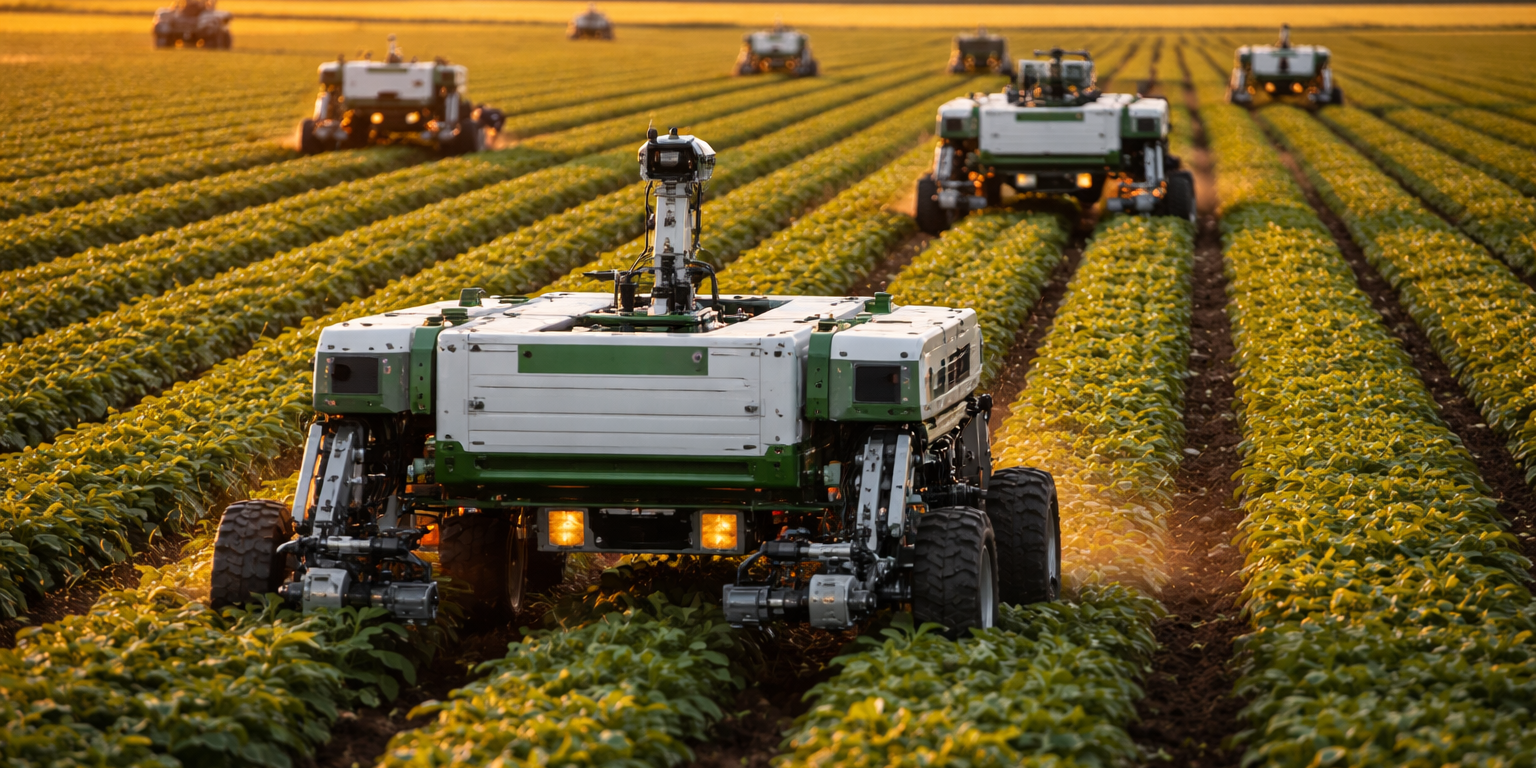
Autonomous field robots now operate across 12 million hectares of farmland worldwide, marking the first time agricultural robotics have achieved deployment density comparable to traditional mechanized equipment. The figure, drawn from operational data across North America, Europe, Australia, and parts of Asia, reflects a fundamental change in how large-scale farming operations approach labor allocation, crop monitoring, and resource management. These systems no longer function as isolated demonstration units but as networked fleets integrated into daily operations alongside conventional tractors and harvesters.
The deployment spans five distinct technology categories that have matured simultaneously over the past three years. Autonomous ground vehicles handle weeding, planting, and selective harvesting tasks that previously required manual labor or broad-spectrum chemical application. Computer vision systems mounted on both mobile platforms and fixed installations identify individual plants, assess health status, and detect pest pressure at resolutions fine enough to guide intervention decisions plant-by-plant rather than field-by-field. Precision irrigation networks use soil sensors, weather data, and predictive models to deliver water in volumes measured by the liter rather than by the acre-foot, reducing consumption while maintaining or improving yields. Drone platforms conduct aerial surveys that generate multispectral imagery for analysis by machine learning models trained to spot nutrient deficiencies, disease patterns, and growth anomalies invisible to human observation. Predictive analytics platforms aggregate data from all these sources to generate operational recommendations that flow back to the robots, closing a control loop that operates with minimal human intervention.
The economics driving adoption differ substantially from earlier waves of farm automation. Where GPS-guided tractors reduced labor costs by making existing operators more efficient, current robotics deployments enable operations that were previously impractical at commercial scale. A Netherlands-based vegetable producer now uses vision-equipped robots to thin lettuce seedlings with 94 percent accuracy, eliminating the need for contract crews that were increasingly difficult to recruit. An Australian grain operation deploys sensor-equipped drones across 8,000 hectares every 72 hours, identifying moisture stress patterns early enough to adjust irrigation schedules before yield loss occurs. A California specialty crop grower uses autonomous platforms to apply targeted fungicide treatments to individual vine sections, cutting chemical use by 60 percent while maintaining disease control equivalent to blanket spraying. These capabilities generate returns not through simple labor substitution but by making profitable certain crops and practices that manual operations could not support economically.
Implementation challenges remain distinct to agriculture compared to other robotics sectors. Outdoor operating environments introduce variables—mud, dust, temperature extremes, variable lighting—that exceed specifications for industrial robots designed for controlled factory floors. Biological systems do not conform to predictable schedules; a harvesting robot must adapt to fruit that ripens unevenly, while a weeding system must distinguish crop seedlings from similar-looking invasive species without the standardized parts and precise positioning available in manufacturing. Connectivity limitations in rural areas complicate real-time data transmission, pushing more processing to edge devices aboard the robots themselves. Training data for machine learning models must account for regional variations in soil types, pest species, and crop genetics that differ substantially across growing regions. Equipment manufacturers have addressed these constraints through ruggedized hardware designs, onboard computing that reduces cloud dependency, and modular software architectures that allow model retraining for local conditions without complete system redesigns.
What to Watch: Monitor expansion of autonomous systems into permanent crops like orchards and vineyards, where higher per-hectare values justify more sophisticated robotics but irregular terrain and three-dimensional canopy structures complicate navigation and manipulation. Track partnerships between agricultural equipment manufacturers and robotics specialists, particularly joint development programs targeting crops that currently lack purpose-built automation solutions. Watch for regulatory developments around autonomous pesticide application, especially in jurisdictions where current rules assume human operators for chemical handling. Follow second-generation platforms from companies that launched initial commercial units in 2024-2025, as revision cycles indicate whether early deployments generated sufficient operational data to drive meaningful performance improvements.