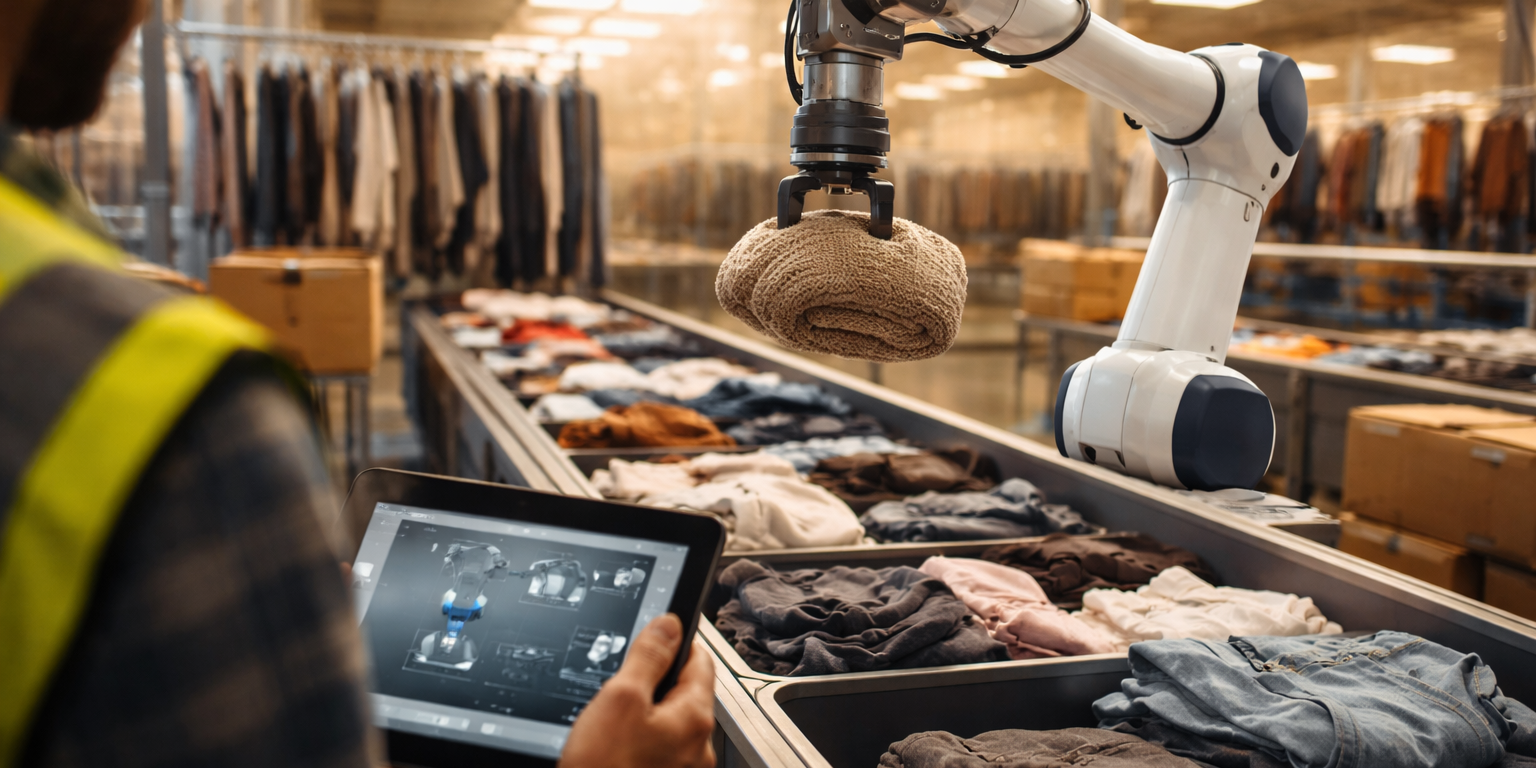
Seventy-five percent is a large number to attach to commissioning, the unglamorous phase where robot deployments quietly lose their margins. That is the reduction in engineering and commissioning effort ABB Robotics is claiming for system integrators who deploy its newly upgraded Fashion Inductor module, which now bundles the company's AI Robot Trainer. Announced from Zurich on October 15, 2026, the release is described by ABB as its first end-to-end vision-based industrial-grade physical AI solution. The target application is fashion logistics, where soft, shapeless, endlessly varied goods have long defeated conventional automation. The figure is ABB's own, and it is a ceiling stated as 'up to,' not an average. Still, it points squarely at the cost that actually decides whether a project gets approved.
Fashion has always been a hard case for robotics. A pallet of identical boxes presents a pick-and-place problem that was solved a generation ago. A bin of folded sweaters, polybagged blouses, and hanging garments is something else entirely: items deform when grasped, reflect and absorb light unpredictably, and change with every seasonal collection. Retailers handle enormous return volumes and short product lifecycles, which means the stock-keeping unit mix churns constantly. Hand-tuned vision systems and bespoke grasp logic, the traditional integrator toolkit, struggle under that churn. Each new item category can mean fresh teaching, fresh testing, and another round of on-site tuning. The Fashion Inductor module exists to load garments onto sortation and conveyor systems, and ABB's pitch is that learning-based vision should replace much of that manual tuning.
The mechanism matters more than the headline percentage. AI Robot Trainer is ABB's tool for teaching robots to handle varied items through training rather than explicit programming, and embedding it in a packaged functional module changes who does the work. Instead of an integrator assembling vision hardware, grasp planning, software, and validation from separate parts for every site, the module arrives with those layers designed to work together. ABB frames the upgrade as helping integrators deploy and scale AI-powered applications faster, which is a deliberate choice of customer. ABB is not selling directly to the retailer here; it is arming the middleman who owns the customer relationship and carries the commissioning risk. That distinction shapes everything about how the product will succeed or fail.
For integrators, labor is the scarce input. Experienced robotics engineers capable of tuning perception pipelines on a live warehouse floor are expensive and booked solid, and every week spent on a single site is a week another project waits. A credible cut in commissioning effort does more than lift margins on one job. It raises how many jobs a given team can run in a year, which is the number that matters on an integrator's income statement. It also lowers the threshold for mid-sized retailers who previously judged garment automation too risky or too custom. The competitive context is crowded. Vision-guided piece-picking has drawn well-funded startups and established automation vendors alike, and several offer their own learning-based grasping. ABB's differentiator is channel and packaging rather than any single algorithm.
There are caveats a senior engineer should apply before taking the figure at face value. A 75 percent reduction is measured against a baseline, and the baseline is not specified in ABB's announcement as relayed by Unite.AI; a custom-engineered legacy cell is a far more generous comparison than a competing packaged product. 'Up to' language leaves wide room between best case and typical case. Fashion logistics also spans a spectrum from flat-packed folded goods to hanging garments and polybagged mixed returns, and performance rarely transfers evenly across them. The metrics that will settle the question are throughput in picks per hour, first-pass grasp success on novel items, and how many hours of retraining a new seasonal range actually requires. None of those were quantified in the material available at publication.
Still, the strategic direction is legible and consistent with where large automation vendors are heading. The value is migrating from the manipulator arm, increasingly commoditized, toward the software layer that makes an arm useful on day one. By labeling the offering an end-to-end physical AI solution, ABB is claiming that layer for itself rather than ceding it to third-party vision and AI specialists. If integrators adopt the module in volume, ABB gains recurring leverage over how fashion logistics cells are built, and every site that trains the system generates operating experience that sharpens the next deployment. If they do not, the upgrade becomes one more capable component competing in a field with no shortage of them.
What to Watch The first signal is named customers: watch for ABB or its integrator partners to disclose live Fashion Inductor sites with real throughput and uptime data, ideally before the peak holiday returns season in the fourth quarter of 2026. Track whether ABB publishes the baseline behind the 75 percent claim, since a defined comparison would turn marketing into something an engineer can audit. Compare the release against rival vision-guided garment-handling offerings from competing automation vendors over the next 60 to 90 days, particularly on pricing and integrator training programs. Finally, monitor integrator commentary at logistics and automation events in early 2027 for evidence that commissioning times are truly shrinking in practice.