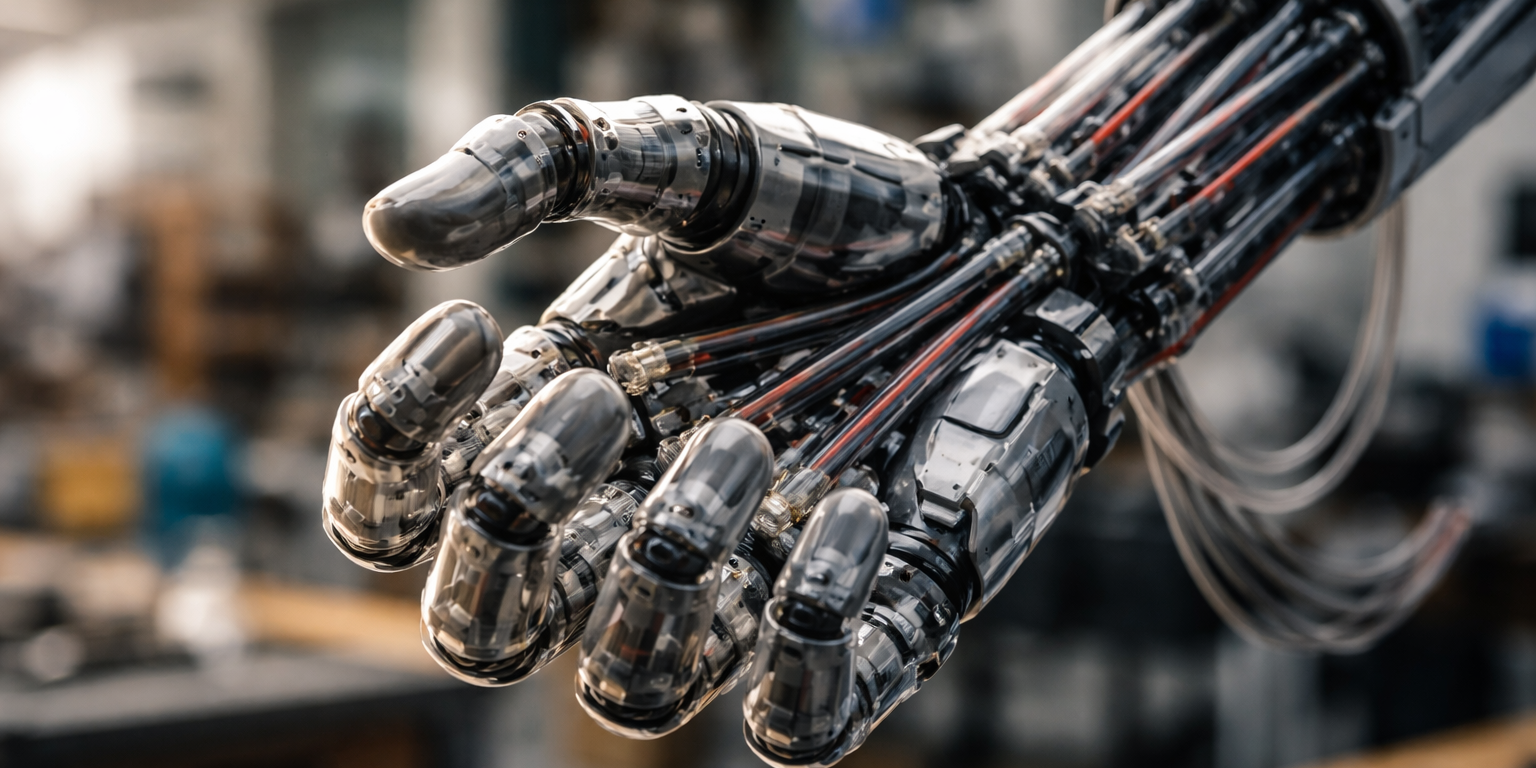
The hands on 1X Technologies' Neo humanoid now articulate across 25 degrees of freedom, a specification that puts the Norwegian firm's hardware within range of human capability for the first time in a commercially targeted platform. The tendon-driven architecture represents a departure from the direct-drive motors and geared linkages that dominate competing designs from Boston Dynamics, Figure, and Tesla. 1X has confirmed plans to mass-produce the hands, though the company has not disclosed target volumes, per-unit cost, or manufacturing partners. For a field wherehand design has consistently lagged the progress made in bipedal locomotion and torso integration, the technical claims matter less than the production commitment.
Tendon-driven systems route cables through channels within the hand structure, mimicking the biomechanics of human musculature. Actuators positioned in the forearm pull the tendons to flex fingers, allowing the hand itself to remain lighter and more compliant than motor-per-joint designs. The approach is not new—research labs including MIT's Biomimetic Robotics Lab and Shadow Robot have demonstrated tendon hands for years—but those systems rarely survive the transition from controlled environments to field deployment. They stretch, snap, and require constant recalibration. 1X claims to have solved the reliability problem, though the company has not published durability data or mean-time-between-failure metrics. What engineers will scrutinize is whether the hands hold up during repetitive industrial tasks, not whether they can perform a single impressive demo.
1X, formerly known as Halodi Robotics before rebranding in 2023, emerged from Norway's robotics research community and has raised over $125 million from investors including OpenAI's Startup Fund. The company deployed earlier versions of its humanoid, the EVE model, in pilot programs with logistics and security clients beginning in 2024. Neo represents the second-generation platform, designed explicitly for manipulation tasks in warehouses, retail environments, and eventually domestic settings. The hands are the most critical subsystem. Without dexterous manipulation, a humanoid is just an expensive bipedal cart. Every credible player in the space—Agility Robotics, Apptronik, Sanctuary AI—is racing to solve the same problem. 1X is betting that tendon drives, not electric motors packed into fingertips, are the correct architectural choice.
The 25-degree-of-freedom specification breaks down unevenly across the hand. Assume four degrees per finger for the index, middle, ring, and pinky, with an additional nine degrees distributed across the thumb, wrist, and palm articulation. That is a reasonable approximation of human hand kinematics, enough to manipulate tools, open containers, and handle objects with varied geometries. Strength and safety claims remain unquantified in the company's disclosures. Tendon systems can modulate grip force more naturally than rigid actuators, but they also introduce failure modes—cable fraying, tension drift, pulley wear—that direct-drive systems avoid. Whether 1X has engineered around these issues will become clear only after extended field trials. The company has not announced pilot customers for Neo, nor has it specified a commercial availability date beyond stating that mass production is intended.
The broader industry context is a race between hardware readiness and application discovery. Humanoids are being built because the physical world is designed for human proportions, not because the form factor is mechanically optimal. Factories, offices, and homes assume bipedal operators with five-fingered hands. Retrofitting those environments for wheeled robots or specialized grippers is expensive and slow. The bet is that a sufficiently capable humanoid can slot into existing infrastructure without modification. That only works if the hands can operate door handles, power tools, and touchscreens as reliably as human workers. Agility's Digit has hands with three fingers and limited wrist articulation—enough for box handling, not enough for general-purpose tasks. Figure's hands use 16 degrees of freedom but rely on electric actuation, adding weight to the distal links. Sanctuary's Phoenix platform uses pneumatic hands, trading precision for compliance. Each company is making different tradeoffs, and none have yet proven their approach in sustained commercial operation.
What to Watch: Track whether 1X announces a manufacturing partnership or in-house production facility by the end of 2026, which would clarify capital requirements and scalability. Monitor pilot deployments of Neo with named customers, particularly in logistics or retail, where hand dexterity directly impacts task performance. Watch for published reliability data—mean cycles between failures, tendon replacement intervals, and comparative benchmarks against competing hand designs. Also note whether competitors like Figure or Agility respond with upgraded hand subsystems in the next two quarters, signaling that tendon architectures are gaining validation across the industry.