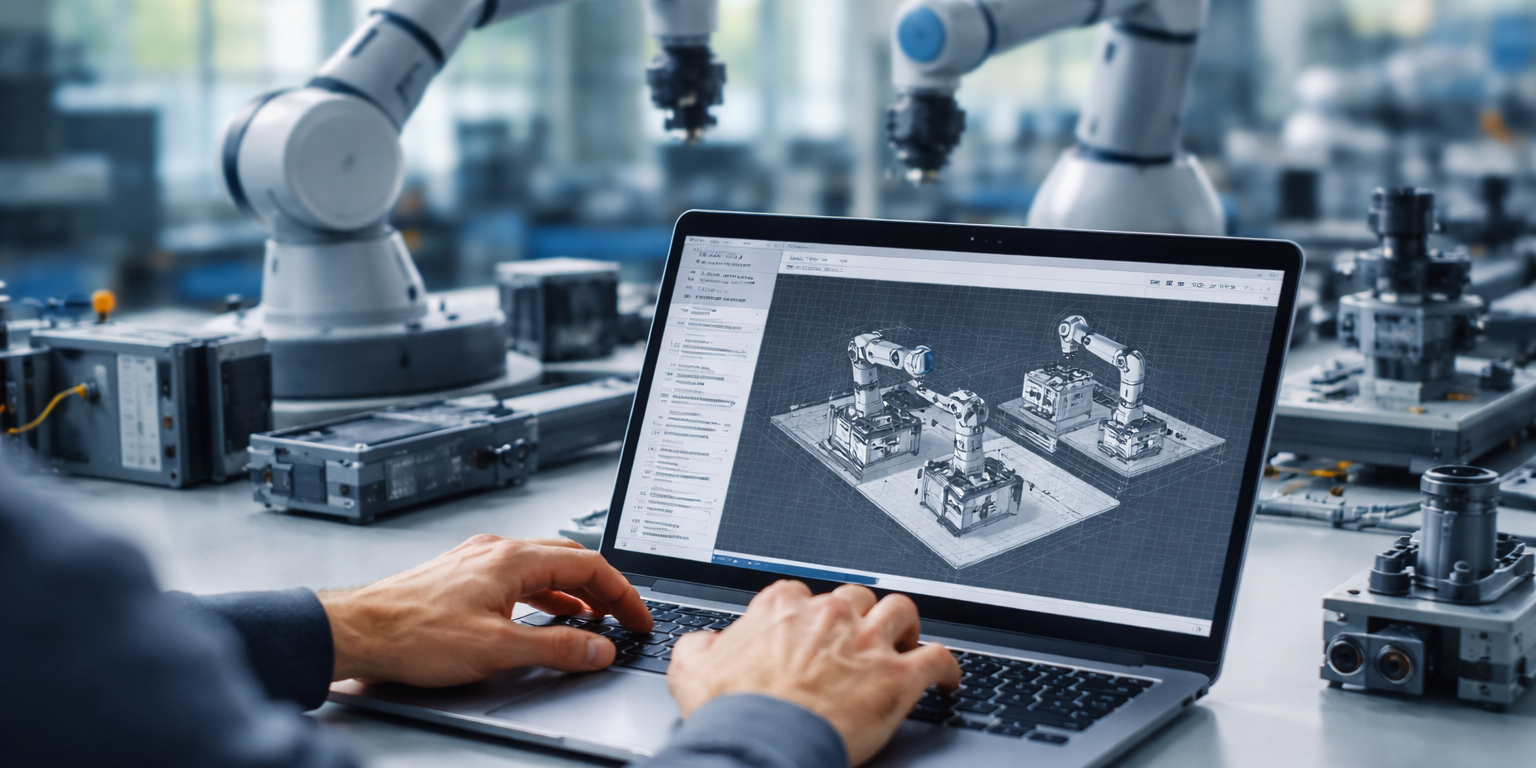
Montreal automation platform provider Vention has formalized technical partnerships with FANUC and Universal Robots, embedding both manufacturers' hardware specifications directly into its cloud-based design environment. Engineers can now configure complete robotic workcells—from cobot arms to industrial six-axis units—without installing CAD software or leaving a web browser. The integration puts digital twins of FANUC's CRX collaborative series and Universal Robots' UR+ ecosystem alongside Vention's existing library of conveyors, grippers, and structural components. Orders flow from simulation to procurement in a single workflow.
The arrangement reflects pressure on automation suppliers to reduce the technical barriers manufacturers face when adding robotics to production lines. Traditional deployment cycles stretch six to eighteen months from concept to operational. Engineers bounce between multiple software packages—motion planning in one tool, structural design in another, integration validation in a third. Vention's platform collapses those stages into a unified environment where collision detection, reach analysis, and cycle time optimization happen simultaneously. FANUC and Universal Robots gain distribution reach among small and mid-sized manufacturers who lack robotics expertise in-house. Vention gains credibility by associating with established OEMs rather than positioning solely as a self-contained hardware vendor.
The technical implementation relies on parametric models FANUC and Universal Robots provided to Vention's engineering team. Each robot model arrives as a geometry file with embedded kinematic data—joint limits, payload curves, mounting interfaces. When a user drags a FANUC CRX-10iA into a workspace, the software enforces the arm's 10-kilogram payload limit and 1,249-millimeter reach automatically. Collision meshes prevent engineers from designing fixtures that interfere with robot motion. The system generates bills of material that include both Vention-manufactured components and third-party hardware, pricing everything in real time. FANUC processes orders through its standard distribution channels; Universal Robots does the same. Vention fulfills the structural elements and ships everything to arrive simultaneously.
Broader industry dynamics favor this model. Collaborative robot shipments grew 23 percent year-over-year in 2025 according to preliminary data from the International Federation of Robotics, but adoption remains concentrated in automotive and electronics. General manufacturing—food processing, packaging, metal fabrication—still operates with minimal automation. The barrier isn't cost. Collaborative robots from Universal Robots and FANUC now start below $20,000. The barrier is deployment complexity. Manufacturers in these sectors don't employ robotics integrators or maintain engineering teams fluent in ROS. Software-defined automation platforms attempt to abstract that complexity behind interfaces familiar to mechanical engineers who already use cloud-based CAD tools. Whether this approach scales beyond simple pick-and-place applications into assembly or inspection remains an open question. Simulation accuracy depends on how well digital models reflect real-world variability—part tolerances, lighting conditions, sensor noise. Vention claims its models achieve ±2-millimeter positioning accuracy in physical validation tests, sufficient for many material handling tasks but marginal for precision assembly.
What to Watch: Vention's customer case studies in Q3 2026 will reveal whether manufacturers actually bypass traditional integrators or still require onsite commissioning support. Watch for FANUC and Universal Robots to report what percentage of their shipments flow through cloud-configured channels versus conventional distribution. Also track whether ABB, KUKA, or Yaskawa announce similar platform partnerships, signaling broader OEM acceptance of software-defined workflows. Integration announcements with vision system providers like Cognex or Keyence would indicate expansion beyond purely mechanical design into perception-dependent applications.