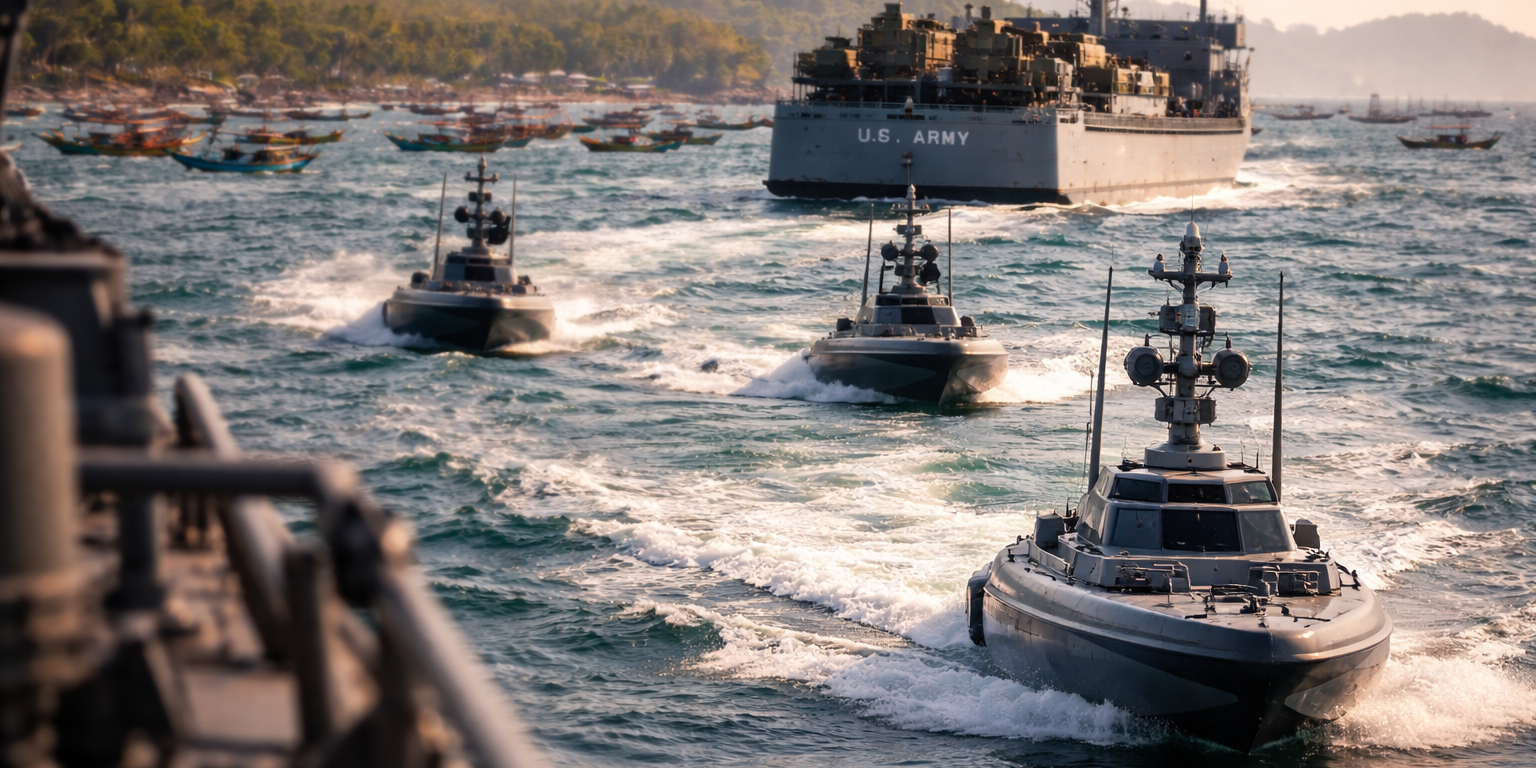
Three autonomous surface vessels flanked a U.S. Army logistics support vessel as it moved through Philippine waters last month, testing whether uncrewed boats can handle escort duties in environments where radar clutter, commercial traffic, and shallow coastal zones complicate navigation. The exercise, part of the annual Balikatan drills between American and Philippine forces, put autonomy systems through conditions that simulators cannot replicate: unpredictable weather, dense fishing vessel traffic, and the operational tempo of a military deployment where autonomous boats must keep pace with human-crewed ships or risk becoming liabilities rather than force multipliers.
The Army has spent three years developing doctrine for autonomous maritime operations, a less publicized effort compared to the Navy's high-profile programs but one driven by immediate operational needs. Army watercraft move equipment and personnel across archipelagic regions where fixed infrastructure is scarce, and the service sees autonomous vessels as a way to extend convoy protection without adding crew requirements. The boats used in the Philippine exercise carried sensor packages for surface surveillance and communications relay equipment, giving the crewed vessel enhanced situational awareness across a wider area than its organic systems could cover. Army officials disclosed that the autonomous vessels operated for eighteen consecutive hours during one phase of the exercise, including nighttime transits through congested shipping lanes near Manila Bay where autonomous collision avoidance systems processed inputs from dozens of vessels simultaneously.
The technology comes from a mix of defense contractors and commercial autonomy firms that adapted systems originally designed for cargo or survey missions. Unlike fully autonomous platforms that operate independently for extended periods, these boats maintain constant data links with a control station aboard the crewed vessel, allowing a single operator to supervise multiple autonomous assets. That architecture reflects the Army's preference for supervised autonomy over full independence, a stance shaped by operational realities in environments where communications can be disrupted and Rules of Engagement require human judgment. The boats demonstrated waypoint navigation, station-keeping relative to the moving escort vessel, and automatic collision avoidance during the exercise. What they did not demonstrate was any capability to respond to hostile action, a gap that highlights ongoing debates within the defense community about whether autonomous surface vessels should carry weapons or remain purely as sensor and communications platforms. The Army's current approach keeps weapons off these boats, using them instead to extend human decision-making range rather than replacing it.
Beyond the immediate military applications, the exercise offers data points for commercial maritime autonomy developers watching how autonomous boats perform in complex real-world conditions. The congested waters off the Philippines present challenges that mirror those faced by autonomous cargo vessels or harbor tugs: dense traffic, variable weather, and the need to integrate with crewed vessels following conventional navigation rules. Army engineers collected performance data on how the boats' machine vision systems handled tropical rain squalls, how their path planning algorithms responded to fishing boats that changed course unpredictably, and how reliably their communications systems maintained links in areas where terrain and atmospheric conditions degrade radio signals. That operational data has value beyond defense applications, particularly for firms developing autonomous systems for commercial shipping routes through Southeast Asia where environmental and traffic conditions resemble those the Army encountered during Balikatan. The exercise also tested logistics and maintenance requirements for deploying autonomous boats far from home bases, revealing that battery management and sensor calibration require more attention than developers anticipated based on testing in controlled environments.
What to Watch: The Army plans to expand autonomous vessel deployments to additional Pacific exercises through late 2026, with particular focus on operations in the Marshall Islands and around Okinawa where different environmental conditions will test system adaptability. Defense contractors are competing for a formal program of record that would move autonomous escort boats from experimental status to standard equipment, with contract awards expected in the fourth quarter. Several commercial autonomy firms have opened dialogues with Army officials about adapting military-tested systems for harbor operations and coastal cargo routes, a reverse technology transfer that could accelerate commercial autonomous shipping timelines if regulatory frameworks support it.