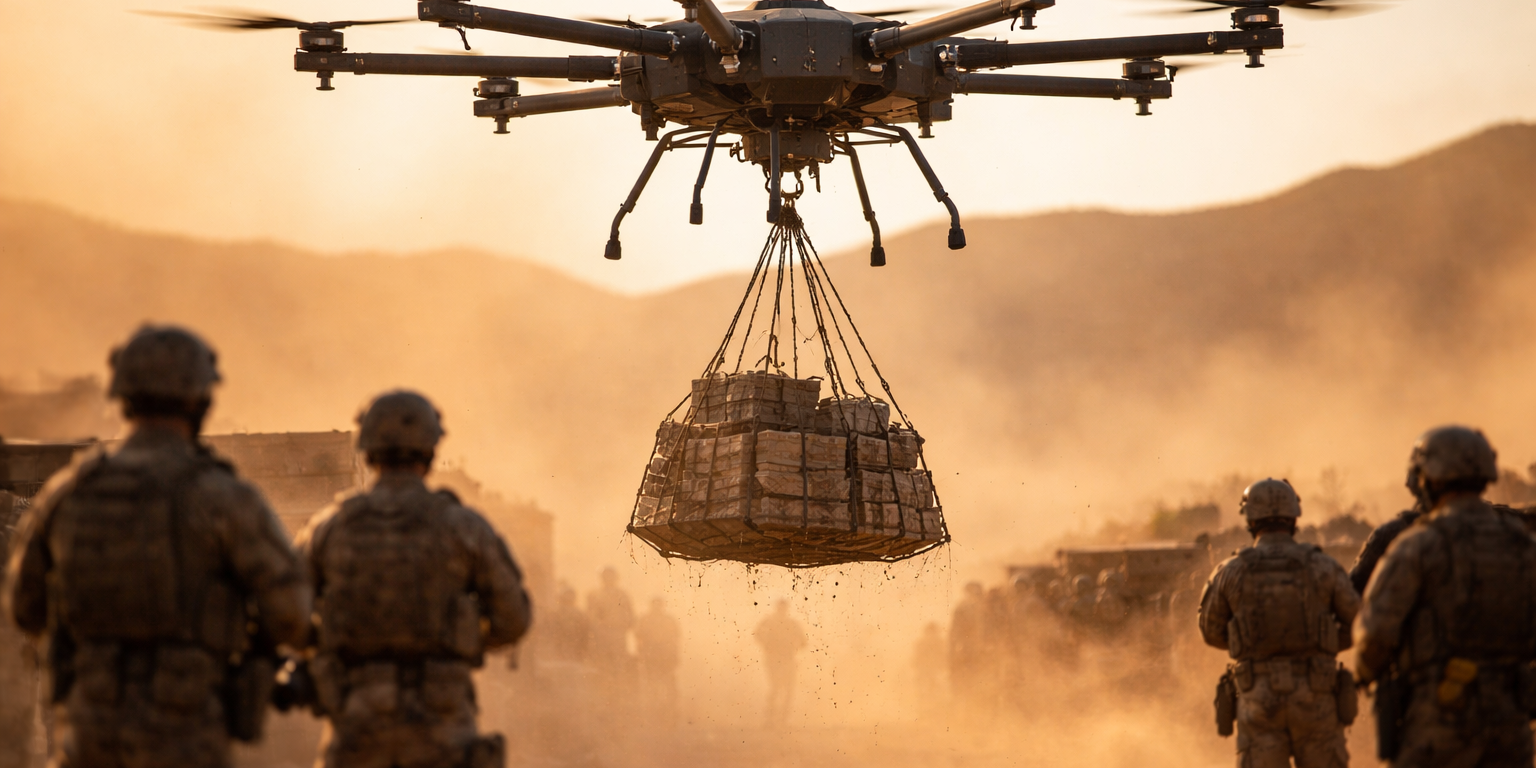
Multiple defense contractors spent the weekend of August 7-9, 2026 demonstrating autonomous heavy-lift drone systems at DARPA's Lift Challenge, a competition designed to push the boundaries of what unmanned aircraft can carry into forward operating areas. The event marks a practical test of systems that military planners have discussed for years but rarely demonstrated at scale: drones capable of hauling significant cargo loads without human pilots, operating in environments where helicopters face increasing anti-aircraft threats.
The Lift Challenge represents a strategic shift in how the Department of Defense thinks about resupply operations. Traditional rotary-wing aircraft require crews, maintenance infrastructure, and operate within predictable flight corridors that adversaries can target. Heavy-lift drones promise to distribute risk differently. They can operate from dispersed locations, follow unpredictable routes, and if shot down, cost the military machines rather than lives. DARPA structured the competition to test not just lifting capacity but autonomous decision-making, obstacle avoidance, and the ability to complete missions with minimal human oversight. The scenarios mirror real-world challenges: delivering supplies to remote outposts, evacuating equipment from compromised positions, and maintaining logistics flows when airspace is contested.
Several teams brought distinctly different approaches to the challenge. Some fielded scaled-up versions of commercial multirotor platforms, betting that distributed propulsion and electric motors would deliver the reliability and control authority needed for heavy loads. Others arrived with hybrid designs that combine fixed-wing efficiency for transit with rotary-wing precision for delivery. The payload requirements remain classified, but industry sources suggest DARPA set targets well above the 200-pound threshold that defines most current commercial heavy-lift systems, pushing into territory traditionally reserved for manned helicopters. Each team had to demonstrate not just raw lifting power but the ability to navigate autonomously to designated coordinates, identify landing zones, and complete delivery without ground-based control inputs beyond mission initiation.
The competition arrives as the military services accelerate investments in autonomous logistics. The Marine Corps has been testing autonomous resupply systems as part of its Force Design 2030 initiative, which envisions distributed forces operating across island chains in the Pacific. The Army's Future Vertical Lift program includes requirements for optionally manned aircraft that can operate autonomously when needed. Heavy-lift drones fill a specific gap in this architecture: they handle payloads too large for tactical quadcopters but operate in environments too dangerous or logistically complex for manned aircraft. Commercial drone companies have been circling this market for years, but military requirements around autonomy, reliability, and operation in GPS-denied environments create barriers that few civilian systems can cross. The Lift Challenge gives DARPA hard data on which technical approaches actually work under field conditions, which fail, and why.
What to Watch: Results from the Lift Challenge should inform DARPA program announcements by late September 2026, potentially including follow-on contracts for the most successful approaches. Watch for Marine Corps statements around Expeditionary Advanced Base Operations exercises scheduled for fall 2026, where heavy-lift drone prototypes may appear in operational testing. The Army's Project Convergence exercise in October 2026 could feature autonomous logistics demonstrations building on Lift Challenge lessons. Several defense contractors are expected to announce commercial variants of their Lift Challenge systems aimed at civilian infrastructure inspection and emergency response markets by year-end 2026.