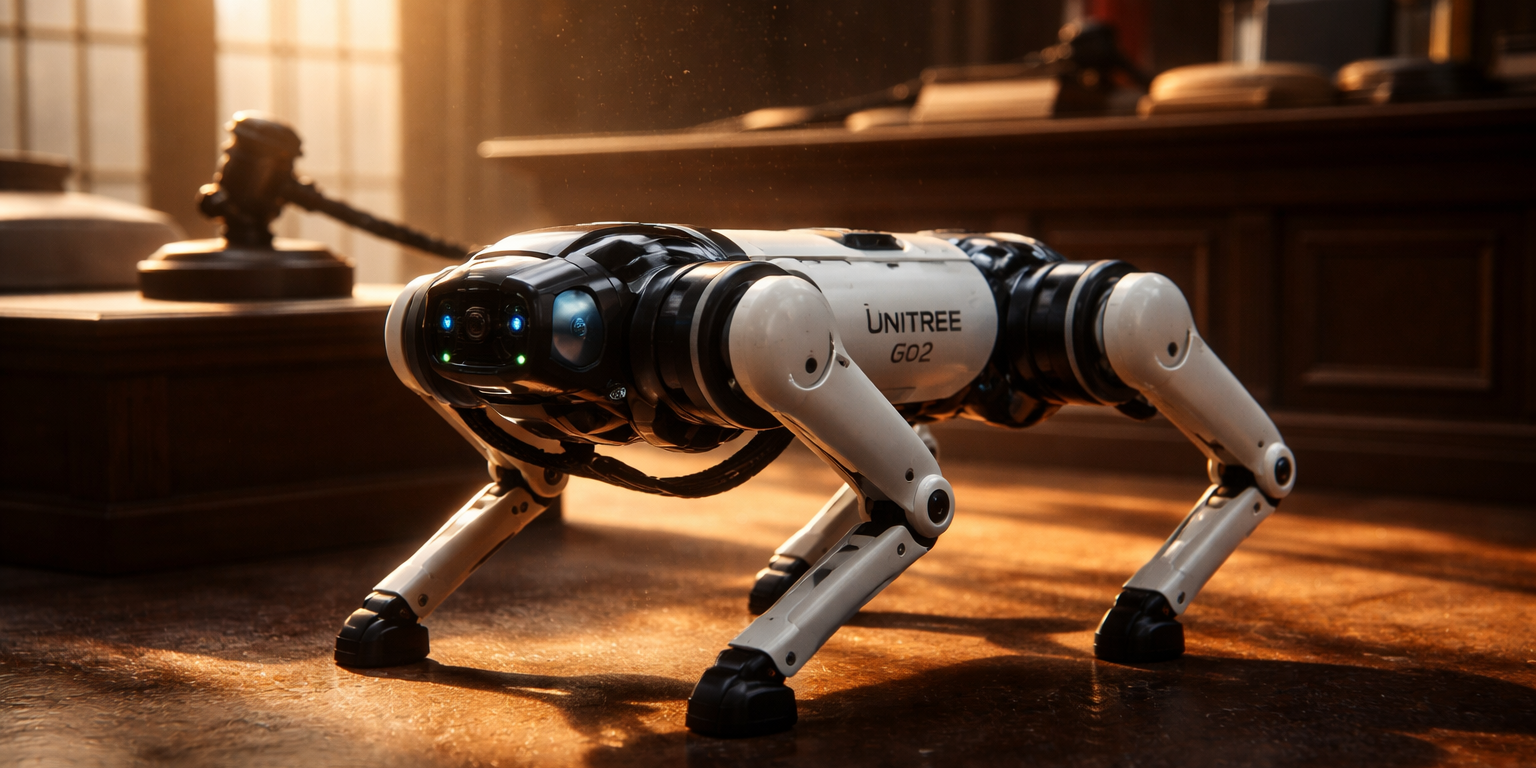
Five days separated the filing of a patent titled "An Electronic Dog" and the launch of two infringement lawsuits against Unitree Robotics, a timeline China's Supreme People's Court found so suspicious it declared the entire legal action malicious. The court's decision, handed down in late July 2026, dismissed claims brought by Luweimei Company against Unitree's Go2 consumer quadruped and its A2 industrial model. For Unitree, which ships roughly 3,000 robot dogs monthly to customers in 47 countries, the ruling eliminates a legal threat that had lingered since the cases first appeared on dockets in early 2025. The Supreme Court's willingness to label the litigation malicious rather than simply rule against the plaintiff signals a harder line from Chinese courts against what appears to be patent trolling in the robotics sector.
Luweimei's strategy fit a familiar pattern. Obtain a broad patent with minimal examination, immediately sue a commercially successful company, then leverage the cost and distraction of litigation to extract a settlement. The "Electronic Dog" patent at the center of the dispute covered general mechanical and control concepts common to most quadruped platforms, a scope so wide it would theoretically apply to Boston Dynamics' Spot, ANYbotics' ANYmal, and Ghost Robotics' Vision 60 as much as to Unitree's models. China's patent system, like most globally, struggles with such overly broad filings, particularly in fast-moving fields where fundamental technologies get implemented by multiple companies independently. Unitree chose to fight rather than settle, a decision that proved correct but consumed legal resources for more than a year. The company's Go2 retails for $1,600 in its base configuration, a price point that depends on high production volumes and thin margins. Extended legal uncertainty threatened supplier relationships and international distribution agreements, particularly in Europe where gray-market concerns already complicate robotics imports.
The Supreme Court's malicious litigation finding carries weight beyond this single case. Chinese courts have historically been reluctant to sanction plaintiffs for bringing weak patent claims, preferring to simply dismiss the cases on their merits. This ruling establishes precedent that could deter similar bad-faith filings, particularly important as Chinese robotics companies like Unitree, DEEP Robotics, and LimX Dynamics compete internationally against better-capitalized American and European firms. Unitree has been especially aggressive in export markets, with the Go2 becoming the best-selling quadruped globally by unit volume in 2025 according to ABI Research data. The company's success makes it an attractive target for litigation, both legitimate and opportunistic. The A2 industrial model, designed for inspection and surveillance applications, sells for approximately $12,000 and competes directly against platforms from Clearpath Robotics and Boston Dynamics in markets where intellectual property protection matters to enterprise buyers. A cloud of unresolved patent litigation would have undermined Unitree's positioning as a reliable supplier to utilities, mining operations, and government agencies.
The decision arrives as China's robotics industry navigates intensifying scrutiny in Western markets. The United States added multiple Chinese robotics firms to export control lists in 2025 and early 2026, citing national security concerns over data collection and dual-use technologies. European regulators have proposed country-of-origin labeling requirements for autonomous systems sold to critical infrastructure operators. Unitree's products, while positioned as commercial and research platforms, use many of the same components and algorithms as military-oriented quadrupeds under development at state-backed Chinese research institutes. The malicious litigation ruling helps Unitree's international standing by demonstrating that Chinese courts will protect legitimate innovators from predatory legal tactics, countering narratives that portray China's legal system as hostile to foreign patent holders while overly protective of domestic infringers. In practice, Unitree's primary competitive advantages are manufacturing scale and aggressive pricing rather than proprietary technology that couldn't be replicated by well-funded competitors. The Go2's bill of materials, estimated at roughly $900 by teardown analyses published in Nikkei Asia, relies on commodity components from global suppliers rather than custom Chinese-developed subsystems.
What to Watch: Monitor whether the Supreme Court's malicious litigation standard gets applied in pending robotics patent cases, particularly suits involving DEEP Robotics and several humanoid developers. Track Unitree's planned production expansion in Hangzhou, scheduled for Q4 2026, which will determine if the company can maintain Go2 pricing against emerging competition from Korean and Indian manufacturers. Watch for any appeals or related filings from Luweimei Company, which could signal whether the plaintiff network behind these cases will attempt similar actions in other jurisdictions. Additionally, observe European customs data for changes in Unitree import volumes following this ruling, as distributors in Germany and the Netherlands had reportedly delayed orders pending legal clarity.