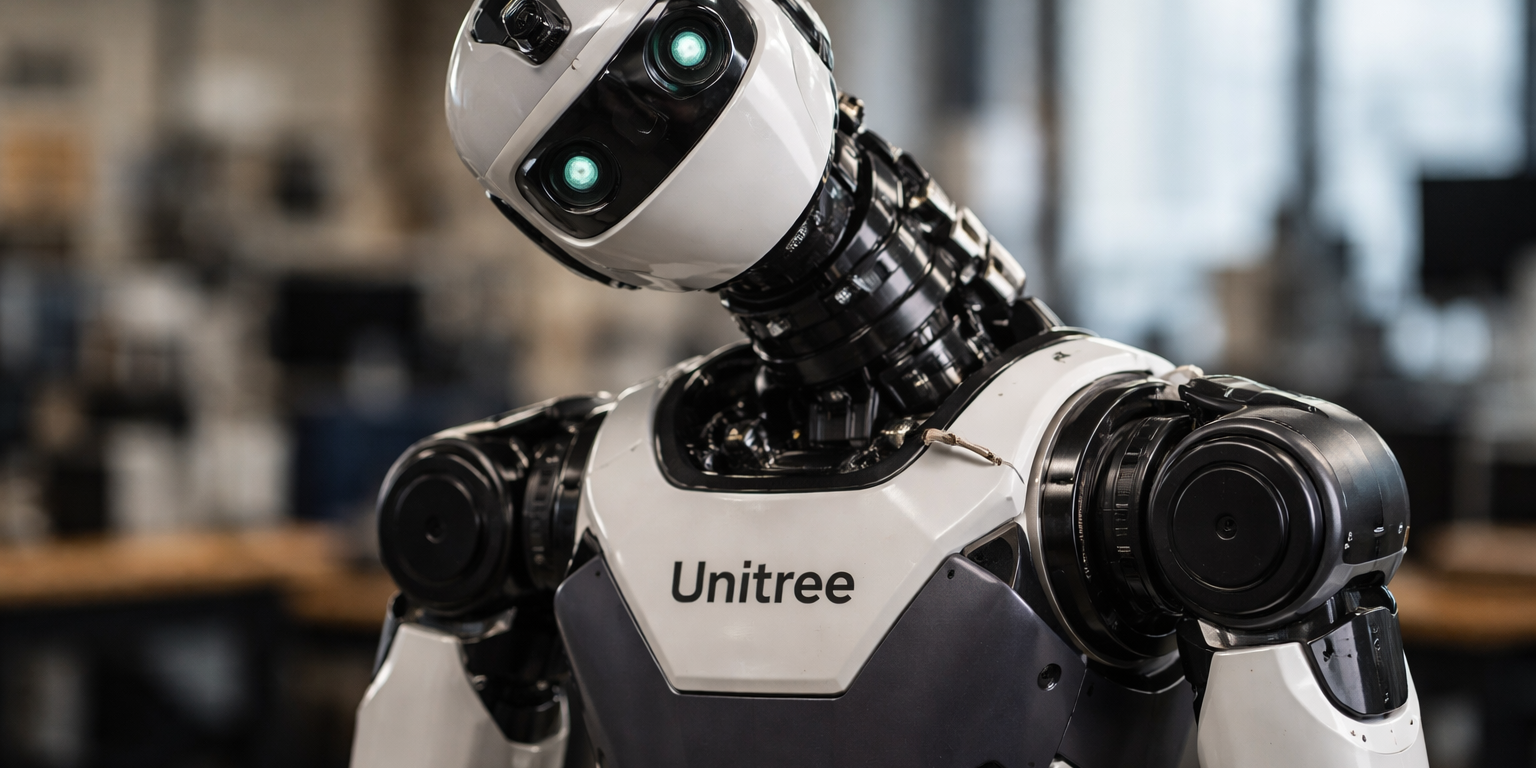
Unitree Robotics now ships a humanoid with independent neck motion as standard hardware. The G1+, launched this month by the Hangzhou manufacturer, adds two cervical degrees of freedom and bumps peak shoulder-and-waist motor torque to 120 newton-meters, a 33 percent increase over the base G1 released in mid-2025. The company has priced the standard configuration at RMB 95,000, or roughly $13,300 at current exchange rates, with an EDU variant available through direct sales channels. That puts the platform within range of university labs and mid-tier industrial research groups, not just venture-backed startups.
Unitree entered the humanoid segment eighteen months ago with the H1, a research platform aimed at the same market Boston Dynamics and Agility Robotics target with Atlas and Digit. The G1 followed as a lower-cost derivative with simplified kinematics and off-the-shelf actuators. The G1+ represents the first major hardware refresh of that line. Beyond the neck joints, the upgrade includes enhanced perception hardware, revised human-robot interaction protocols, and longer battery endurance, though Unitree has not published runtime figures under controlled load testing. The company has also declined to specify whether the torque boost comes from new motor windings, updated gearing ratios, or higher voltage rails. Engineers evaluating the platform for manipulation tasks will want those details before committing to development timelines.
The neck articulation matters more than it appears. Most low-cost humanoids mount cameras and LiDAR on rigid frames, forcing the entire torso to reorient when the perception stack needs a new vantage. That burns power and introduces latency into closed-loop control. Two cervical degrees of freedom allow the head to track objects independently while the torso stabilizes or continues a manipulation sequence. It is a feature Boston Dynamics implemented on Atlas years ago but one that has been absent from sub-$20,000 platforms. Unitree's decision to include it as standard hardware, rather than an optional module, suggests the company sees humanoid perception as a bottleneck worth solving at the mechanical layer. That aligns with broader industry movement toward embodied AI, where sensor placement and actuation speed directly limit model performance regardless of compute resources.
The pricing structure reveals Unitree's go-to-market strategy. At $13,300, the G1+ undercuts Figure's Figure 02 and 1X Technologies' NEO by wide margins, both of which have been discussed in the $20,000 to $30,000 range for commercial variants expected by late 2027. It also sits below Agility's published per-unit cost for Digit, which the company has indicated runs above $50,000 in small-batch production. Unitree is betting that research labs and systems integrators will tolerate narrower safety margins and less software support in exchange for capital efficiency. The EDU version likely includes ROS 2 integration, simulation environments, and extended warranty terms, but the company has not published a public price list. That opacity is standard practice in the Chinese robotics market, where volume buyers negotiate directly and published MSRPs serve mainly as anchors.
The broader context is a humanoid arms race entering its hardware commoditization phase. Tesla continues development on Optimus with volume production targets sometime in 2027. Sanctuary AI has raised over $100 million for its Phoenix platform. Apptronik is building Apollo units for pilot deployments in logistics and manufacturing. Every participant faces the same constraint: getting per-unit cost below $15,000 without sacrificing reliability or safe human interaction. Unitree's approach, shipping incremental hardware upgrades on an existing platform rather than redesigning from scratch, mirrors the strategy that made DJI dominant in drones. Whether that works for bipedal robots, which face tighter tolerances and harsher operating conditions than quadcopters, remains an open question. But the G1+ gives researchers a new baseline to test manipulation algorithms and whole-body control without waiting for Figure or Tesla to open their order books.
What to Watch: Unitree has not announced US distribution for the G1+, but gray-market imports will likely appear through academic procurement channels within 60 days. Track whether Figure AI or Agility adjusts pricing ahead of their 2027 commercial launches in response to this sub-$15,000 threshold. Also monitor whether Unitree publishes manipulation benchmarks or open-sources its neck control stack, both signals of whether the company intends to build an ecosystem or remain a hardware vendor. Finally, watch for teardowns from research labs—peak torque claims need independent verification under load, and the robotics community has a strong culture of public testing.