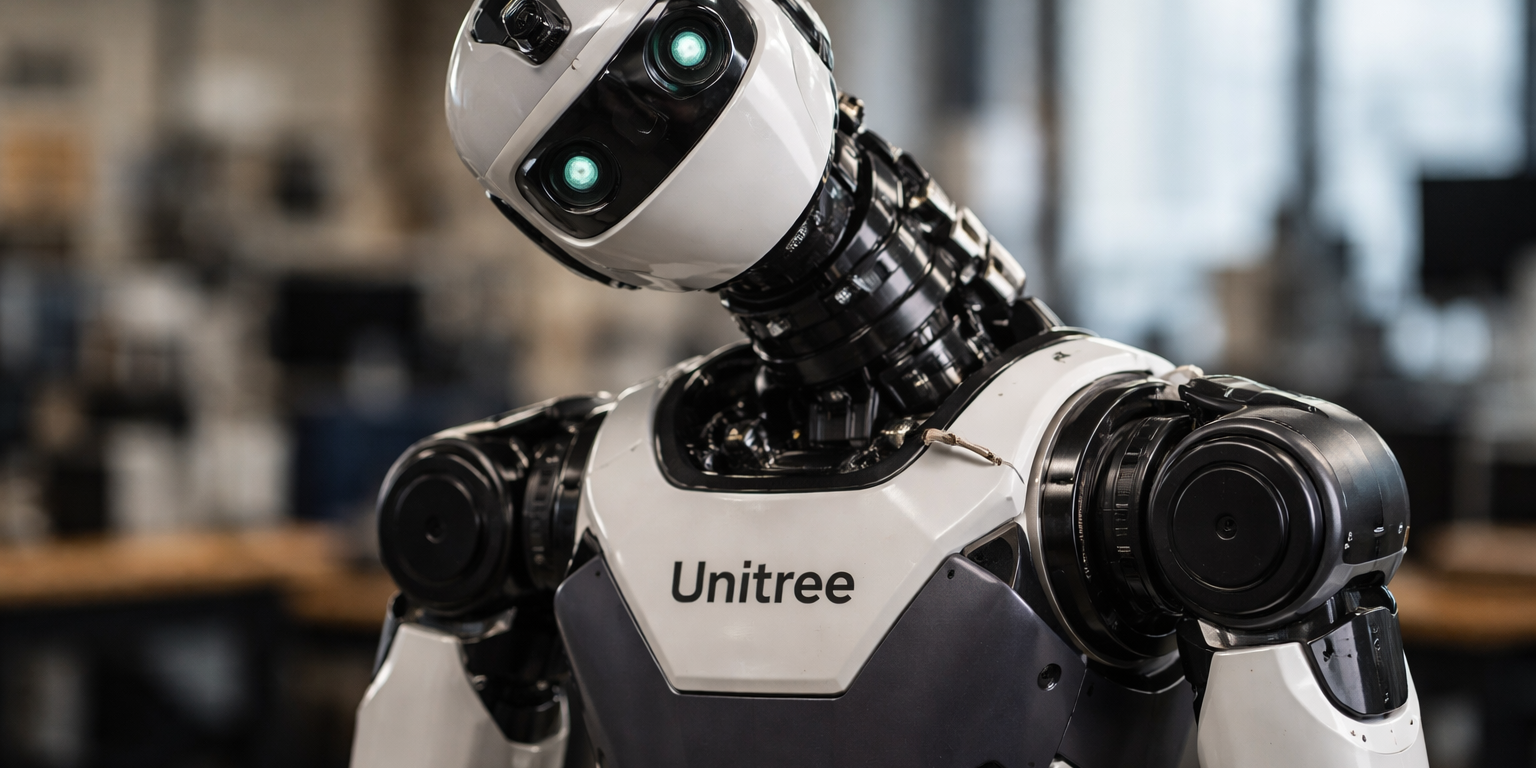

Unitree Robotics, the manufacturer behind the $16,000 G1 humanoid and sub-$2,000 Go2 quadruped, has filed preliminary documents for an initial public offering with the Shanghai Stock Exchange, according to regulatory filings published September 18. The company declined to specify a target valuation or offering size, but three people familiar with the process said Unitree aims to raise between $400 million and $600 million at a valuation exceeding $3 billion. That would place the seven-year-old firm alongside Boston Dynamics and Agility Robotics in terms of private market assessment, though neither of those competitors has pursued public listings. Unitree's filing comes seven months after the company shipped its 10,000th quadruped unit and three months after it began volume production of the G1 humanoid at a new 120,000-square-meter facility in Hangzhou's Qiantang District. The IPO prospectus lists research and development expansion, international sales infrastructure, and supply chain redundancy as primary uses of proceeds.
Simultaneously, UniX AI—Unitree's majority-owned software and artificial intelligence subsidiary—opened engineering and sales offices in Singapore, Seoul, Tokyo, and Munich between July and September 2026. Each location now employs between twelve and twenty-five staff, primarily focused on adapting Unitree's simulation environments and reinforcement learning pipelines for regional compliance requirements and local partner integrations. The Singapore office, which opened first in early July, has already signed distribution agreements with two regional system integrators serving logistics and warehousing clients. South Korea's office supports partnerships with Hyundai Motor Group and LG Electronics, both of which have evaluated Unitree quadrupeds for factory inspection tasks. Japan's Tokyo presence targets manufacturing customers, while the Munich operation focuses on automotive and industrial automation sectors across the European Union. UniX AI operates semi-independently from Unitree's hardware division, with separate leadership reporting to founder Wang Xingxing, who remains CEO of both entities. The subsidiary generated approximately $42 million in revenue during the first half of 2026, mostly from simulation software licenses and custom training pipelines sold to external robotics developers, according to a person briefed on the financials.
The international expansion addresses a persistent challenge for Chinese robotics manufacturers: despite competitive hardware pricing and rapid iteration cycles, most struggle to gain traction outside Asia. Unitree sold roughly 73 percent of its units within China during 2025, a ratio the company aims to invert by 2028. Regulatory barriers partially explain the imbalance—export controls on certain AI training technologies and heightened scrutiny of Chinese tech firms in Western markets have slowed adoption. But product-market fit plays a role too. European and North American buyers often demand different feature sets, documentation standards, and support structures than Asian customers. UniX AI's regional offices exist specifically to bridge that gap, tailoring software interfaces and training protocols to match local expectations. The Munich team, for instance, has spent three months adapting Unitree's Isaac Gym-based simulation stack to satisfy German machinery safety directives, a requirement that barely registers in China's regulatory framework. Meanwhile, the Seoul office works with partners to integrate Unitree's quadrupeds into South Korea's emerging standards for autonomous mobile robots in semiconductor fabs, where contamination control and navigation precision exceed typical warehouse requirements.
Unitree's IPO timing reflects broader momentum in the robotics capital markets. At least six robotics firms have gone public or filed to do so since January 2026, including two SPAC mergers and three traditional listings. Investor appetite has strengthened as commercial deployments move beyond pilot projects into volume orders—warehouse automation alone saw installed base growth of 37 percent year-over-year through Q2 2026, according to the International Federation of Robotics. Humanoid development, once dismissed as science fiction by institutional investors, now attracts serious capital after Tesla demonstrated Optimus performing useful factory tasks at its Fremont plant earlier this year and Figure AI closed a $675 million Series B in March. Unitree benefits from offering both quadrupeds and humanoids at price points 40 to 60 percent below Western competitors, though questions remain about after-sales support and software maturity. The company ships approximately 1,200 quadrupeds monthly and projects humanoid volume will reach 300 units per month by year-end 2026 as production scales. Those figures remain modest compared to traditional industrial robot makers like Fanuc or ABB, which ship tens of thousands of units quarterly, but represent rapid growth for a category that barely existed commercially three years ago.
What to Watch: Track Unitree's IPO pricing and allocation when the offering formally launches, likely in late Q4 2026 or early Q1 2027, for signals on public market appetite for robotics hardware plays with China exposure. Monitor whether UniX AI's European and North American offices translate into meaningful order flow by mid-2027—initial distribution agreements rarely predict sustained revenue. Watch competitors like Boston Dynamics and Agility Robotics for pricing responses if Unitree gains share in Western logistics markets, where the Go2 undercuts Spot by approximately $50,000 per unit. Finally, observe how Hyundai and LG's pilot deployments in South Korea perform through the end of 2026, as those partnerships could validate Unitree's quality and support capabilities outside its home market.