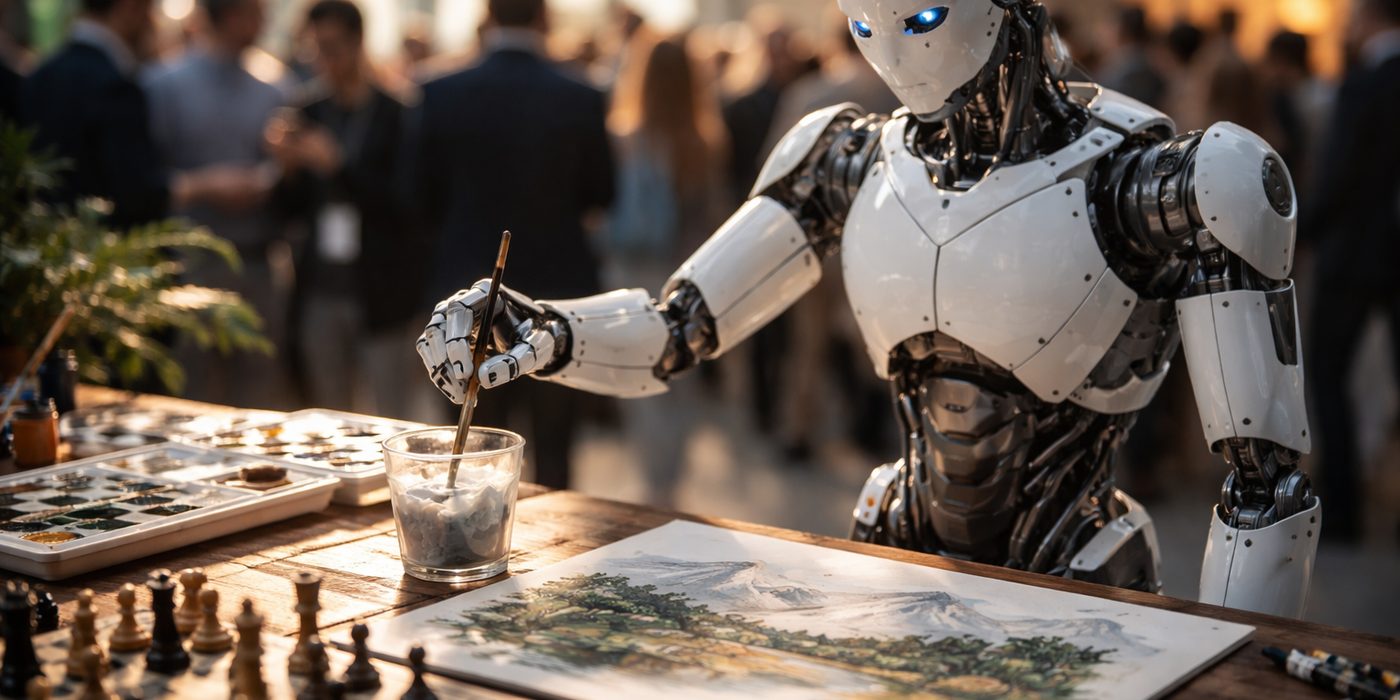
Dynamically replacing the water in a brush cup is not a task anyone programs into a humanoid on purpose. It is the kind of incidental, easy-to-forget step that separates a robot performing a scripted demo from one that actually understands what painting requires. That, according to Unitree Robotics founder and CEO Wang Xingxing, is what his company's machines are now doing. Speaking Thursday at the China International Import Expo in Shanghai, Wang said Unitree's humanoids can paint pictures and play chess without prior training, using OpenAI's GPT-6 to sequence the physical steps, including rinsing brushes and blending pigments, as the work unfolds.
The claim arrives with an important caveat: it comes from the CEO's own remarks at a trade fair, not from a published benchmark, a peer-reviewed paper, or an independent demonstration. Nobody outside Unitree has yet described the success rate, the number of attempts, or how much scaffolding sits between the language model and the actuators. Still, the direction of travel is consistent with where the field has been heading. Through 2025 and into 2026, humanoid developers have increasingly treated large multimodal models as a planning layer, translating a vague instruction into a chain of sub-goals that a lower-level controller then executes. Wang's description of unprompted brush-water changes fits that architecture, in which the model infers necessary steps rather than following a hand-written script.
Unitree is an unusual company to be making this argument. Based in Hangzhou, it built its reputation on aggressively priced hardware rather than on software: the G1 humanoid and the H1 before it undercut Western rivals by margins that made researchers and universities take notice, and its quadrupeds became a common sight in labs worldwide. That cost advantage matters here. A frontier language model can reason about painting, but it needs a body that is dexterous, repeatable, and cheap enough to be wasted on experiments. Unitree has spent years optimizing exactly that part of the stack, which makes the company a natural testbed for anyone who wants to see how far a general-purpose model can stretch across physical tasks.
For engineers, the sharper question is where the intelligence actually lives. Painting and chess are deliberately chosen showpieces, one demanding continuous fine manipulation and the other demanding discrete strategic reasoning, and handling both with a single model suggests the planning layer is carrying more weight than it did even a year ago. But planning is only half the problem. Brushwork requires force control, compliance, and visual feedback at rates no cloud-hosted model can supply on its own, so the interesting engineering lies in the handoff between the model's high-level intent and the onboard controllers that keep the arm steady. Wang's remarks did not detail that boundary, and it is precisely the detail investors and integrators will want.
There is also a strategic wrinkle that deserves attention. Unitree, a Chinese manufacturer, is crediting an American model as the engine of its most visible capability claim. That dependency is notable at a time when export controls, data-residency rules, and national AI ambitions are pulling the two ecosystems apart. If a flagship Chinese humanoid relies on a US frontier model for its reasoning, it raises practical questions about latency, access continuity, and what happens if that supply line tightens. It also underscores a quiet reality of the sector: hardware has become increasingly commoditized and increasingly Chinese, while the most capable general-purpose reasoning still sits largely with a handful of US labs.
The commercial stakes are real. Unitree has been widely reported to be preparing a public listing, and a credible demonstration of general-purpose intelligence would strengthen the narrative that its robots are platforms rather than novelties. Rivals will read the claim closely. Companies pairing humanoid bodies with foundation models, including Figure AI, Agility Robotics, and Tesla with Optimus, all face the same integration challenge, and a cheaper body that can borrow a stronger brain narrows the gap they have been counting on. Whether painting and chess translate into warehouse picking or factory assembly is a separate matter, but the demo is aimed at proving the underlying generality.
What to Watch The first test is evidence: look for Unitree to release video, a technical write-up, or third-party demonstrations in the coming weeks that show failure rates and the degree of human intervention behind the painting and chess feats. Track whether OpenAI confirms or comments on the GPT-6 integration, since a joint statement would materially change how seriously the claim is read. Watch Unitree's reported IPO preparations and any updated pricing on the G1 and H1, which would show whether the company is pivoting from selling hardware to selling capability. Finally, monitor how Figure AI, Agility Robotics, and Tesla's Optimus program respond with their own foundation-model demos before the end of 2026.