
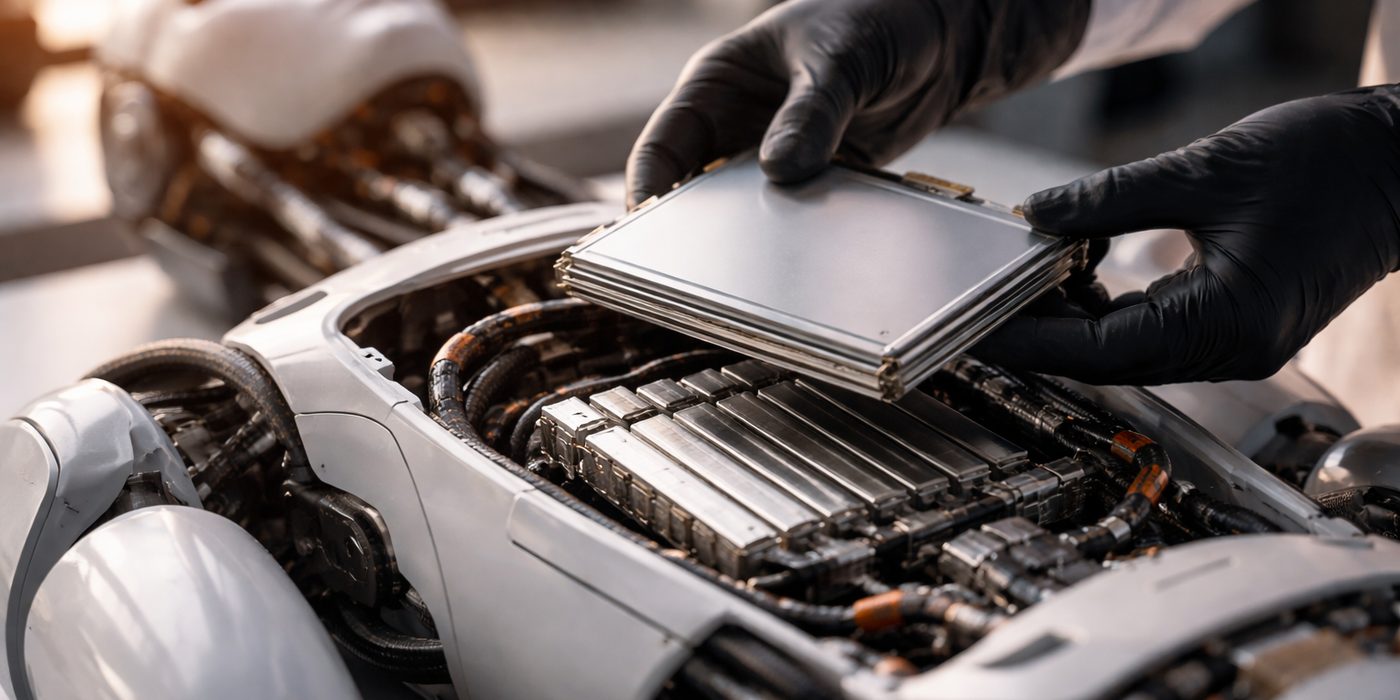
The battery pack in the torso of a humanoid robot is a strange place to find the first real commercial foothold for solid-state chemistry, but that is where it has landed. Iron, the anthropomorphic platform at the center of the story, is the first humanoid to receive a solid-state cell, according to reporting from Notebookcheck.net, and the pairing makes more sense than it first appears. Solid-state batteries have spent more than a decade promising to transform electric vehicles, yet cost and manufacturing yield have kept them out of showrooms. A humanoid needs something different. It needs a lot of energy in very little volume, and it can absorb a high cost per kilowatt-hour because it carries so few of them.
The economics explain the timing. A passenger EV pack runs to 60 kilowatt-hours or more, so every extra dollar per kilowatt-hour multiplies into thousands of dollars on the sticker. A humanoid robot typically carries somewhere between one and three kilowatt-hours. Even at several times the price of conventional lithium-ion, the pack remains a modest slice of the bill of materials for a machine that costs tens of thousands of dollars to build. That arithmetic is why Notebookcheck framed robots and drones as the natural entry point: any device where high energy density must fit inside a constrained space can treat solid-state's premium as a rounding error rather than a dealbreaker.
For engineers, the appeal goes beyond raw capacity. Humanoids are brutal on batteries. Walking, balancing, and lifting produce sharp, uneven current draws, and the pack sits inside a torso where heat has few places to go. Conventional lithium-ion cells use a liquid electrolyte that is flammable and degrades under thermal stress, which forces designers to add cooling hardware, protective casings, and safety margins that eat into the very volume they are trying to save. A solid electrolyte can tolerate higher temperatures and removes the liquid fire risk, which in principle lets a designer shrink the thermal management system and put more active material in the same space. Every gram saved in the torso is a gram the leg actuators no longer have to lift.
Runtime remains the number that buyers care about, and it is the one that has quietly capped humanoid deployments. Most commercial bipedal platforms deliver roughly two to four hours of useful work per charge, forcing operators into battery swaps or charging breaks that undercut the labor-replacement pitch. Warehouse and factory customers evaluate these machines against shift length, not demo-day spectacle. If a solid-state pack can stretch that window meaningfully without adding mass, it changes the unit economics of a pilot program. The open question for Iron is whether the real-world gains match the chemistry's theoretical advantage once the cell is wrapped in packaging, wired into a battery management system, and subjected to the shocks of bipedal locomotion.
The larger lesson for the industry is about supply chains rather than any single robot. Solid-state manufacturers have struggled to find a customer willing to pay early-production prices while yields improve, and humanoids may be the first segment willing to do so at volume. That creates a feedback loop: robot makers fund the learning curve, cell producers refine their processes, and costs fall toward the thresholds that eventually matter for vehicles. If it works, the humanoid category will have done something unusual for a young industry, acting as the proving ground for an adjacent technology rather than merely consuming it. Competitors building bipedal platforms will be watching the Iron results closely, because a credible runtime advantage would pressure every rival still relying on conventional cells.
What to Watch Track whether Iron's maker publishes verified runtime and cycle-life figures over the coming weeks, since independent numbers will matter far more than chemistry claims. Watch for announcements from other humanoid builders, including Figure, Agility Robotics, and Unitree, about their own solid-state pilots before the end of 2026. Pay attention to cell suppliers' pricing disclosures and yield updates in Q4 earnings calls, which will show whether the premium is shrinking. Finally, monitor any safety certification filings for solid-state packs in humanoid enclosures, because regulatory acceptance will determine how quickly the technology moves from a single debut to a standard option.