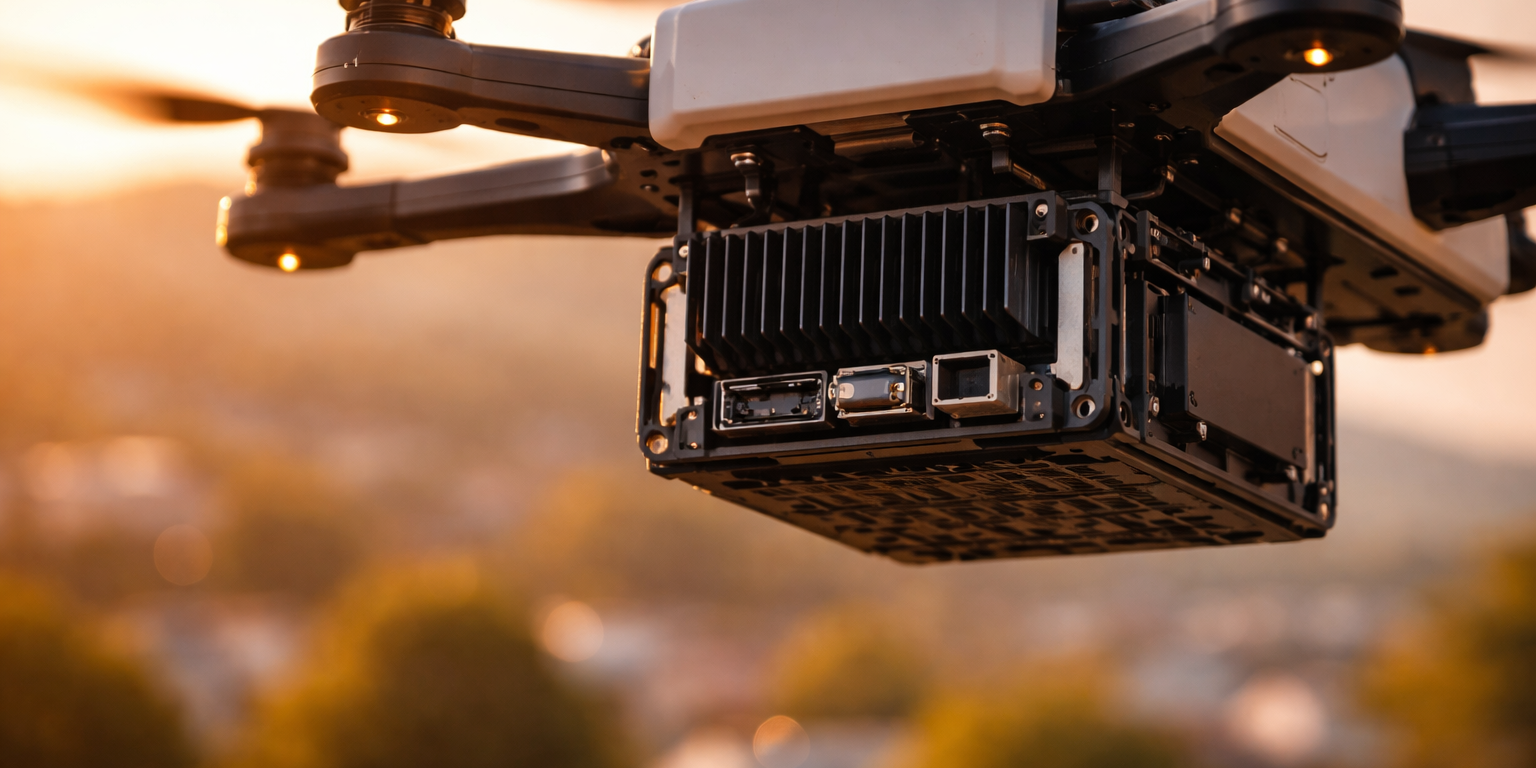
Advantech shipped its ASR-D501 AI companion computer on September 30, designed specifically for engineers building autonomous drones that need onboard inference without the thermal and power penalties of desktop-class GPUs. The unit measures 96mm × 90mm × 37mm and draws under 25 watts at full load, specifications that matter when flight time dictates whether a delivery drone completes its route or returns to base early. The company built the platform around an AMD Ryzen Embedded V3000 series processor, pairing four Zen 3 CPU cores with integrated Radeon graphics capable of 1.6 teraflops for vision workloads like object detection and obstacle avoidance.
The ASR-D501 arrives as commercial drone developers face mounting pressure to internalize autonomy rather than rely on consumer-grade flight controllers or third-party software stacks. Advantech's move mirrors broader industry consolidation around vertically integrated hardware-software platforms. The companion computer ships with PX4 autopilot firmware and ROS 2 middleware pre-installed, eliminating weeks of integration work that typically consumes early-stage engineering budgets. Advantech also bundled sensor fusion libraries optimized for the AMD GPU architecture, targeting developers who need simultaneous localization and mapping (SLAM) or visual-inertial odometry running in real time. The platform supports up to four MIPI-CSI camera inputs and dual gigabit Ethernet ports, allowing concurrent streams from forward-facing, downward-facing, and stereo depth cameras without bottlenecking data throughput.
Advantech operates primarily as an industrial PC supplier to factory automation and transportation customers, segments where rugged, passively cooled hardware justifies premium pricing. The ASR-D501 represents the company's first purpose-built drone product, entering a market where NVIDIA Jetson modules claim roughly 60 percent share among commercial UAV startups, according to third-party developer surveys conducted in early 2026. Auterion, the Swiss company that commercializes PX4, announced partnerships with Intel and Qualcomm earlier this year to create reference designs for its Skynode flight computer. Those deals underscore how drone autonomy increasingly depends on which silicon vendor subsidizes software integration. Advantech's differentiation hinges on x86 compatibility—the Ryzen Embedded architecture runs standard Linux distributions and Docker containers without the ARM-specific toolchain adjustments required by Jetson or Snapdragon platforms. That architectural choice appeals to developers porting machine learning models trained on x86 workstations, though it sacrifices the power efficiency ARM vendors tout.
The unit includes a CAN FD bus interface for connecting to external flight controllers, an architecture common in enterprise drones where redundancy requirements mandate separate autopilot hardware. Advantech positioned the ASR-D501 as a perception and planning layer rather than a replacement for dedicated flight controllers like the Pixhawk or Cube series. That design philosophy aligns with current aerospace certification norms, which treat AI-driven navigation as advisory rather than safety-critical. The thermal envelope allows sustained operation at temperatures up to 60°C, relevant for drones operating in Middle Eastern oil and gas inspection or equatorial agricultural surveys. Advantech rated the board for 3G vibration resistance and EN 50155 shock compliance, industrial standards that exceed typical consumer electronics but fall short of military MIL-STD specifications.
Pricing remains undisclosed, though Advantech's historical positioning suggests the ASR-D501 will retail between $800 and $1,200 in volume, competing directly with NVIDIA Jetson AGX Orin modules that street around $1,000. The company manufactures the boards in Taiwan with AMD processors fabbed at TSMC's 7nm node. Lead times currently sit at eight weeks for orders under 100 units, a constraint that may limit adoption among startups prototyping on shortened funding runways. Advantech announced partnerships with sensor suppliers Leopard Imaging and LiDAR manufacturer Livox, both offering pre-validated hardware bundles that reduce procurement complexity. The company also opened an SDK repository on GitHub with sample code for object tracking, geofencing, and return-to-home logic, though the repository showed only 47 commits as of late September, suggesting documentation maturity lags hardware availability.
What to Watch: Monitor whether Advantech secures design wins with established drone manufacturers like Skydio, DJI Enterprise, or Parrot by Q1 2027—those relationships determine whether the ASR-D501 moves beyond evaluation units. Track AMD's embedded roadmap for next-generation Ryzen parts with improved NPU performance, which would close the AI inference gap with ARM competitors. Watch for Auterion certification announcements, as PX4 compatibility alone does not guarantee inclusion in Auterion's commercial Skynode ecosystem. Finally, observe pricing pressure if NVIDIA refreshes Jetson at lower tiers or Qualcomm accelerates its Flight RB5 successor timeline.