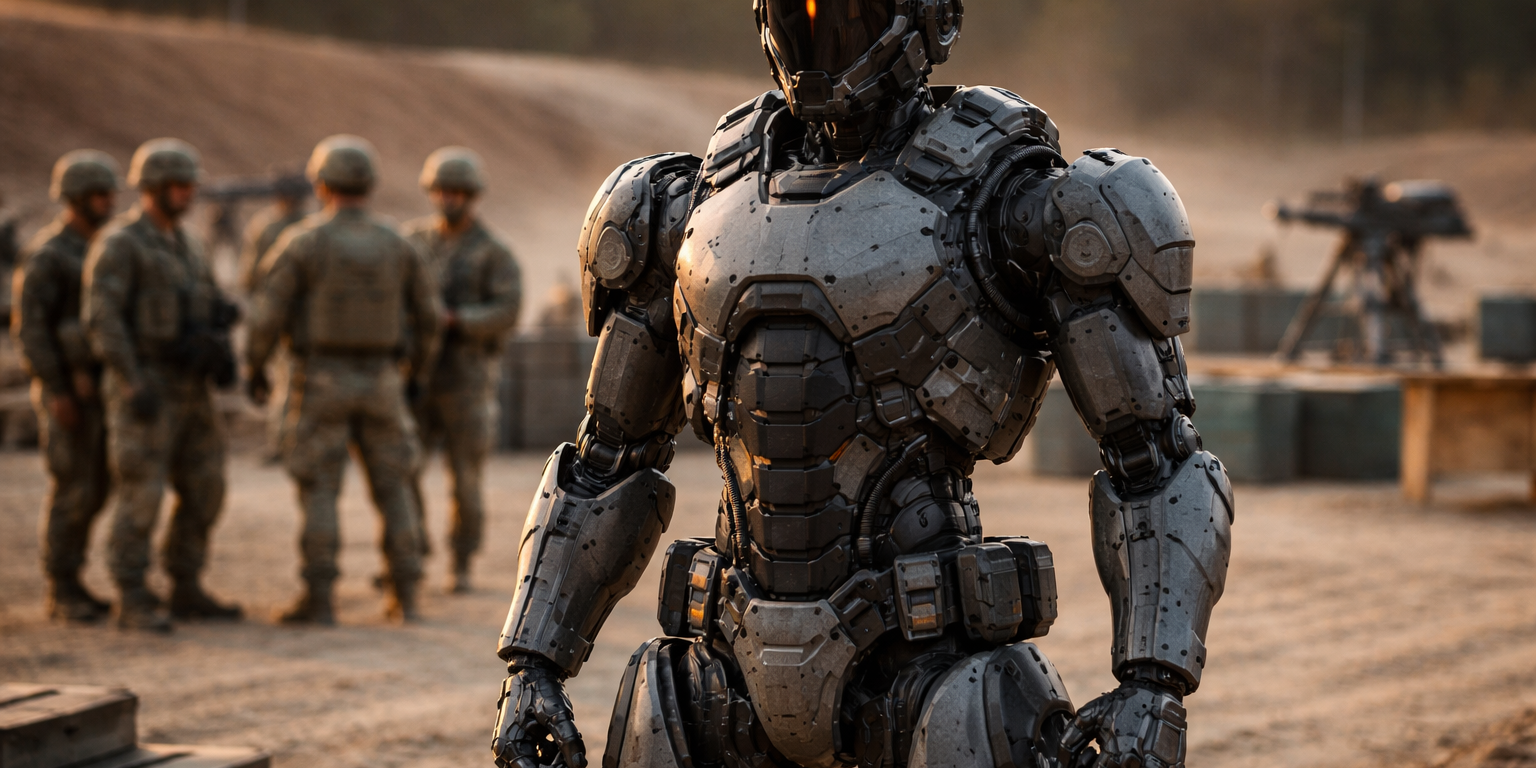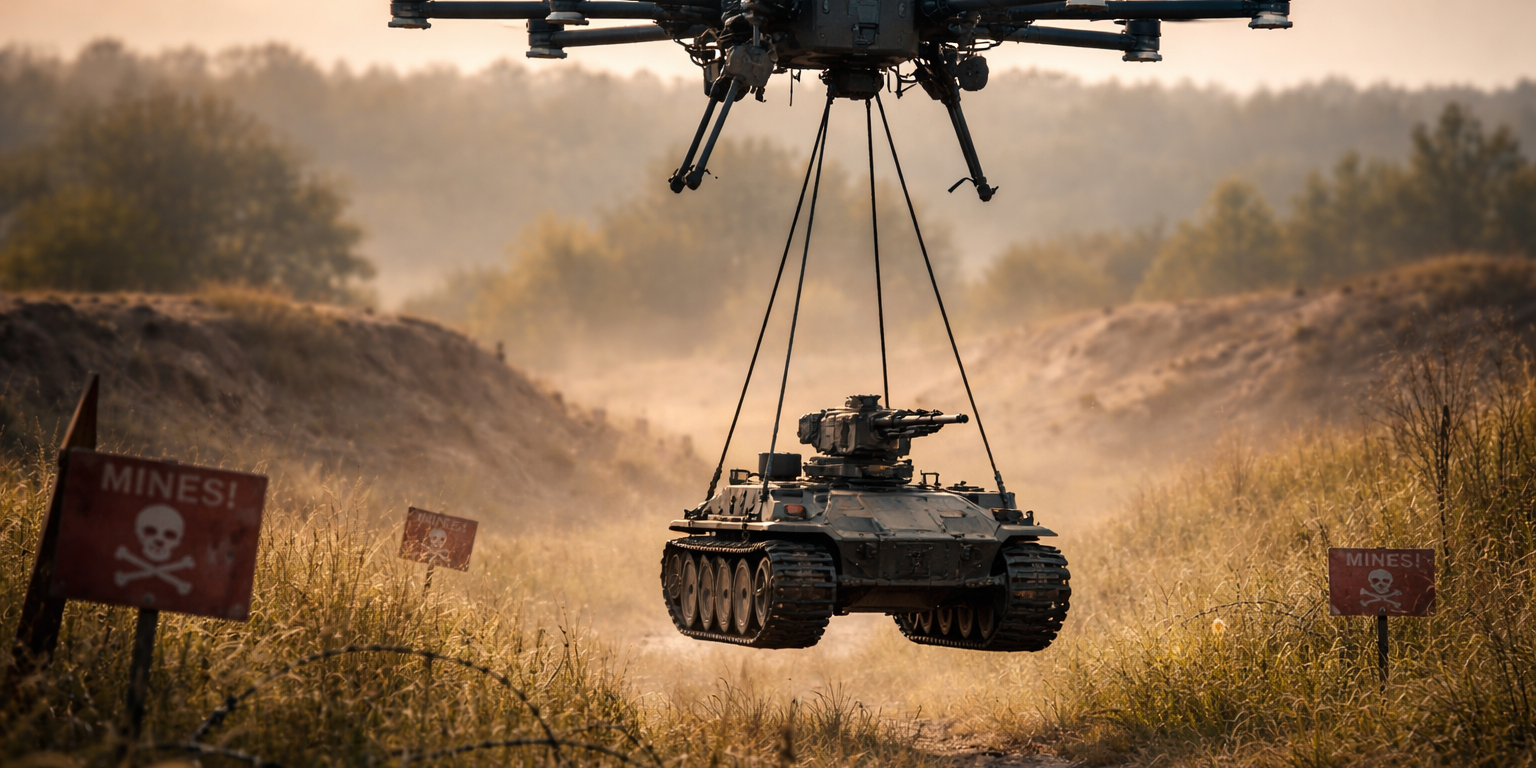
A Ukrainian heavy-lift multicopter delivered an armed unmanned ground vehicle into a combat zone in footage verified by multiple defense analysts this week, representing the first confirmed operational deployment of aerial-inserted ground robots in warfare. The video, which circulated through military channels before reaching public forums, shows a commercial-style multirotor drone carrying what appears to be a tracked UGV equipped with a remotely operated weapon system, lowering the platform into position before detaching and returning to base. The insertion occurred in an area Ukrainian forces described as heavily mined, where foot patrols and conventional vehicle approaches had proven impossible.
The tactic solves a problem that has vexed ground commanders since the proliferation of anti-personnel mines and sensor networks made traditional infiltration prohibitively costly. Ukrainian engineers have been experimenting with heavy-lift drone platforms capable of carrying payloads between 30 and 60 kilograms for the past eighteen months, initially focusing on ammunition resupply and casualty evacuation. The shift to weaponized ground robots represents a logical extension of that work, but one with implications far beyond Ukraine's immediate tactical needs. Defense contractors in the United States, Israel, and Turkey have been developing similar concepts in laboratory settings, but none have progressed to field deployment. Ukraine's battlefield necessity has compressed what would normally be a decade-long development cycle into months.
The specific hardware visible in the footage includes a hexacopter or octocopter configuration with a suspended cargo system, though the manufacturer remains unconfirmed. Ukrainian defense officials declined to comment on the platform's origin, citing operational security, but analysts noted similarities to commercially available agricultural drones modified for military use. The ground robot itself appears to be a custom-built platform rather than a repurposed commercial unit, featuring a low-profile chassis, tracked locomotion, and what analysts believe is a 7.62mm or 5.45mm remote weapon station. Battery life and communication range remain the limiting factors for both air and ground components. Current generation heavy-lift multicopters typically operate for 15 to 25 minutes under load, restricting insertion range to roughly 8 to 12 kilometers from the launch point. The ground robot, once deployed, faces similar endurance constraints, with most tracked UGVs in this weight class operating for 2 to 4 hours on a single charge under combat conditions.
The broader defense industry has taken notice. Three separate defense contractors contacted by RoboticsIntl.com within 48 hours of the footage's release indicated they are accelerating programs related to air-mobile ground robotics, with two specifying they are now targeting 2027 for prototype demonstrations previously scheduled for 2028 or 2029. One U.S. Army program manager, speaking on background, acknowledged that doctrine for heliborne UGV insertion has existed in planning documents since 2019 but lacked urgency until Ukrainian forces demonstrated viability. The tactical advantages are clear: mines and obstacles that stop wheeled or tracked vehicles mean nothing to an aerial insertion. Anti-aircraft systems must be positioned to defend against low-altitude, low-speed threats in addition to traditional fast-movers. And perhaps most significantly, the humans operating both the delivery drone and the ground robot can remain kilometers away from the forward edge of battle, reducing casualty risk while maintaining strike capability. The method is not without vulnerabilities. Electronic warfare can sever control links. Small arms fire can disable the delivery drone during its most vulnerable phase. And the ground robot, once inserted, must still contend with all the challenges facing any remotely operated platform: limited situational awareness, communication lag, and the ever-present risk of jamming or spoofing. But for operations in heavily contested areas where human presence is untenable, the calculus has shifted. The Ukrainian deployment demonstrates that current commercial drone technology, when paired with purpose-built ground robots, can execute missions that would otherwise require helicopter support or special operations teams.
What to Watch: Monitor procurement announcements from U.S. Army Futures Command and Marine Corps Warfighting Laboratory through the remainder of 2026 for solicitations related to air-mobile UGV systems. Track developments from Israel's Elbit Systems and Rafael Advanced Defense Systems, both of which have active programs in autonomous ground vehicles and have historically moved quickly to operationalize concepts proven in regional conflicts. Watch for export control restrictions on heavy-lift drone components, particularly flight controllers and power systems capable of military-relevant payload capacity, as governments reassess dual-use technology frameworks in light of this deployment.