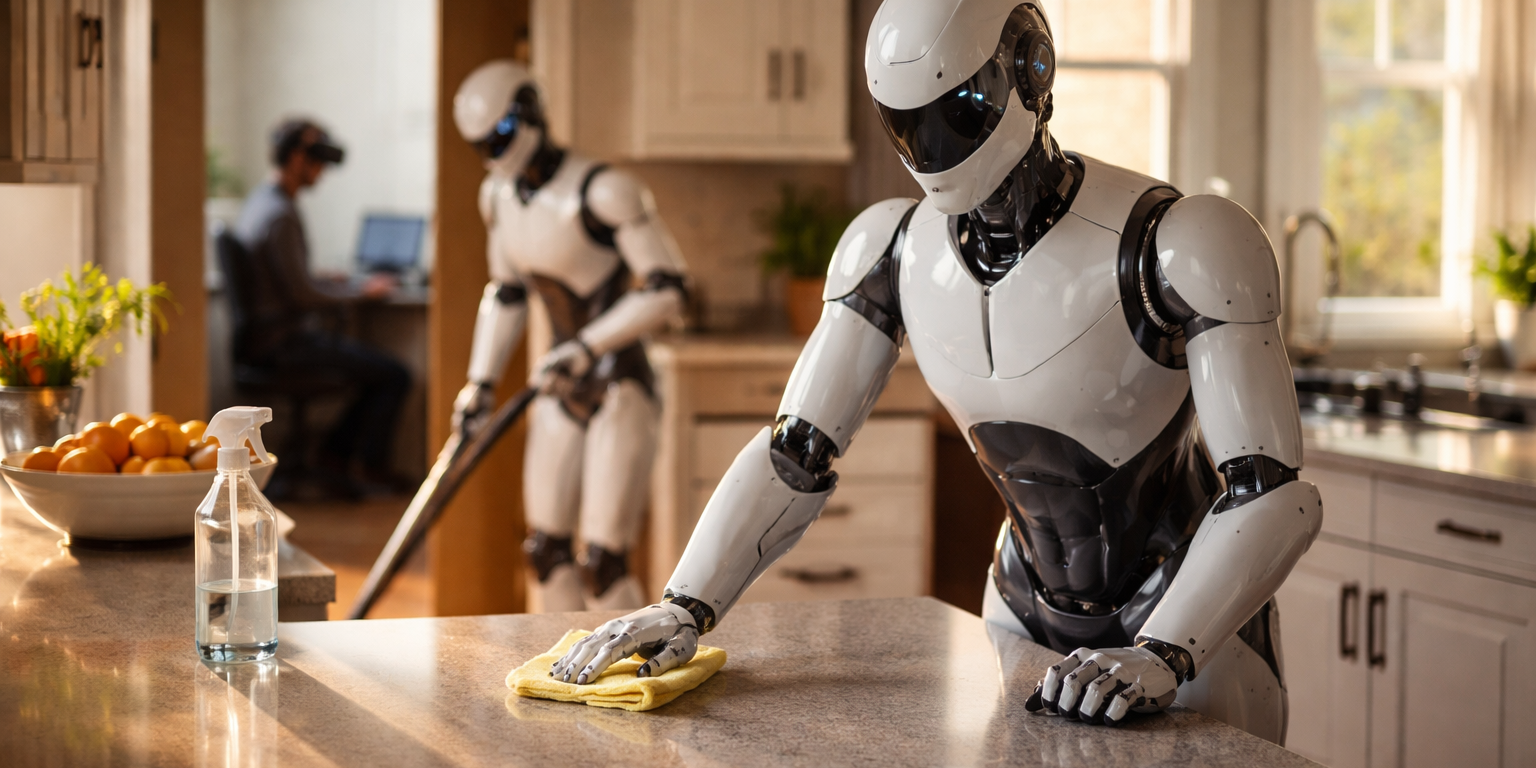
The robot that wiped the counter was not entirely working alone. That, more than the vacuuming or the surface cleaning, is the detail that defines a recent afternoon spent with two Tau Robotics humanoids, priced at more than $55,000 apiece and sent into a home to do the kind of chores that every household-robot pitch deck promises and almost none can yet deliver on their own. The machines vacuumed floors and cleaned countertops. They did so with help from humans working behind the scenes, a reality the reporter's account makes plain and one that any engineer evaluating the category should read as the central finding rather than a footnote.
The arrangement is familiar to anyone who has tracked the sector. Home humanoids have spent the past two years moving from stage demonstrations to actual domestic environments, and nearly every credible effort has leaned on some form of remote human assistance to bridge the distance between what a learned policy can do reliably and what a messy kitchen demands. Teleoperation fills the gaps: the unfamiliar object, the awkward grasp, the dishwasher rack that does not behave like the training data. It also generates the demonstration data that future autonomous models are trained on. In that sense the human in the loop is both a crutch today and a data engine for tomorrow, and the commercial question is how long the crutch has to stay.
That question is sharpened by the price. At $55,000 and up, a household humanoid costs roughly as much as a well-equipped compact car, and the buyer is not purchasing a finished appliance. They are purchasing access to a platform that performs some tasks autonomously, some with remote help, and some not at all. The title of the original piece, which asks whether such a robot can load the dishwasher, points straight at the hardest category of domestic work. Loading dishes demands dexterous manipulation of fragile, irregularly shaped objects, spatial reasoning about a cluttered rack, and recovery from small failures. Vacuuming a floor and wiping a flat counter are comparatively forgiving. The distance between those tasks is where most of the remaining engineering risk sits.
For investors and operators, the economics come down to a ratio that rarely appears in marketing materials: how many robot-hours does one human operator support? If a single remote pilot can supervise several machines, handling only the exceptions, the model begins to resemble a service business with falling marginal labor cost. If the ratio stays near one to one, the product is effectively an expensive telepresence rig, and the unit price looks hard to justify against hiring a human cleaner. Tau Robotics and its competitors have not published that figure, and it is arguably the single most informative number the category could disclose. Until it appears, buyers are evaluating capability on faith, and the reporter's afternoon offers one of the few independent glimpses of how much work the humans are really doing.
The broader read-through reaches beyond one company. Household deployment is the most unforgiving test environment in robotics, with no controlled lighting, no standardized objects, and customers who notice every failure. Whatever Tau Robotics learns from home placements feeds directly into the training loops that determine whether the category scales or stalls. Rivals building humanoids for the home are chasing the same dataset and facing the same tradeoff between showing progress and admitting dependence on remote labor. The companies that are candid about their autonomy rates will likely earn more durable trust than those that obscure them, because a buyer who discovers the human behind the curtain after purchase rarely forgives the omission.
What to Watch Watch for any disclosure from Tau Robotics on operator-to-robot ratios or the share of tasks completed fully autonomously, since that metric will determine whether the $55,000-plus price point is defensible. Track whether competing household-humanoid makers publish comparable autonomy figures through the end of 2026, and whether any announce dishwasher-loading or similar dexterous-manipulation benchmarks verified by outside reviewers. Pay attention to follow-on hands-on coverage from independent reporters over the next 60 to 90 days, which will show whether the assisted performance seen in this home holds across different environments. Finally, monitor funding and pricing moves in the segment, because a price cut or a subscription model would signal that vendors believe autonomy is improving fast enough to change the unit economics.