A $400 million check is a loud way to say you are tired of watching a single competitor own an entire category. Stryker, the Kalamazoo, Michigan, medical technology giant best known for its Mako orthopedic robot, has committed that sum to CMR Surgical and will act as the exclusive U.S. sales agent for the company's Versius portfolio. The structure matters as much as the number. Stryker is not acquiring CMR outright. It is buying a stake and a distribution franchise, which lets it sell a soft-tissue robot into American hospitals without absorbing the full cost and regulatory burden of building one from scratch.
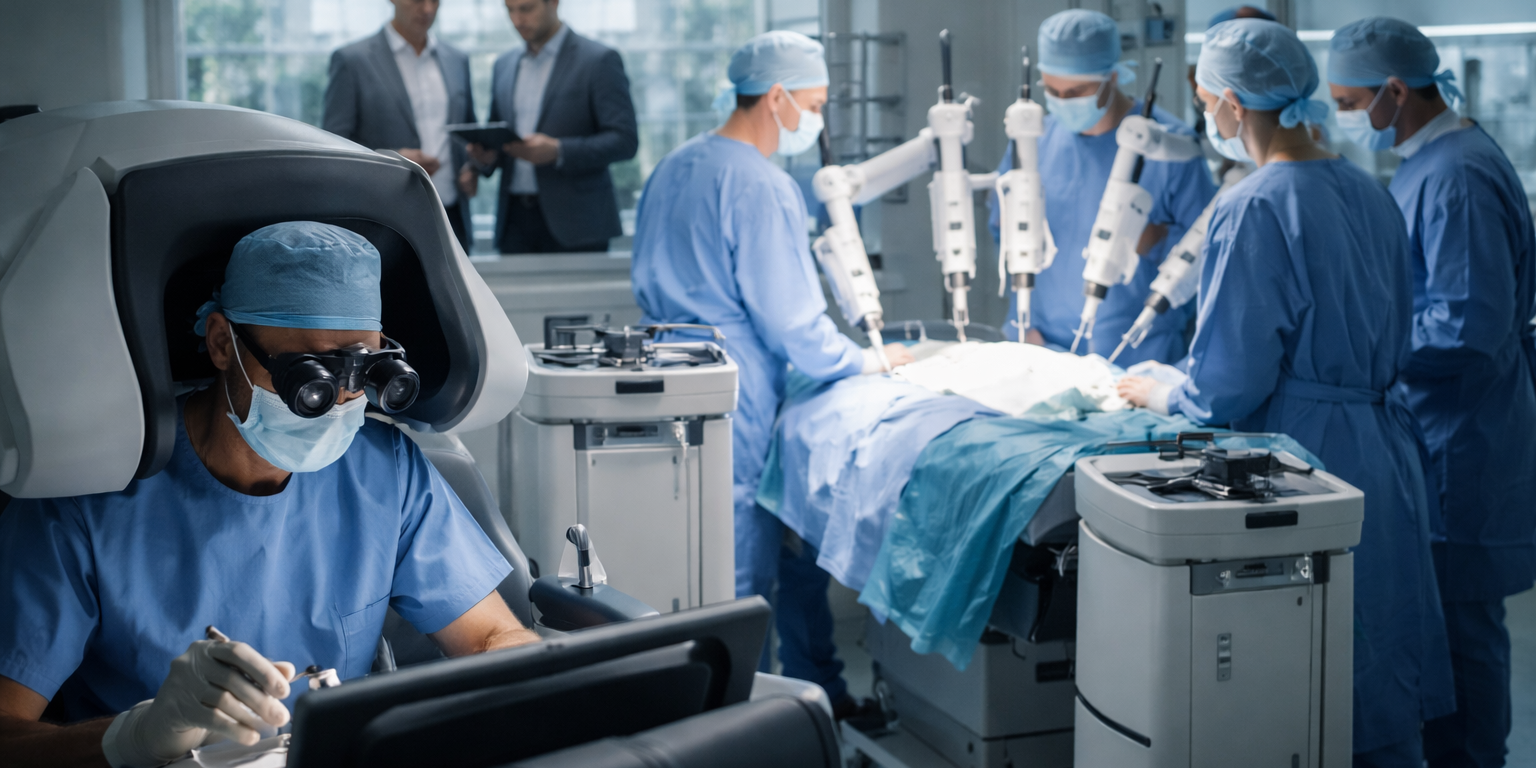
CMR's problem has never been engineering. Versius, developed in Cambridge, uses small, independently mounted modular arms that can be wheeled to the operating table and arranged around a patient, a deliberate contrast to the single, bulky cart of a da Vinci system. Surgeons operate from an open console with a design meant to echo the ergonomics of laparoscopic work. The system has been used in thousands of procedures across Europe, Asia, Australia, and Latin America. The company's trouble was commercial: a funding squeeze that surfaced in 2023, reported efforts to find a buyer, and a U.S. presence that lagged its overseas footprint. U.S. adoption requires FDA clearance, and then something harder to win, which is the trust of hospital procurement committees that have standardized on Intuitive for two decades.
This is where Stryker's value to CMR becomes concrete. The company employs one of the largest and most entrenched capital-equipment sales organizations in American surgery, with account relationships spanning orthopedics, neurotechnology, and general surgical supplies. Selling a surgical robot is not like selling a consumable. It involves multi-year capital approvals, service contracts, surgeon training pipelines, and procedure-volume commitments. Stryker has run that playbook with Mako, which it has placed in thousands of operating rooms and which drives pull-through revenue in implants. Applying the same machinery to Versius gives CMR a go-to-market engine it could not have built on its own balance sheet, and it gives Stryker a credible way to talk to a general surgery or urology department chief, a conversation it has largely been unable to have.
For the wider industry, the sharpest observation is about modularity as a commercial strategy rather than a technical one. Intuitive's installed base, which numbers in the thousands of systems worldwide, is a moat built on integration: instruments, software, training, and data all tied to one platform. A challenger that competes system for system, feature for feature, rarely dislodges that. Versius instead pitches flexibility and a smaller capital footprint, an argument that lands with ambulatory surgery centers and community hospitals that cannot justify a seven-figure single-purpose cart. If Stryker can bundle Versius alongside Mako under shared contracting, it could offer a combined robotics portfolio that Intuitive, which has no orthopedic franchise of comparable scale, cannot easily replicate. That bundling logic, more than any single robot spec, is the real bet.
The risks are not trivial. Exclusive agency arrangements concentrate dependency: if Stryker's sales teams prioritize Mako, Versius could become an afterthought in a crowded bag. Clinical evidence in the U.S. market is still thinner than what Intuitive can cite from years of published outcomes, and surgeons are conservative about changing platforms mid-career. Service logistics, instrument supply, and surgeon training will all need to scale in lockstep with any early placements, because a handful of poor first-year experiences can stall adoption for years. Engineers and investors should also watch how the deal reshapes the competitive set, since Medtronic's Hugo, Johnson & Johnson's Ottava, and other entrants are chasing the same hospital capital budgets. Consolidation around a few well-capitalized distribution partners looks increasingly likely, and Versius now has one.
What to Watch
Track Stryker's fourth-quarter 2026 earnings call for the first quantified commentary on Versius placement targets and how management allocates sales resources between Mako and the new portfolio. Watch for FDA clearance announcements or expanded indications for Versius in 2026 and early 2027, since broader labeling in urology, general surgery, and gynecology will determine how large the addressable U.S. market actually is. Monitor early reference-site announcements from U.S. health systems, particularly ambulatory surgery centers, as the clearest signal of whether the modular pitch is resonating. Finally, follow Intuitive Surgical's pricing and leasing moves through the end of 2026, because any shift toward more flexible contracting would suggest the incumbent sees the Stryker-CMR pairing as a genuine threat.