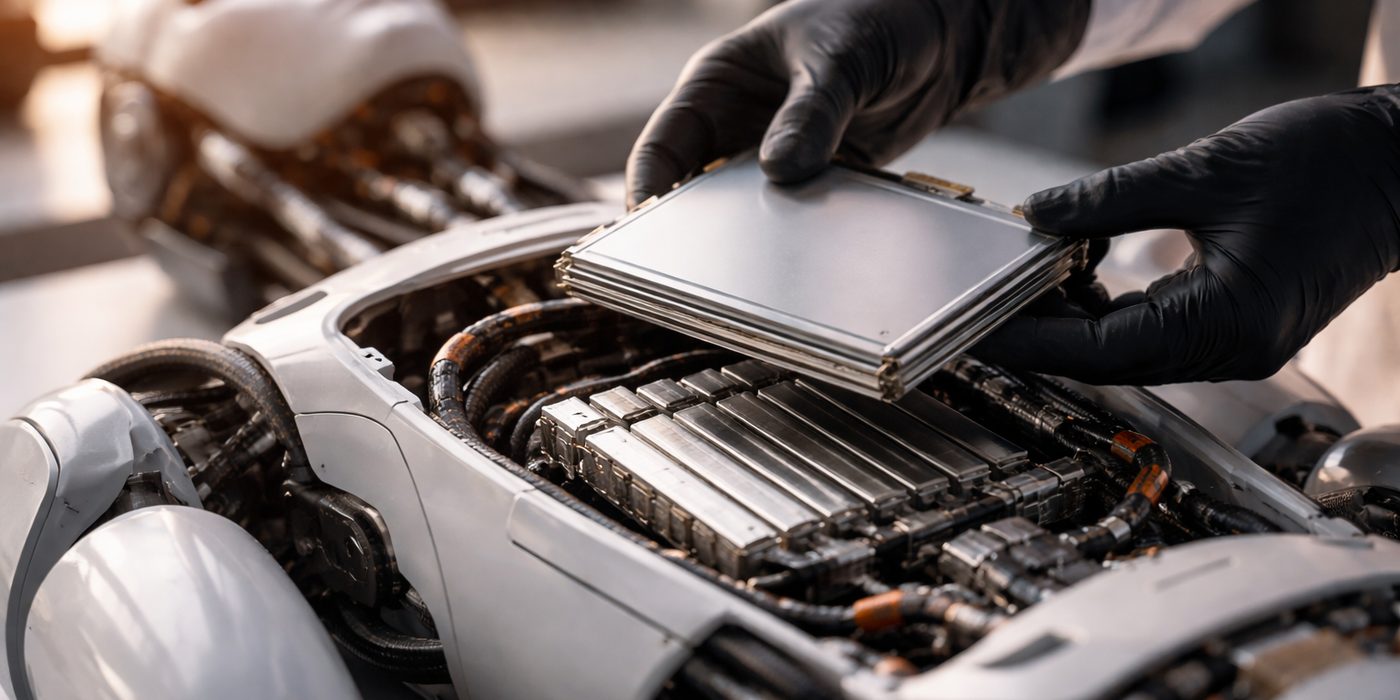

The most telling thing at FIX 2026 in Daegu was what wasn't on the main stage: a finished, free-walking humanoid positioned as the product. Instead, South Korean exhibitors filled their booths with the parts that make one possible, including joint actuators, reducers, grippers, and sensing modules, alongside dual-arm machines built for factory cells and autonomous driving systems aimed at robotaxi service. The framing was deliberate. Korean developers appear to be betting that the money in humanoids will be made one layer down from the robot, selling the subsystems that every humanoid maker, domestic or foreign, still struggles to source at reasonable cost and volume.
That strategy has a logic rooted in Korea's industrial profile. The country already runs among the highest robot densities in manufacturing worldwide, and its conglomerates and mid-sized suppliers have decades of experience in precision motion control, batteries, and semiconductors. Daegu itself sits in a region with deep machinery and auto-parts roots, which made it a natural venue for a show pitched at factory automation. The humanoid wave has given these suppliers a new reason to repackage existing competencies. A harmonic reducer built for an industrial arm and a compact actuator built for a humanoid knee are close cousins, and the same engineering teams are increasingly serving both markets.
The dual-arm machines drew a different kind of attention. Rather than chasing full anthropomorphic form, these systems mount two manipulators on a fixed or wheeled base and target tasks that a human performs with both hands, such as assembly, part handling, and machine tending. For plant managers, that is a more defensible pitch than a walking robot. Legs add cost, power draw, and failure modes, and most factory tasks do not require them. A dual-arm cell can slot into an existing line with modest changes to fixtures and safety zones. The trade-off is flexibility: it does not climb stairs or cross a facility on its own, which limits it to stations where work arrives at the robot.
The autonomous driving exhibits pointed to a broader pattern in how Korean firms think about physical AI. Robotaxi stacks and humanoid control systems share perception pipelines, sensor fusion methods, and increasingly the same large-model approaches to planning, so companies working across both domains can spread development costs and talent. That cross-pollination matters because both fields are constrained by the same bottleneck: reliable behavior in unstructured environments, validated cheaply and at scale. For investors, the question is whether Korean players can convert booth-level capability into volume orders, since showing components at a trade fair and winning multi-year supply contracts with global humanoid builders are very different achievements. Pricing, durability data, and delivery lead times will decide that, not demos.
What to Watch Track whether any of the Daegu component exhibitors announce named supply agreements with humanoid developers before the end of 2026, since a signed customer would be the first hard proof the component-first strategy is working. Watch for pilot results from dual-arm cell deployments on Korean factory floors, particularly cycle-time and uptime figures that can be compared against conventional industrial arms. On the mobility side, follow regulatory moves from Korea's transport ministry on expanded robotaxi service zones, as permit decisions will set the pace for commercial driving-stack revenue. Finally, monitor the early-2027 trade show calendar for the first Korean humanoid shipped as a complete product, which would show whether these suppliers intend to stay in the component business or move up the stack.