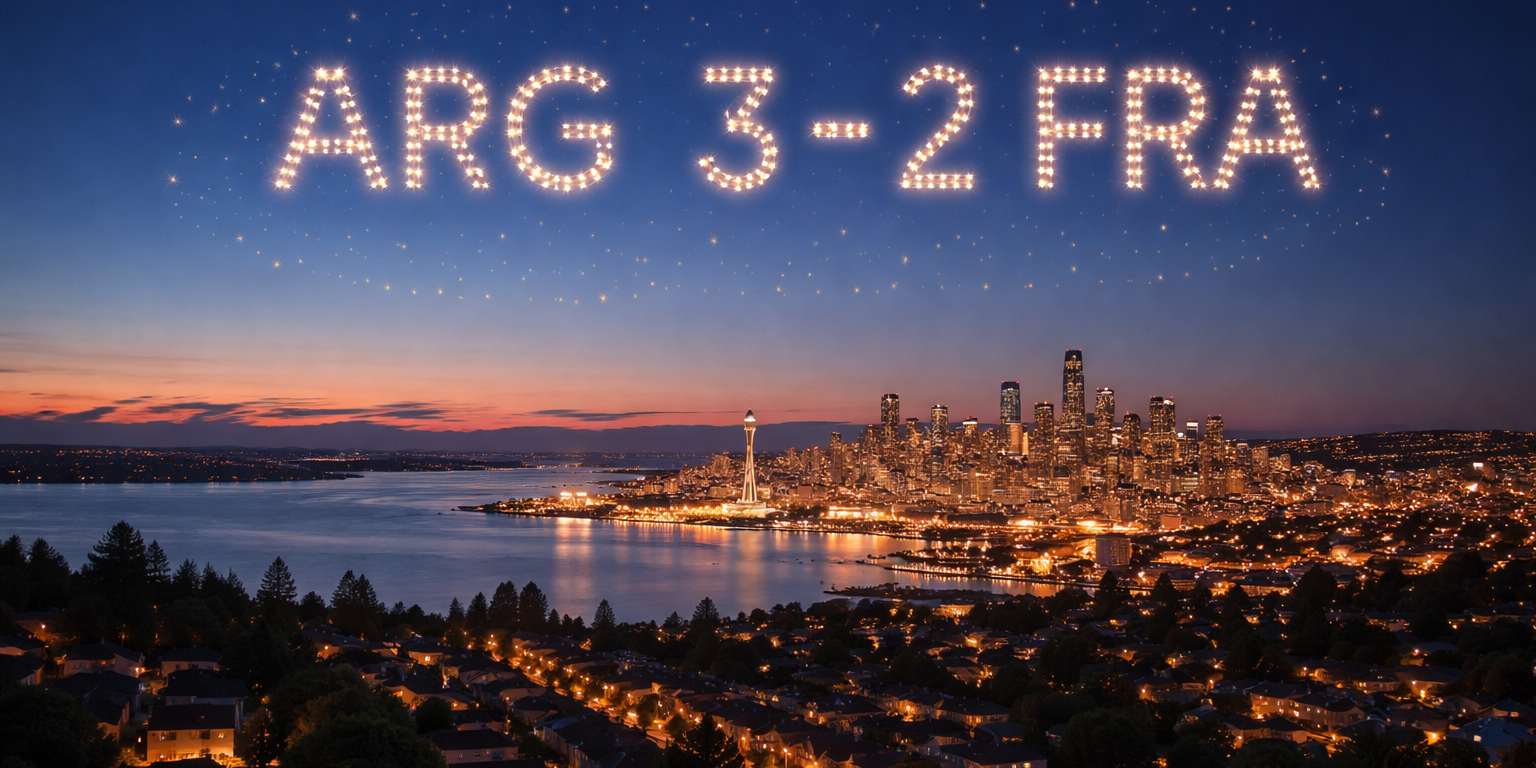
Hundreds of drones lift off from a staging area near Seattle's waterfront each time the city hosts a FIFA World Cup match, forming alphanumeric characters hundreds of feet across that display live scores, match times, and team information visible from neighborhoods miles inland. The system operates autonomously once airborne, with each drone calculating its position relative to the swarm using a combination of GPS, inertial measurement units, and peer-to-peer communication protocols that allow real-time formation adjustments as scores change. Seattle's deployment marks the first time a U.S. municipality has contracted for persistent, multi-day drone operations in Class B airspace for public information display rather than one-off entertainment events.
The technical architecture behind the scoreboard differs substantially from the pre-programmed light shows that have become common at major sporting events and festivals. Those performances follow fixed choreography determined weeks in advance. Seattle's system integrates a live data feed from FIFA's match management system, translating score updates into new formation instructions that propagate through the swarm within seconds. Each drone receives updated position coordinates and adjusts its flight path independently, creating what appears to the ground observer as instantaneous text changes floating against the sky. The drones maintain formation for the duration of each match, typically 90 minutes plus stoppage time, then return to base for battery swaps before the next scheduled flight. On days when Seattle hosts multiple matches, the fleet executes up to four sorties.
Seattle's Department of Transportation worked with the FAA for eight months to secure the necessary waivers for operations over populated areas, a process that required detailed risk assessments for every flight corridor and contingency protocols for equipment failures. The approved flight zone extends from 400 to 800 feet above ground level, keeping the drones below commercial aviation traffic while maintaining visibility from ground level. Each drone in the fleet carries redundant flight control systems, parachute recovery mechanisms that deploy automatically if multiple rotors fail, and transponders that broadcast position data to nearby aircraft. The city contracted with a drone services firm that has conducted similar operations in Dubai and Singapore, though never before with live data integration or in airspace as congested as Seattle's. The contract value and the number of drones deployed have not been publicly disclosed, but industry observers estimate the fleet at 300 to 500 units based on the size and complexity of the displayed information.
The Seattle deployment arrives as robotics companies focused on swarm coordination face pressure to demonstrate commercial applications beyond military reconnaissance and agricultural monitoring. Investor interest in drone light show companies surged following several high-profile performances at Olympic ceremonies and New Year's Eve celebrations, but the market for one-time entertainment spectacles has proven limited. Municipal contracts for persistent operations, by contrast, offer recurring revenue and serve as proof points for regulatory approval in complex airspace. Several cities hosting World Cup matches explored similar systems but ultimately opted for traditional LED screens or projection mapping due to concerns about weather reliability and airspace conflicts. Seattle's success in securing FAA approval despite operating near Seattle-Tacoma International Airport positions the city as a testbed for future applications, from emergency notifications to advertising.
What to Watch: Monitor whether other World Cup host cities adopt similar systems before the tournament concludes in mid-July 2026. Watch for FAA policy updates regarding swarm operations in Class B airspace, as Seattle's approval may establish precedent for commercial applications. Track whether the city extends the contract beyond the World Cup for Seahawks games or other events at Lumen Field, scheduled to resume in September 2026. Pay attention to European regulatory responses, as several cities there have expressed interest in replicating the system for Champions League matches.